


Theme & Story
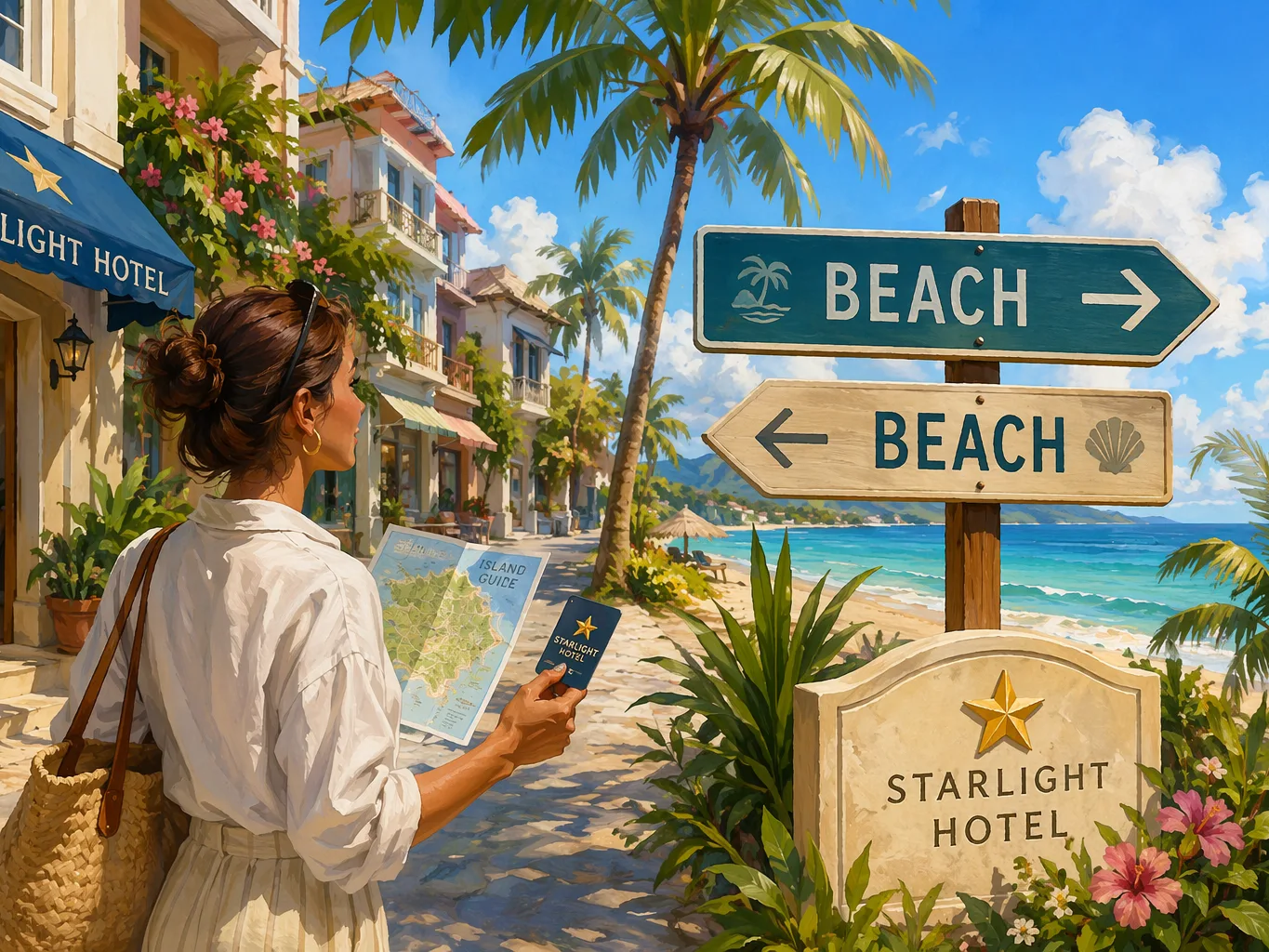
This song is a cheerful travel-and-directions lesson set during a tropical vacation. The speaker arrives at a sunny destination, checks into a hotel, asks about a reservation, a double room, breakfast, and the elevator, then goes outside to explore the city and find the beach.
The story is simple and practical: a traveler uses polite English to ask for help, understand directions, and move through a new place confidently. It is especially useful for language learners because it repeats common travel phrases in a memorable way.
Metaphors & Meaning
The lyrics are mostly literal, not deeply metaphorical. They are designed for learning real-life English situations: hotel check-in, asking for directions, and moving around a city.
However, a few lines have a slightly poetic feeling:
- “Let the city be our guide!” means the travelers are open to exploring and discovering things naturally. The city is not literally a person, but it feels like one that can lead them.
- “Within my reach” means something is close enough or possible to get to. Here, the speaker asks if the beach is nearby.
- “Follow the light!” can be literal, like walking toward sunlight or a sign, but it also gives the song an adventurous, optimistic feeling.
- Culturally, the song reflects common travel interactions in English-speaking tourist areas: greeting hotel staff politely, asking questions clearly, and thanking people for help.
Vocabulary & Slang
- Key travel and direction phrases include:
- Reservation: an arrangement made in advance, for example, a hotel room booking.
- Double room: a hotel room for two people, often with one double bed or space for two guests.
- Key card: a plastic card used to open a hotel room door.
- Breakfast: the morning meal; many hotels include it or serve it at set times.
- Elevator: a machine that takes people up and down between floors. In British English, this is usually called a lift.
- Where is the beach?: a basic and very useful question form for asking location.
- Go straight ahead: continue walking forward.
- Turn to the right / Turn right: change direction to the right side.
- Turn to the left / Turn left: change direction to the left side.
- Across the street: on the other side of the road.
- On the corner: at the place where two streets meet.
- Next to the bank: beside the bank.
- I am on my way: I am leaving now and going toward my destination.
- There is no strong slang in the song. The English is polite, clear, and beginner-friendly.
Grammar Notes
- Polite requests with “please”: The song often uses polite English, such as “Excuse me, please” and “A double room for two nights, please.” This is important in hotels, restaurants, and public places.
- Question form: “Where is...?”: The repeated question “Where is the beach?” is a basic structure: Where + be verb + noun? Other examples: “Where is the elevator?” and “Where is the restaurant?”
- Question form: “What time is...?”: “What time is breakfast?” asks about a scheduled event. We can also say: “What time is check-in?” or “What time is the bus?”
- Imperatives for directions: Phrases like “Go straight ahead,” “Turn right,” “Turn left,” and “Look for the sign” are commands or instructions. In English, imperatives often start with the base verb: go, turn, look, follow.
- Prepositions of place: The song practices useful location words: on the corner, next to, across the street, facing the sea. These help describe where things are.
- Contractions: “Let’s” means “let us.” In “Let’s find the hotel,” the speaker is suggesting an action to do together.
Overall, the lyrics work like a mini travel conversation set to music. They teach practical vocabulary, polite questions, and direction commands that learners can use immediately in real life.