


Theme & Story
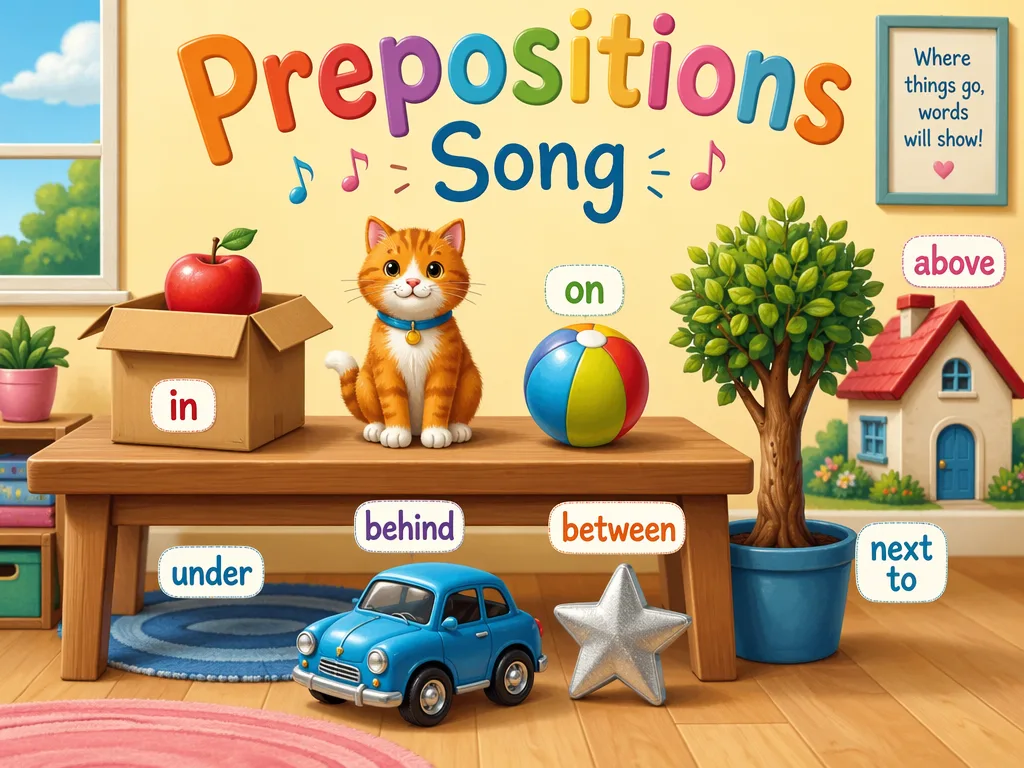
“Where Is It?” is a playful educational song about prepositions of place—words that tell us where something or someone is. The song asks simple questions like “Where is the ball?” and then answers by showing objects in different positions: an apple in a box, a bird on a tree, a dog under a table, and a cat between two chairs.
The “story” is like a classroom game or scavenger hunt. The singer invites the listener to look around, notice objects, and sing the location words together. By the end, “Everything is where it should be,” meaning the learner has understood the pattern.
Metaphors & Meaning
This song is mostly literal, because it is designed for language learning. However, there are a few expressive lines:
- “Above the world, like a silver star” uses a simile. It compares something high in the sky to a bright star. This makes the preposition above feel imaginative and visual.
- “Just look me in the eye” can mean “pay attention to me” or “focus.” It is not only about physically looking at someone’s eyes.
- “Everything is where it should be” gives the song a satisfying ending. It suggests order, understanding, and confidence.
- in: inside something — “The apple is in the box.”
- on: touching the top or surface of something — “The bird is on the tree.”
- under: below something — “The dog is under the table.”
- next to: beside something — “The keys are next to the phone.”
- behind: at the back of something — “The boy is behind the stone.”
- between: in the middle of two things — “The cat is between the two chairs.”
- above: higher than something — “The light is above the stairs.”
- “Let’s find out” = Let us discover the answer.
- “Look around” = Check the area near you.
- “If you are able” = If you can do it. This sounds a little formal or poetic here because it rhymes with “table.”
- “It’s not a wonder” = This means “it is not surprising” or “it is not mysterious.” In natural English, people more often say “It’s no wonder” or “It’s not a mystery.”
- Question form with “be”: “Where is the ball?” uses the order Where + is + noun? This is a very important beginner question pattern.
- Subject + be + preposition phrase: Many lines follow the pattern The apple is in the box or The cat is between the chairs. This structure is perfect for practicing location.
- Imperatives: “Look around,” “Read the words,” and “Sing the prepositions with me” are commands or invitations. In English, imperatives often start with the base verb.
- Contraction: “Let’s” = “Let us.” It is friendly and common in songs, classrooms, and everyday speech.
- Ellipsis in lyrics: Lines like “The ball is IN” and “The cat is UNDER” are shortened. In full grammar, you would usually say in the box or under the table. Songs often shorten phrases for rhythm and repetition.
- Adjective order practice: Phrases like “the tall green tree,” “the big grey stone,” and “the dark brown stairs” show how English often places adjectives before nouns.
- Repetition for learning: The song repeats “in, on, under,” “next to, behind, between,” and “above” to make the grammar easy to remember.
There are no deep cultural references here; the song uses everyday objects—balls, cats, apples, phones, chairs, cars—so learners can easily connect the words to real life.
Vocabulary & Slang
Key location words:
Useful phrases: