


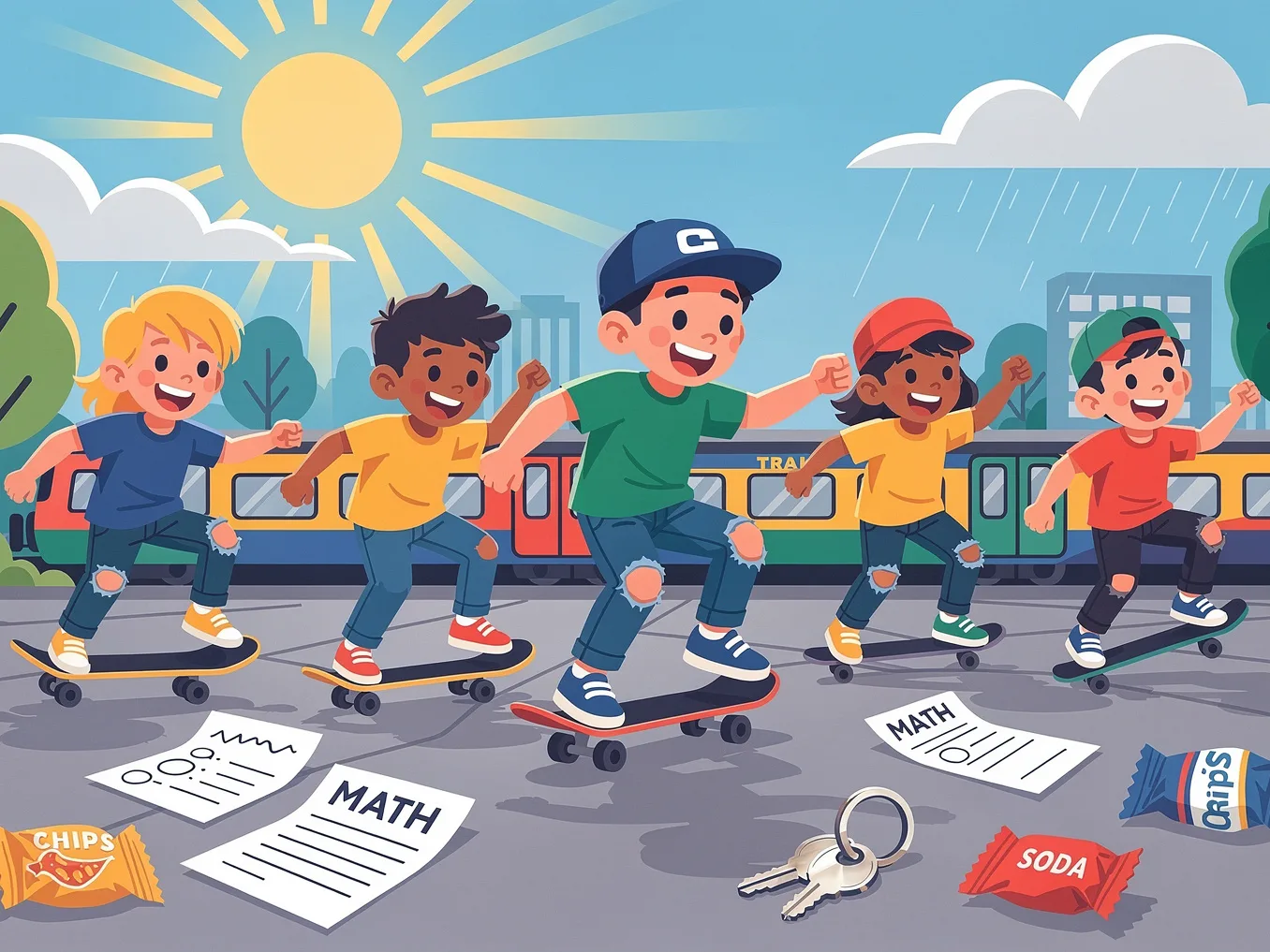
Theme & Story
“Yesterday Was Wild” is a playful, high-energy song about a child or teenager remembering an exciting day with friends. The speaker wakes up late, avoids homework, grabs a board, meets friends, rides around, catches a train, eats food, plays, loses keys, tears jeans, and sings in the rain. The main feeling is freedom: yesterday was messy, chaotic, and fun.
The song is also clearly designed for English learners. It tells a simple story in the past tense and repeats many useful irregular verbs: wake/woke, take/took, go/went, make/made, run/ran, catch/caught, sing/sang, buy/bought.
Metaphors & Meaning
- “Yesterday was wild” does not mean the day was literally an animal or in nature. Here, wild means exciting, uncontrolled, full of surprises, and maybe a little naughty.
- “We were kings, and we were queens” is figurative. The children were not real royalty. It means they felt powerful, happy, and free, as if the whole world belonged to them.
- “The summer sun was feeling great” gives the sun a human feeling. This is a simple example of personification. It means the weather felt warm, bright, and enjoyable.
- “I broke the rules! I made a mess!” suggests rebellion and chaos, but the tone is not serious or dark. It sounds like innocent childhood mischief.
- “Let’s go!”: A very common energetic phrase meaning “Come on!” or “I’m ready!” It can also show excitement.
- “Board”: In this context, probably a skateboard or similar riding board.
- “Had a ride”: Means they rode around, likely on skateboards, bikes, or public transport.
- “Feeling great”: Means something feels enjoyable or positive.
- “Homework... NO!”: A funny dramatic rejection of responsibility.
- “Made a mess”: Literally means created disorder, but it can also mean caused trouble.
- “Caught the train”: Means successfully got on the train before it left.
- “Best day ever!”: A common enthusiastic phrase meaning an extremely good day.
- packed from pack
- passed from pass
- wanted would be another example, though it is not in the song
- wake → woke: “I woke up late.”
- take → took: “I took my board.”
- go → went: “I went outside.”
- make → made: “I made a mess.”
- run → ran: “We ran so fast.”
- catch → caught: “We caught the train.”
- sing → sang: “We sang it in the rain.”
- buy → bought: “We bought some food.”
- eat → ate: “We ate it all.”
- lose → lost: “I lost my keys.”
- tear → tore: “I tore my jeans.”
- break → broke: “I broke the rules.”
- “We didn’t stop.”
- “We didn’t wait.”
- “I passed the test?”
- make/made
- take/took
- write/wrote
- go/went
- spend/spent
Culturally, the song reflects a common pop-punk or children’s adventure theme: skipping responsibilities, hanging out with friends, riding boards, catching trains, and enjoying summer freedom.
Vocabulary & Slang
Grammar Notes
This song is excellent for practicing the simple past tense, especially irregular verbs.
Regular past tense
Some verbs add -ed:Irregular past tense
Many verbs change form completely:Negative past tense
The song uses didn’t + base verb:Notice that after didn’t, the verb stays in the base form: not “didn’t stopped,” but didn’t stop.
Questions in the past
This is written like a spoken reaction. In standard grammar, you might ask: “Did I pass the test?” But lyrics often use informal sentence patterns to sound natural, funny, or rhythmic.