


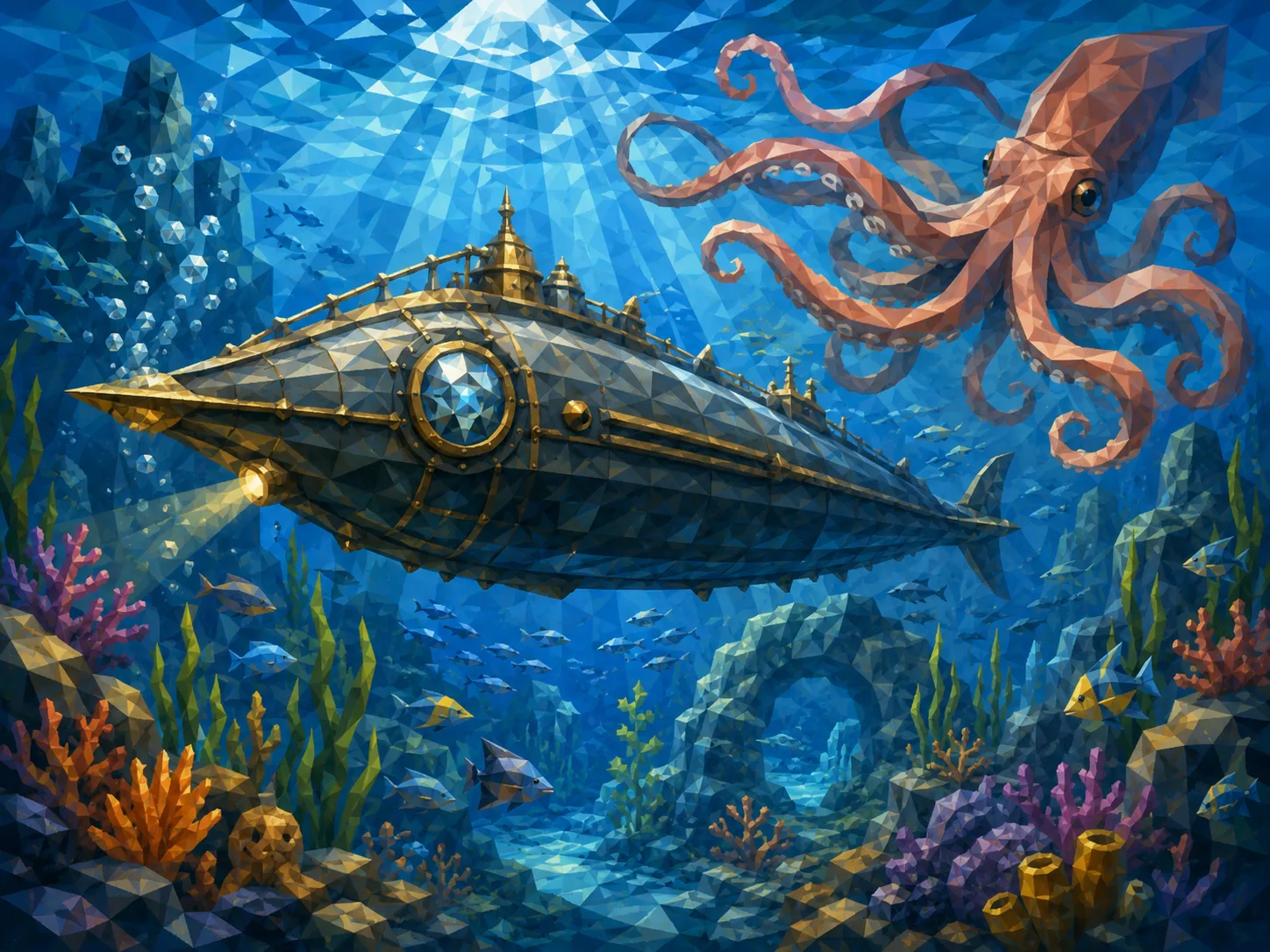
The year 1866 was marked by a strange event that nobody has forgotten yet. For some time, ships at sea had been seeing “an enormous thing”: a long object, narrow at both ends, sometimes shining in the dark, much larger than a whale and much faster.
On July 20, 1866, the steamship Governor Higginson came across this moving mass off the east coast of Australia. Captain Baker thought at first that he had found an unknown sandbank, until two columns of water shot up from it with a hissing noise, high into the air. A sandbank does not do that. So it had to be a sea animal, unknown until then, that blew out water and air like a whale.
Three days later another ship saw the creature in the Pacific, thousands of kilometers away, and a few weeks later two more ships saw it in the Atlantic. They judged it to be more than a hundred meters long, far longer than the largest whale ever seen.
Soon the monster was everywhere. People sang about it in the cafés and made fun of it in the newspapers. For six months scientists argued about it, until a funny article in a popular paper made the whole world laugh, and for a while people forgot the monster.
But in the spring of 1867 the question was no longer a scientific puzzle. It became a real danger.
On April 13, 1867, the Scotia, a large passenger steamer, was crossing a calm Atlantic. In the afternoon, while the passengers were at lunch, they felt a slight shock. The Scotia had not struck anything; something had struck her. Nobody was worried until the carpenter ran up shouting, “We are sinking! We are sinking!” Captain Anderson calmed the frightened passengers. The ship was divided into sections by strong walls, and the water had filled only one of them. The Scotia went on slowly and reached Liverpool three days late.
In dry dock the engineers could hardly believe their eyes. Below the waterline there was a hole in the iron hull, two meters wide, in the shape of a perfect triangle. Its edges were so clean that a machine could not have made a neater cut. Something sharp and terribly hard had been driven through the thick iron with enormous force and then pulled out again.
After this, people blamed the monster for every ship that disappeared without a trace, and every year many ships did. The public demanded that the seas be cleared of this creature at any price.
At that time I had just come back from a scientific trip to Nebraska, where the French government had sent me to do research. I was an assistant professor at the Museum of Natural History in Paris. I had arrived in New York at the end of March with a valuable collection, and I planned to sail home to France in May.
I had read everything about the question in the American and European papers. Something really existed: anyone who doubted it could put his finger into the Scotia’s wound. Only two answers remained: a monster of enormous strength, or a machine that traveled under the water. But who could build such a machine in secret? Every government declared that it had none.
In France I had published a book in two volumes on the mysteries of the great depths of the sea, so in New York many people asked for my opinion. For as long as I could, I said nothing definite. But at last the New York Herald asked me for a clear opinion, and I had to give one.
In my article I wrote that we know almost nothing about the great depths of the ocean. Perhaps unknown animals live down there. But if the creature is one of the animals we know, it can only be a giant narwhal. The common narwhal, a kind of whale, carries a long horn of ivory as hard as steel, and such horns have been found stuck in the bottoms of ships. Make the animal ten times larger and stronger, I wrote, send it at full speed against a ship, and you have the hole in the Scotia. Unless, I added, it is something that nobody has ever seen or imagined.
These last words left me a way out, and they were cowardly. I wanted to protect my dignity as a professor and not give the Americans too much to laugh about, for Americans love a good laugh. But in fact I had said that the monster existed, and my article was much discussed.
The United States acted first. In New York they prepared a fast frigate, the Abraham Lincoln, to hunt the narwhal, and Commander Farragut armed it quickly. But as soon as the hunt was decided on, the monster disappeared. For two months nobody saw it. Then, on July 2, news came that a steamer had seen it in the North Pacific. The frigate took on food and coal, ready to leave at once.
Three hours before it sailed from Brooklyn, I received a letter at my hotel:
“To Professor Aronnax, Museum of Paris, Fifth Avenue Hotel, New York.
Sir, if you will agree to join the Abraham Lincoln on this expedition, the Government of the United States will be glad to see France represented in it. Commander Farragut has a cabin ready for you.
Very sincerely yours,
J. B. Hobson, Secretary of the Navy”