


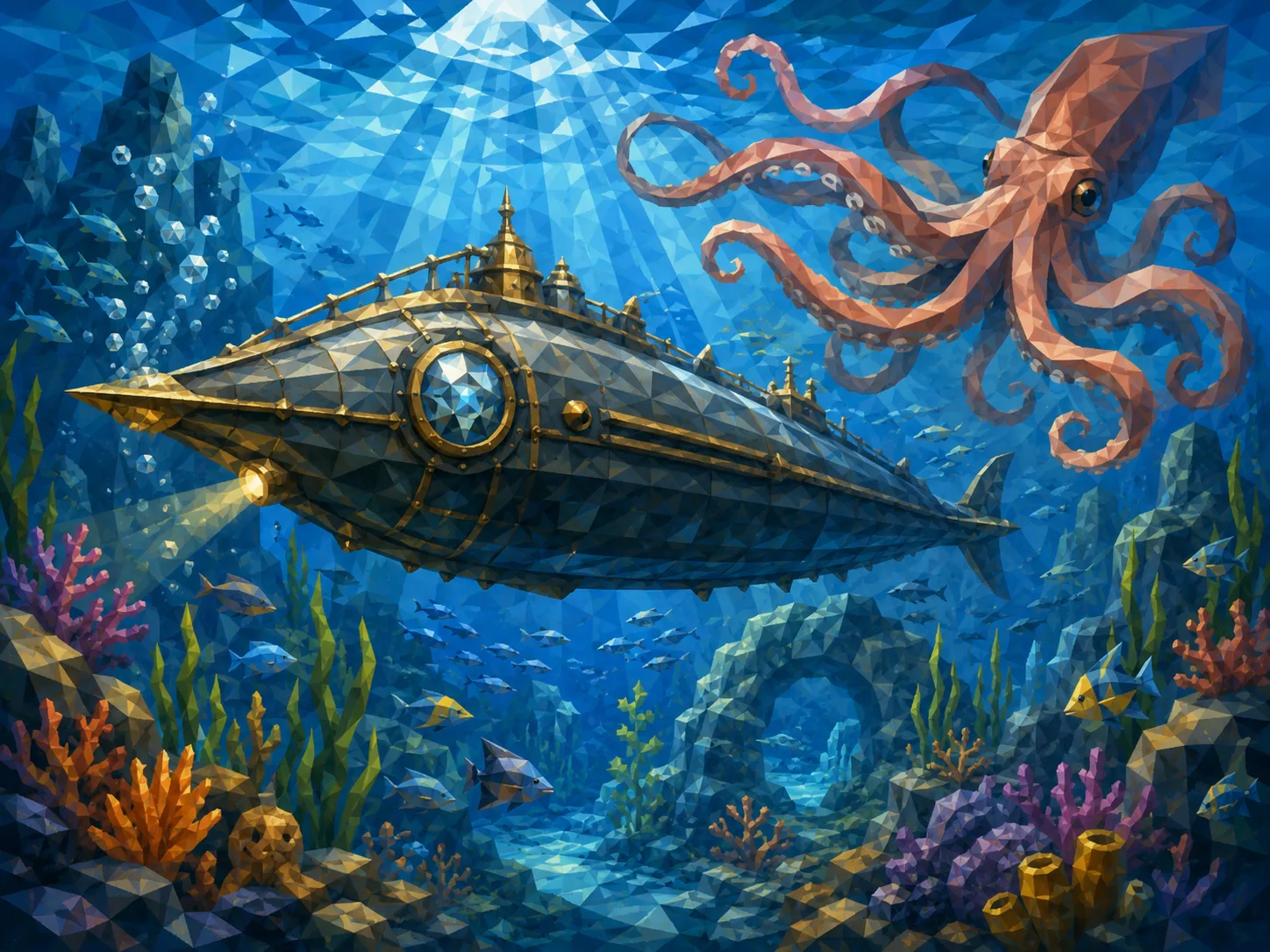
The scene in the coral cemetery left a deep mark on me. Always that same fierce distrust of men! Conseil believed the captain was a misunderstood genius who, tired of the world, had taken refuge in the sea. But that explained only one side of him. The night in the cell, the telescope snatched from my hands, the man’s deadly wound: all of it pointed somewhere else. No, Captain Nemo did not only run away from men. His terrible machine served his love of freedom, but perhaps it also served some plan of revenge.
Day after day we crossed the Indian Ocean. One evening a fleet of argonauts sailed past us, hundreds of small creatures in delicate shells, each with two arms raised like a sail; then, as if at a signal, they all folded their sails and disappeared. Another day big sharks threw themselves at the salon windows, and Ned could hardly be kept from going up to harpoon them.
On January 28 we saw mountains to the west: Ceylon, the island that hangs like a pearl below India.
“Ceylon is famous for its pearls,” said Captain Nemo. “Would you like to visit its pearl beds tomorrow with your companions, Professor Aronnax?”
“Certainly, Captain.”
“By the way, you are not afraid of sharks?”
“Sharks!” I said. “I admit, Captain, that I do not know that kind of fish very well yet.”
“We are used to them, and in time you will be too. We will be armed, and on the way we may hunt a few. It is interesting. Until tomorrow, then, and early.”
He said it in a careless tone and left. A bear hunt in the mountains is one thing; a shark hunt in the shark’s own water is another. I wiped my forehead, which was wet with cold sweat.
Ned and Conseil came in, cheerful. They did not know what was waiting for them.
“Professor,” said Ned, “your Captain Nemo, the devil take him, has just made us a very nice offer.”
They wanted to know about pearls. “A pearl, Ned,” I said, “is a tear of the sea to a poet, a jewel to a lady, and to a scientist, simply a disease of certain shellfish. Some oysters hold many. One, they say, held a hundred and fifty sharks.”
“A hundred and fifty sharks!” cried Ned.
“Did I say sharks?” I said quickly. “I meant pearls.” Then, copying the captain’s careless tone, I asked, “By the way, Ned, are you afraid of sharks?”
“Me? A harpooner? It’s my job to laugh at them!”
“Not from a ship, Ned. In the water.”
“In the water? Well, with a good harpoon… You know, Professor, a shark has to turn over on its back to seize you, and while it does…”
The way he said “seize” made my blood run cold.
“And you, Conseil?”
“I will be honest with master. If master is going to face sharks, I do not see why his faithful servant should not face them with him.”
At four the next morning the steward woke me, and we set off in the boat toward the coast with five sailors at the oars. At six the day came all at once, as it does in the tropics, and we stopped above the pearl beds in shallow water. We put on our diving suits, but took no lamps.
“The sun will light our way,” said the captain, “and a lamp might attract dangerous creatures.”
“And our guns?”
“Guns! What for? A blade is surer than a bullet. Here is a good blade. Put it in your belt.”
Ned, I noticed, had brought an enormous harpoon.
We stepped out of the boat into water only a meter deep, then walked down a gentle slope until the waves closed over our heads. At about seven we reached the oyster beds, where millions of pearl oysters covered the rocks. Ned filled a net with the finest, but the captain walked on, and we followed him into a large cave. At the bottom of a kind of pit lay an enormous oyster, more than two meters wide. The captain put his dagger between the two halves of the shell and lifted the soft flesh inside. There, loose in the folds, lay a pearl as large as a coconut, perfectly round and clear, a jewel beyond price. I reached out to touch it, but the captain stopped me with a sign and pulled out his dagger, and the shell closed. He was leaving the pearl there to grow, year after year.
Soon afterward he made us crouch in a crack in the rock. A shadow sank to the bottom a few meters away. A shark, I thought. But it was a man: an Indian diver, a poor fisherman who had come to gather oysters before the season. Again and again he came down with a stone between his feet and a rope tied to his boat, filled his bag with oysters in half a minute, and went back up. He did not see us. How many of those oysters, for which he risked his life, held no pearl at all!
For half an hour I watched him. Then suddenly, while he was kneeling on the bottom, he made a movement of terror and sprang up.
A huge shadow had appeared above him: a shark of enormous size, with burning eyes and open jaws. I could not move. The diver threw himself aside, but the shark’s tail struck his chest and knocked him down. The shark turned on its back to bite him in two.
Then Captain Nemo stood up and walked straight at the monster, dagger in hand. The shark turned toward its new enemy. The captain waited, perfectly calm, jumped aside as it rushed at him, and drove his dagger deep into its side.
But the fight was not over. Blood poured from the wound, and the sea turned red. Through it I saw the captain holding on to a fin, striking again and again, unable to give the final blow. Horror held me to the spot. The captain fell under the huge body, and the shark’s jaws opened wide…
Quick as thought, Ned rushed forward and struck with his harpoon. He did not miss. Hit in the heart, the shark thrashed so violently that it knocked Conseil over. Ned pulled the captain free. The captain, unhurt, went straight to the Indian, took him in his arms and pushed off toward the surface. We followed.
In the fisherman’s boat Captain Nemo and Conseil rubbed the poor man hard until he came back to life. When he opened his eyes and saw four great copper heads bending over him, he was terrified. And what must he have thought when the captain took a bag of pearls from his suit and put it in his hand? His astonished eyes showed that he did not know what kind of beings had saved his life and made him rich.
Back in our own boat, with our helmets off, Captain Nemo spoke first to the harpooner.
“Thank you, Mr. Land.”
“I owed you that, Captain.”
A pale smile passed over the captain’s lips, and that was all.
On board, I thought about his courage, and about his devotion to a human being, a member of the race he had fled. Whatever he said, this strange man had not managed to kill the kindness in his heart. When I told him so, he answered in a voice that trembled a little:
“That Indian, Professor, lives in an oppressed country; and I am still, and shall be to my last breath, one of them!”