


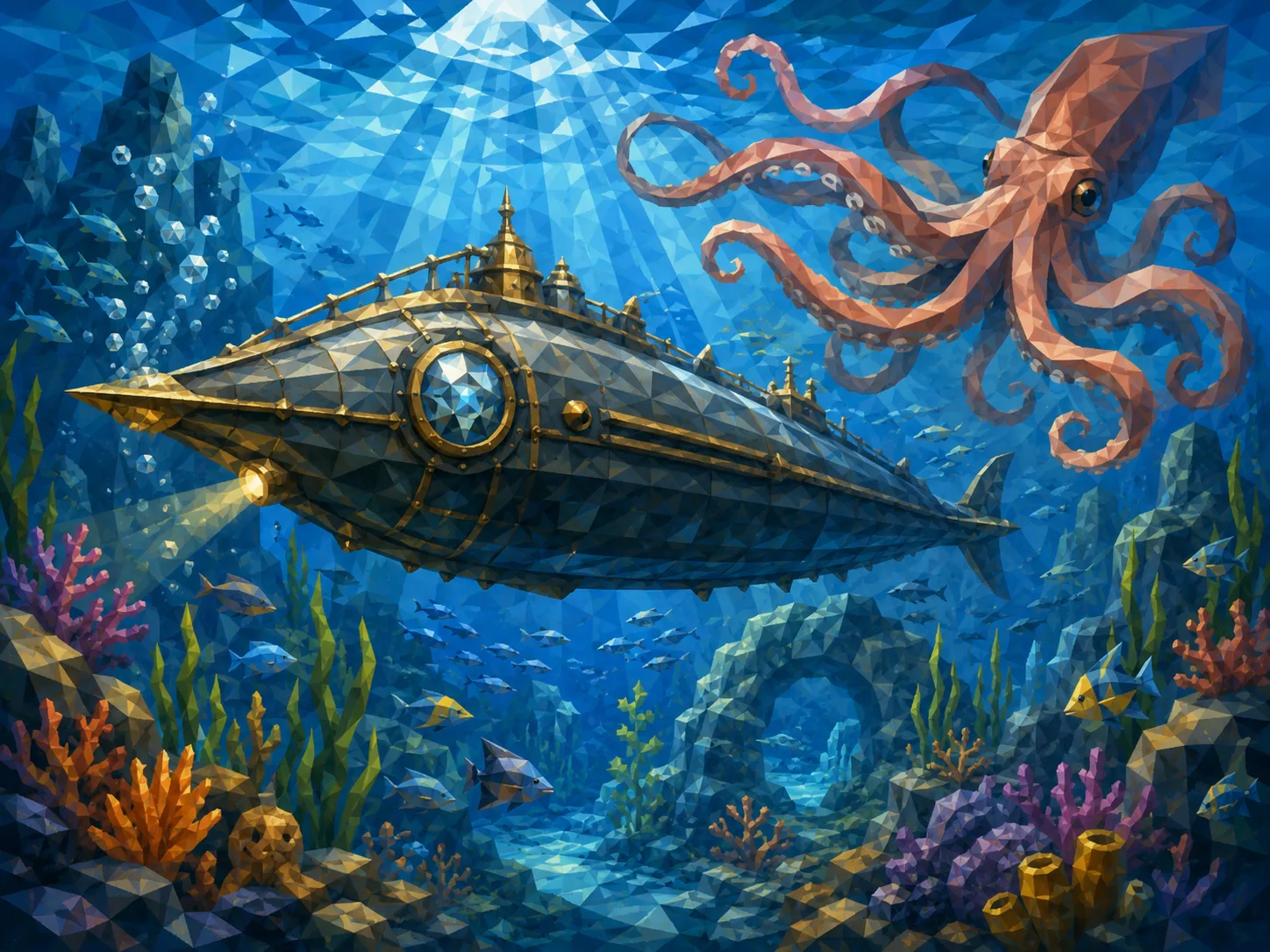
At dawn on February 12 the Nautilus rose to the surface, and I hurried up onto the platform. To the south lay a low gray coast: Egypt. In a single night the current under the isthmus had carried us from one sea to another. At about seven o’clock Ned and Conseil joined me.
“Well, Professor,” said the Canadian cheerfully, “where is this Mediterranean of yours?”
“We are floating on it, Ned.”
“I don’t believe it.”
“Then look. You have good eyes: you can see the long pier of Port Said running out into the sea.”
Ned looked for a long time.
“You’re right, Professor, and your captain is a remarkable man. Good! Now let’s talk about our own little business, where nobody can hear us. We are close to Europe. Before Captain Nemo drags us to the bottom of the polar seas, I want to leave the Nautilus.”
I did not want to stand in my friends’ way, but I had no wish at all to leave Captain Nemo. Thanks to him, I was rewriting my book on the great depths inside the sea itself. Would I ever have such a chance again?
“Ned,” I said, “are you tired of life on board?”
He crossed his arms. “Honestly, I’m not sorry about this voyage. I’ll be glad I made it. But now I’ve had enough of it.”
“A good chance may come in six months just as well as now, near France or England or America.”
“Professor, you talk about the future. I talk about the present: we are here, and we must make the most of it.”
I felt that I was beaten. “You are right,” I said at last. “Captain Nemo will never let us go, so we must take the first good chance. But it must be a real one. If our first attempt fails, we will never get another, and Captain Nemo will never forgive us.”
“A dark night, close to some European coast,” said Ned. “I know how the boat works. We get inside, undo the bolts and come up to the surface, and the pilot won’t notice a thing.”
“Then watch for your chance. But I think it will never come. Captain Nemo knows that we have not given up hope, and he will be on his guard near the coasts of Europe.”
“We’ll see,” said Ned, shaking his head.
“The day you are ready, come and tell us, and we will follow you.”
So ended a conversation that was later to have serious results. At first the facts seemed to prove me right, to Ned’s great despair. The Nautilus now stayed deep and far from the coasts, perhaps because Captain Nemo distrusted us in these busy seas, perhaps because he wanted to hide from the ships of every nation that crossed them.
On February 14 we were heading for Crete. When I left on the Abraham Lincoln, the whole island had risen against its Turkish rulers. What had happened since then I had no idea.
That evening I was alone with the captain in the salon. He seemed silent and troubled. Unusually for him, he had both shutters opened and walked from one window to the other, studying the water. Suddenly a man appeared outside: a diver with a leather bag at his belt, swimming with strong strokes.
“A man!” I cried. “A shipwrecked sailor! We must save him!”
The captain did not answer. The man swam up to the window, pressed his face to the glass and looked at us. To my great surprise, Captain Nemo made a sign to him. The diver answered with his hand, swam up to the surface and did not come back.
“Don’t worry,” said the captain. “That is Nicholas, from Cape Matapan. He lives in the water more than on land and swims from one Greek island to another, even as far as Crete.”
“You know him, Captain?”
“Why not, Professor?”
Without paying any more attention to me, he opened a tall cabinet near the window. It was full of bars of metal, and they were bars of gold. Where did this fortune come from, and what was he going to do with it? I said nothing. I watched. One by one he packed the bars into an iron chest until it was full. He closed it and wrote an address on the lid, in letters that looked like Greek. Then he pressed a button, and four men came in and, with some difficulty, pushed the chest out of the salon.
Captain Nemo turned to me.
“You were saying, Professor?”
“I wasn’t saying anything, Captain.”
“Then allow me to wish you good night.”
I went back to my room, deeply troubled. What connected the diver and the gold? Soon I felt the ship rising. I heard steps on the platform and the boat being put into the sea; then everything was silent. Two hours later the same noises came again, the boat was lifted back into its place, and the Nautilus went down. The gold had been delivered. But to whom?
The next afternoon, as I worked in the salon, it grew so hot that I had to take off my coat. Yet we were twenty meters under the water, where the heat of the sun could never reach. Was there a fire on board? Captain Nemo came in and looked at the thermometer.
“Forty-two degrees,” he said. “We are floating in a stream of boiling water. Look.”
The shutters opened, and I saw the sea all white around us. Yellow clouds drifted through the water, and bubbles rose around us as if the sea were boiling in a pot. When I touched the glass, it burned my hand.
“We are near Santorini, Professor. I wanted to show you a volcano erupting under the sea. Nothing is ever finished in these waters.”
The sea turned red. Red flames outshone our electric light, and the heat in the salon became unbearable. I could hardly breathe.
“We cannot stay here any longer,” I said.
“It would not be wise,” answered the captain calmly.
A quarter of an hour later we were breathing fresh air on the surface. If Ned had chosen these waters for our escape, I thought, we would never have come out of this sea of fire alive.
On February 16 we left the Greek islands, and the Nautilus crossed the whole Mediterranean in forty-eight hours, deep under the water and at full speed. Captain Nemo did not appear once. It seemed to me that he did not like this sea, closed in by the countries he wanted to avoid; perhaps it brought back too many memories. For Ned it was a bitter disappointment. We came up only at night, and leaving the ship at that speed would have been like jumping from an express train. Before sunrise on February 18 we passed through the Strait of Gibraltar and came out into the Atlantic.