


Häufige Unfälle
Entdecke kleine Unfälle im Alltag und lerne nützliche Formulierungen, um zu beschreiben, was passiert ist.
Preview
Questions with solutions-
1. Wähle die richtige Antwort aus.
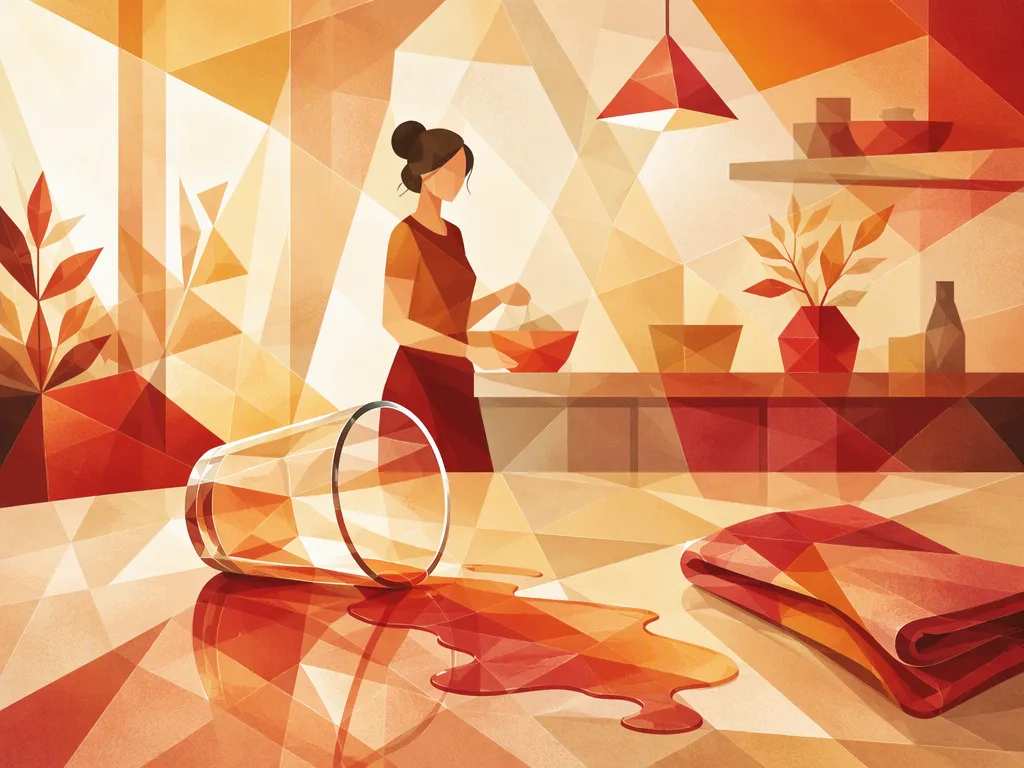
Was ist mit dem Saft passiert?
Lily knocked over her cup. Now there's juice all over the table.
- She spilled it.
- She drank it.
- She poured it into a glass.
Der Saft ist nicht mehr in der Tasse.
Show solution
- She spilled it.
Wir verwenden “spill”, wenn Flüssigkeit versehentlich aus ihrem Behälter ausläuft.
-
2. Wähle die richtige Antwort aus.
How did Ben hurt his finger?
Ben was cutting an apple. The knife slipped, and now his finger is bleeding.
- He burned his finger.
- He cut his finger.
- He twisted his finger.
Think about the sharp edge of a knife.
Show solution
- He cut his finger.
“Cut” can describe both cutting food and an injury from something sharp.
-
3. Wähle die richtige Antwort aus.
What happened to Ana's hand?
Ana accidentally touched a very hot pan, and now her hand is red and really hurts.
- She bruised her hand.
- She cut her hand.
- She burned her hand.
The injury came from heat.
Show solution
- She burned her hand.
A hot object or hot liquid can cause a burn.
-
4. Wähle die richtige Antwort aus.
Was ist mit Omars Schlüsseln passiert?
The keys fell out of Omar's hand. He can see them on the floor by his feet.
- He dropped them.
- He lost them.
- He threw them.
Die Schlüssel fielen versehentlich herunter, und Omar weiß, wo sie sind.
Show solution
- He dropped them.
“Drop” bedeutet, etwas fallen zu lassen. “Throw” beschreibt, etwas absichtlich durch die Luft zu werfen.
-
5. Wähle die richtige Antwort aus.
Was kann Eva über den Teller sagen?
The plate fell onto the kitchen floor. It's now in three separate pieces.
- It's scratched.
- It's broken.
- It's bent.
Der Teller ist nicht mehr in einem Stück.
Show solution
- It's broken.
“Broken” beschreibt etwas, das so beschädigt ist, dass es nicht mehr ganz ist oder nicht mehr funktioniert.
-
6. Wähle die richtige Antwort aus.
Welcher Teil von Jacks Körper stieß gegen das Regalbrett?
Jack stood up under a low shelf and bumped his head.
- His shoulder.
- His back.
- His head.
Denk an den obersten Teil seines Körpers, als er aufstand.
Show solution
- His head.
“bump” bedeutet in Bezug auf einen Körperteil, damit gegen etwas zu stoßen, meist aus Versehen.
-
7. Wähle die richtige Antwort aus.
Wie ist Maya gestürzt?
The bathroom floor was wet. Maya's feet slid across it, and she fell.
- She slipped.
- She tripped over a bag.
- She fell off a chair.
Ihre Füße bewegten sich über eine nasse Oberfläche.
Show solution
- She slipped.
Du rutschst aus (“slip”), wenn deine Füße wegrutschen und du das Gleichgewicht verlierst.
-
8. Wähle die richtige Antwort aus.
Was ist Leo passiert?
Leo's foot caught on a bag in the hallway, and he fell forward.
- He slipped on a wet floor.
- He tripped over the bag.
- He fell down the stairs.
Beim Gehen blieb sein Fuß an etwas hängen.
Show solution
- He tripped over the bag.
Du kannst über etwas am Boden “trip over”, zum Beispiel über eine Tasche oder ein loses Kabel.
-
9. Wähle die richtige Antwort aus.
What is the dark mark on Nina's leg?
Nina hit her leg against a table yesterday. There's a dark purple mark, but the skin isn't cut.
- A burn.
- A cut.
- A bruise.
Hitting something can leave a colored mark without breaking the skin.
Show solution
- A bruise.
A bruise can change color as it gets better.
-
10. Wähle die richtige Antwort aus.
Wie kann Tom seine Verletzung beschreiben?
Tom fell on a rough sidewalk. His knee rubbed against it, and a little skin came off.
- I scraped my knee.
- I twisted my knee.
- I burned my knee.
Die raue Oberfläche hat etwas Haut abgeschürft.
Show solution
- I scraped my knee.
Eine Schürfwunde ist eine oberflächliche Verletzung. Aufgeschürfte Knie sind nach einem Sturz häufig.
-
11. Wähle die richtige Antwort aus.
Was kann Sam über den Unfall sagen?
Sam stepped off the curb. His foot turned sideways, and now his ankle hurts.
- I cut my heel.
- I twisted my ankle.
- I scraped my toes.
Sein Fuß drehte sich in eine unnatürliche Richtung.
Show solution
- I twisted my ankle.
“Twisted my ankle” beschreibt den Unfall, ohne genau anzugeben, wie schwer die Verletzung ist.
-
12. Wähle die richtige Antwort aus.
What does Rosa mean?
“I caught my finger in the door when it closed. Ouch!”
- Her finger touched a hot door handle.
- Her finger was cut by a sharp key.
- Her finger was trapped as the door shut.
Her finger was in the way when the door closed.
Show solution
- Her finger was trapped as the door shut.
Here, “caught” means trapped, not catching something that was thrown, like a ball.
-
13. Wähle die richtige Antwort aus.
Was bedeutet “Watch out!” hier?
A ball is flying toward Dan. His friend shouts, “Watch out!”
- Be careful! Something could hit you.
- You can relax. The danger has passed.
- Stay there. Nothing is coming toward you.
Der Freund möchte einen Unfall verhindern.
Show solution
- Be careful! Something could hit you.
“Watch out!” ist eine schnelle Warnung vor einer Gefahr in unmittelbarer Nähe.
-
14. Wähle die richtige Antwort aus.
Did Alex fall down the stairs?
Alex says, “I nearly fell down the stairs, but I grabbed the railing and stayed on my feet.”
- Yes, but he wasn't hurt.
- No, he stopped himself from falling.
- Yes, and he hurt his arm.
Notice “nearly” and “stayed on my feet.”
Show solution
- No, he stopped himself from falling.
“Nearly” means almost. The fall came close to happening, but it did not happen.
-
15. Wähle die richtige Antwort aus.
What happened in Chris's fall?
“I fell outside the store. I didn't hurt myself, but my jacket caught on a sharp edge and tore.”
- His arm was cut.
- His phone was broken.
- His jacket was torn.
Chris was not injured, but something he was wearing was damaged.
Show solution
- His jacket was torn.
“Tore” is the past form of “tear.” Torn clothing has a hole or opening in the fabric.