


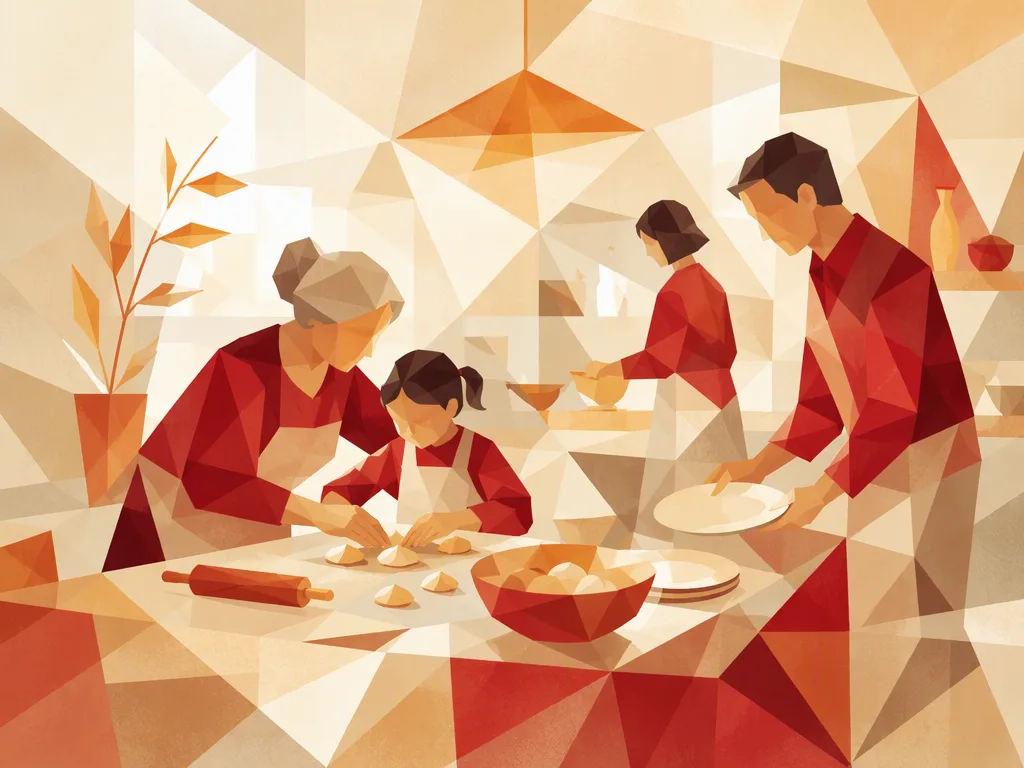
Familientraditionen
Entdecke die Mahlzeiten, Feste und alltäglichen Routinen, die Familien zusammenbringen.
Preview
Questions with solutions-
1. Wähle die richtige Antwort aus.
Was gibt es bei dieser Familie normalerweise sonntags zum Frühstück?
Dad: Your brother is making pancakes.
Mia: Great! Our usual Sunday breakfast.- Eggs on toast.
- Pancakes.
- Oatmeal.
Show solution
- Pancakes.
“Our usual” zeigt, dass dieses Frühstück eine regelmäßige Gewohnheit der Familie ist.
-
2. Wähle die richtige Antwort aus.
Was wird Noah tun, um zu helfen?
Grandma: I'll bake the pie. Could you set the table, Noah?
Noah: Sure. Do we need six plates?- Prepare the table for the meal.
- Make the dessert.
- Wash the dishes after dinner.
Show solution
- Prepare the table for the meal.
Den Tisch zu decken bedeutet, Teller und andere Dinge bereitzustellen, die man für eine Mahlzeit braucht.
-
3. Wähle die richtige Antwort aus.
Was passiert, kurz bevor Maya ihre Geschenke öffnet?
Maya: Can I open my birthday presents now?
Dad: After we take our family photo, as always.- The family eats birthday cake.
- The family sings a birthday song.
- The family takes a photo.
Show solution
- The family takes a photo.
“After” macht die Reihenfolge klar: Das Foto kommt vor den Geschenken.
-
4. Hör zu und gib die Antwort ein.
Ein Familienmitglied spricht über ein Picknick.
Show solution
- My aunt brings her homemade bread to every family picnic.
“Homemade” beschreibt etwas, das zu Hause zubereitet statt verzehrfertig gekauft wurde.
-
5. Wähle die richtige Antwort aus.
Wie hat Mama gelernt, diese Suppe zuzubereiten?
Sam: This soup tastes just like Grandma's.
Mom: She showed me how to make it when I was your age.- She watched a cooking video.
- Her mother taught her.
- She found it in a cookbook.
Show solution
- Her mother taught her.
Oma brachte Mama das Rezept bei und half der Familie damit, eine kulinarische Tradition zu bewahren.
-
6. Wähle die richtige Antwort aus.
Was erwartet der Gastgeber, dass der Gast mitbringt?
Guest: Should I bring a gift to your family dinner?
Host: You don't need to. Just bring a dish we can all share.- A wrapped present for the host.
- A plate to use during dinner.
- Some food for everyone to enjoy.
Show solution
- Some food for everyone to enjoy.
Hier steht “a dish” für zubereitetes Essen, nicht für einen leeren Teller.
-
7. Wähle die richtige Antwort aus.
Wann wird die Familie heute mit dem Abendessen beginnen?
Mom: We usually eat at six, but Uncle Joe can't get here until seven.
Dad: We'll wait for him before we start.- When Uncle Joe arrives at seven.
- At six, as usual.
- Half an hour before Uncle Joe arrives.
Show solution
- When Uncle Joe arrives at seven.
“We'll wait for him” zeigt, dass es wichtiger ist, den Gast dabei zu haben, als zur üblichen Zeit zu Abend zu essen.
-
8. Wähle die richtige Antwort aus.
Wie wird die Familie auf Avas Bedürfnisse reagieren?
Ava: I don't eat meat anymore.
Uncle: We'll still make our usual beef stew, but we'll cook a vegetable dish for you too.- They will ask Ava to eat the beef stew.
- They will add a meal that Ava can eat.
- They will stop making beef stew for everyone.
Show solution
- They will add a meal that Ava can eat.
Die Familie behält ihre übliche Mahlzeit bei und bietet eine zusätzliche Option an, damit Ava mitessen kann.
-
9. Hör zu und gib die Antwort ein.
Ein Sprecher beschreibt eine Veränderung bei einer Familienfeier.
Show solution
- We used to celebrate at my uncle's house, but now we meet at ours.
“Ours” bedeutet hier “our house”, sodass der Sprecher “house” nicht wiederholen muss.
-
10. Wähle die richtige Antwort aus.
Warum schlägt der Sohn einen Anruf vor?
Dad: Your sister can't come home this year.
Son: Then let's call her when we sit down to dinner.- To ask his sister to arrive before dinner.
- To get his sister's recipe for the meal.
- To include his sister even though she is far away.
Show solution
- To include his sister even though she is far away.
Ein Anruf ermöglicht es jemandem, der weit weg ist, einen Moment mit der Familie mitzuerleben.
-
11. Wähle die richtige Antwort aus.
Welchen Grund nennt Opa dafür, dass er die alten Dekorationen behält?
Grandpa: These decorations are old, but I don't want new ones. We made them together when your mom was little.
- They remind him of time spent with his family.
- New decorations cost too much.
- He thinks old decorations always look better.
Show solution
- They remind him of time spent with his family.
Ein alter Gegenstand kann wegen der Familienerinnerungen, die mit ihm verbunden sind, wertvoll sein.
-
12. Wähle die richtige Antwort aus.
Was bietet die Tante Ben an?
Aunt: We always play cards after dinner.
Ben: I don't know the game.
Aunt: Sit beside me for the first round. I'll explain as we play.- A different game that everyone already knows.
- Help learning the game while he takes part.
- A chance to play after everyone else finishes.
Show solution
- Help learning the game while he takes part.
“As we play” bedeutet, dass die Erklärung und das Spiel gleichzeitig stattfinden werden.
-
13. Wähle die richtige Antwort aus.
Welche Änderung am Picknickplan schlägt Papa vor?
Mom: Our family picnic is planned for Sunday, but the forecast says rain.
Dad: Let's eat at home instead. Everyone can bring the food they planned.- Change the day, but keep the outdoor location.
- Keep the location, but invite fewer people.
- Change the location, but keep the shared meal.
Achte darauf, was sich ändert und was gleich bleibt.
Show solution
- Change the location, but keep the shared meal.
Das Wetter verändert den Ort, an dem sie sich treffen, aber alle können trotzdem das geplante Essen miteinander teilen.
-
14. Wähle die richtige Antwort aus.
Welchen Plan für die Feiertage schlägt Max vor?
Ella: Are we spending this holiday with my parents again?
Max: We were there last year. Let's visit mine this year and yours next year.- Take turns visiting each family in different years.
- Visit both families on the same day.
- Keep visiting Ella's parents every year.
Achte darauf, auf wen sich “mine” und “yours” beziehen.
Show solution
- Take turns visiting each family in different years.
Sich abzuwechseln kann einem Paar dabei helfen, die Zeit an den Feiertagen zwischen seinen beiden Familien aufzuteilen.
-
15. Wähle die richtige Antwort aus.
Was ist Papa an dieser Tradition am wichtigsten?
Lena: Now that we've moved, we can't walk along our old river this New Year's Day.
Dad: We can walk in the park here. The important part is starting the year together.- Returning to their old town every year.
- Spending time together, even in a different place.
- Following exactly the same walking route.
Konzentriere dich darauf, was Papa als wichtig bezeichnet.
Show solution
- Spending time together, even in a different place.
Eine Tradition kann ihre Bedeutung behalten, auch wenn sich einige Details ändern.