


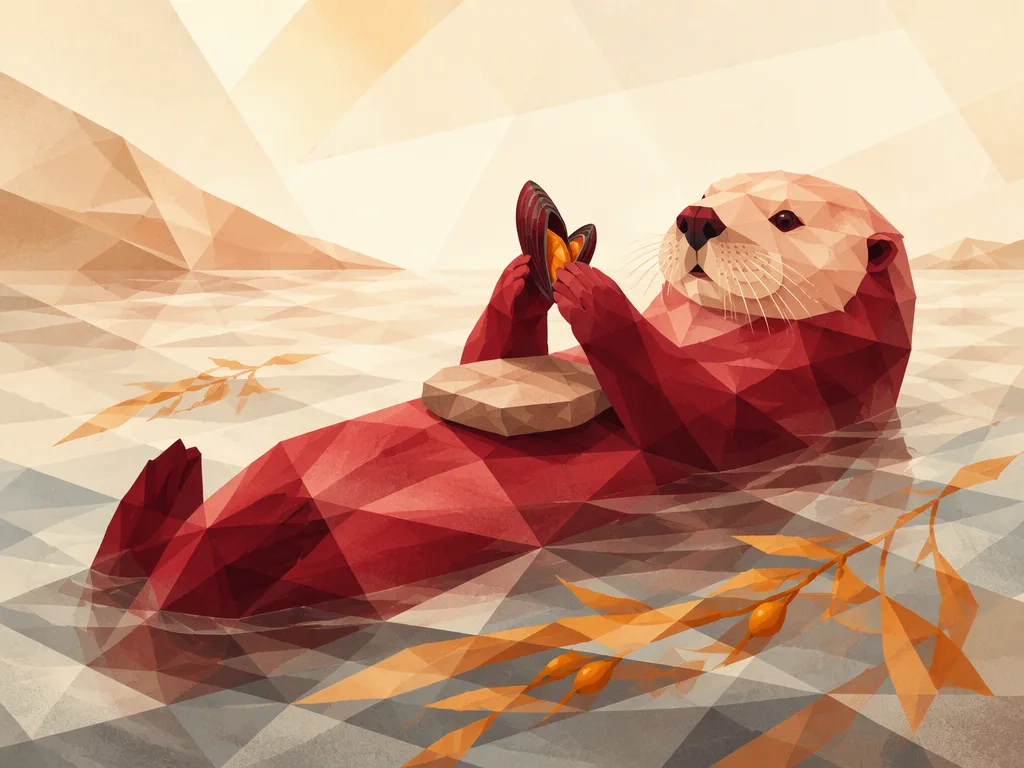
Wie Tiere denken
Entdecke, wie Tiere Werkzeuge benutzen, sich nützliche Informationen merken und Probleme lösen – vom Öffnen von Schalen bis zur Vorbereitung auf eine zukünftige Gelegenheit.
Preview
Questions with solutions-
1. Wähle die richtige Antwort aus.
Welches unmittelbare Problem hilft der Stein zu lösen?
A sea otter floats on its back, rests a stone on its chest, and repeatedly strikes a mussel against it.
- Keeping the mussel from sinking before it is eaten.
- Getting through the mussel's protective shell.
- Separating the mussel from a rock on the seabed.
Überlege, was wiederholte Schläge mit einer harten Oberfläche bewirken.
Show solution
- Getting through the mussel's protective shell.
Der Stein bietet eine harte Schlagfläche. Ein externer Gegenstand wird zu einem Werkzeug, wenn ein Tier ihn benutzt, um eine Aufgabe zu erledigen.
-
2. Wähle die richtige Antwort aus.
Warum wird der Zweig durch das Entfernen der Blätter nützlicher?
Before inserting a leafy twig into a narrow passage in a termite mound, a chimpanzee strips off the leaves. Termites cling to the inserted twig, allowing the chimpanzee to pull them out.
- It prevents termites from clinging to the twig.
- It widens the passage inside the mound.
- It allows the twig to enter the passage more easily.
Überlege, wie sich die Form des Zweigs verändert.
Show solution
- It allows the twig to enter the passage more easily.
Das Abstreifen der Blätter passt das Objekt an die Aufgabe an. Zur Verwendung von Werkzeugen kann auch gehören, ein Werkzeug vorzubereiten und nicht nur eines in die Hand zu nehmen.
-
3. Wähle die richtige Antwort aus.
Welche Veränderung würdest du erwarten, nachdem die Bienen das neue Belohnungsmuster gelernt haben?
Bees learn to associate a blue feeder with a sugary reward. The reward is then removed from the blue feeder and offered in a yellow one instead.
- More visits to the yellow feeder.
- A lasting preference for the blue feeder despite unrewarded visits.
- Equal visits to both feeders regardless of their rewards.
Nützlich ist die Verknüpfung zwischen einer Farbe und einer Belohnung, nicht die Farbe allein.
Show solution
- More visits to the yellow feeder.
Bienen können erlernte Verknüpfungen anpassen, wenn sich die Belohnungen ändern. Diese Flexibilität hilft ihnen, lohnende Nahrungsquellen zu finden.
-
4. Wähle die richtige Antwort aus.
Which gardening action would preserve these memory cues?
Squirrels can use nearby landmarks to find buried food again. In a garden, the positions of familiar rocks and logs may provide reference points.
- Rearranging the rocks and logs into a different pattern.
- Leaving the familiar rocks and logs in their existing positions.
- Removing the rocks and logs to create an open search area.
A remembered location is more useful when its surroundings remain stable.
Show solution
- Leaving the familiar rocks and logs in their existing positions.
Stable landmarks help preserve spatial information. Squirrels can also use other cues, including smell, so memory is not their only resource.
-
5. Wähle die richtige Antwort aus.
Why does reaching the treat require self-control?
A dog sees a treat through a transparent barrier. The opening is at one end, so reaching the treat requires first moving away from the direct route toward it.
- The dog must resist moving straight toward the visible reward.
- The dog must remember the reward because it is hidden from view.
- The dog must wait for the reward to move within reach.
The most tempting movement is not the useful one.
Show solution
- The dog must resist moving straight toward the visible reward.
This kind of detour involves inhibitory control: holding back an immediate response that would prevent success.
-
6. Wähle die richtige Antwort aus.
Which information helps explain the birds' changing preference?
In cache-recovery studies, scrub-jays preferred stored worms after a short delay but favored stored nuts after a longer delay. The worms spoiled more quickly than the nuts.
- Where the food was hidden and how far the birds flew to reach it.
- How much food was hidden and how many birds were nearby.
- What food was hidden and how long ago it was stored.
One food loses its value faster than the other.
Show solution
- What food was hidden and how long ago it was stored.
Scrub-jays can combine information about what food they cached, where, and when. Researchers call this episodic-like memory, without assuming that it feels like human remembering.
-
7. Wähle die richtige Antwort aus.
What practical advantage can this social cue provide?
In studies of socially learned food preferences, a rat often favors an unfamiliar food after encountering another rat that has recently eaten it.
- It reveals the location where the other rat found the food.
- It guides food choice without requiring the rat to sample every new food first.
- It reveals how much of the food the other rat consumed.
Another animal's feeding experience can influence a preference without revealing every detail.
Show solution
- It guides food choice without requiring the rat to sample every new food first.
Food odors on another rat's breath can influence later choices. This is useful social information, not a guarantee that a food is harmless.
-
8. Wähle die richtige Antwort aus.
Welche Rolle spielt es, den längeren Stock zu holen?
In experiments, some New Caledonian crows have used a short stick to retrieve a longer one, then used the longer stick to reach food that the short stick could not reach.
- It is an intermediate goal that makes the final goal achievable.
- It is the final reward, making food retrieval unnecessary.
- It repeats the same food-retrieval action with an equally capable tool.
Das erste Werkzeug reicht nicht bis zur Nahrung, verändert aber, was möglich wird.
Show solution
- It is an intermediate goal that makes the final goal achievable.
Eine Abfolge von Werkzeugen verknüpft kleinere Ziele: Das Beschaffen eines Gegenstands liefert die Mittel, um einen späteren Schritt abzuschließen.
-
9. Wähle die richtige Antwort aus.
Which ability is this behavior used to investigate?
Researchers have observed dolphins positioning their bodies in front of a mirror to inspect temporary marks on areas they cannot normally see directly.
- Distinguishing familiar companions from unfamiliar dolphins.
- Learning new movements by copying another dolphin.
- Recognizing their own bodies in a reflection.
Consider why inspecting a mark on one's own body matters.
Show solution
- Recognizing their own bodies in a reflection.
Mirror-directed inspection is relevant to self-recognition. It does not, by itself, establish every form of self-awareness.
-
10. Wähle die richtige Antwort aus.
What makes retaining the tool future-oriented?
In some experiments, apes have selected and retained a useful tool before returning later to an apparatus where they could use it to obtain food. The tool had no immediate use when selected.
- Selecting the tool completes the feeding task before the delay begins.
- Keeping the tool preserves the means to benefit from a later opportunity.
- The tool provides its reward during selection rather than during later use.
Separate the time of preparation from the time of benefit.
Show solution
- Keeping the tool preserves the means to benefit from a later opportunity.
Preparing now for a later task is future-directed behavior. Whether an ape imagines that future as a human would is a separate question.