


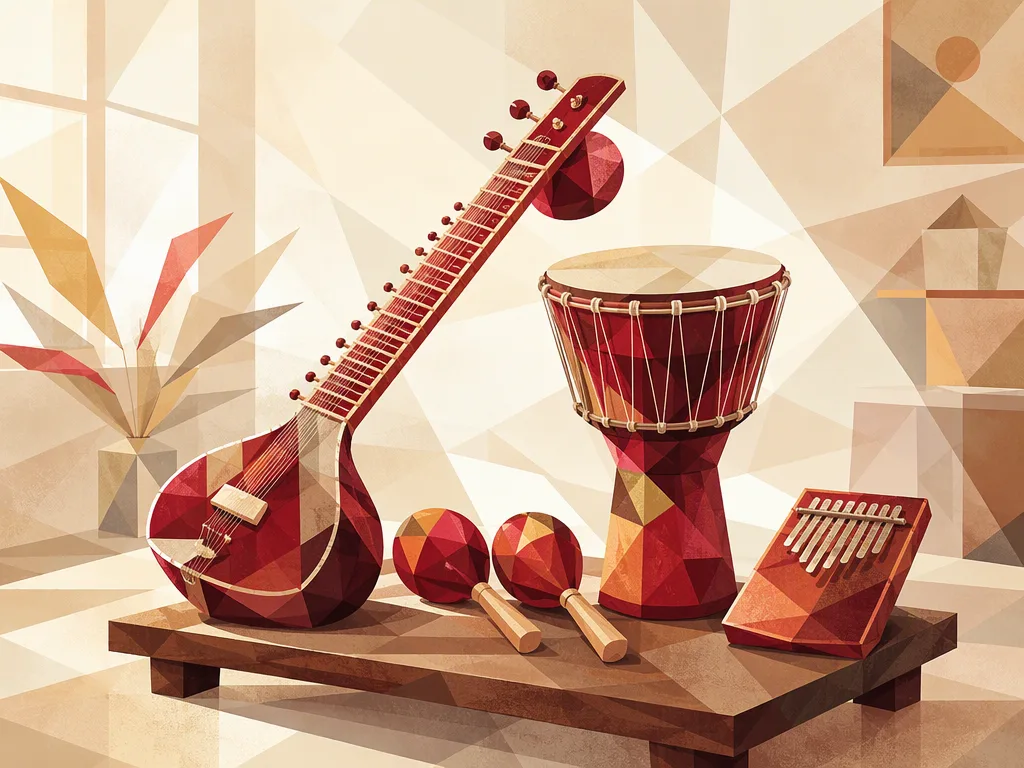
Musikinstrumente aus aller Welt
Entdecke, wie Instrumente gespielt werden, woher sie stammen und was ihre Klänge besonders macht.
Preview
Questions with solutions-
1. Fülle die Lücke aus.
A guitar player usually ___ the strings with their fingers or a small pick.
- plucks
- bows
- blows into
- shakes
Show solution
A guitar player usually plucks the strings with their fingers or a small pick.
A pick is a small tool used to catch and release the strings, making them move and produce sound.
-
2. Wähle die richtige Antwort aus.
Which part of the violin does the bow touch?
A violin player holds the instrument under their chin and moves a bow to produce a note.
- The keys
- The strings
- The drumhead
- The mouthpiece
Show solution
- The strings
The hairs on the bow catch the strings as the bow moves across them, helping the player produce a long, steady note.
-
3. Wähle die richtige Antwort aus.
Which instrument family does the flute belong to?
Most modern flutes are made of metal, but their sound comes from air moving inside a tube.
- Strings
- Brass
- Woodwinds
- Percussion
The material alone does not decide the family.
Show solution
- Woodwinds
A woodwind instrument does not have to be made of wood. How it produces sound is more important.
-
4. Fülle die Lücke aus.
A drum belongs to the ___ family because it is usually played by hitting it.
- string
- woodwind
- brass
- percussion
Show solution
A drum belongs to the percussion family because it is usually played by hitting it.
Schlaginstrumente können geschlagen, geschüttelt oder geschabt werden. Trommeln sind nur ein Teil dieser großen Instrumentenfamilie.
-
5. Wähle die richtige Antwort aus.
Wie werden Maracas normalerweise gespielt?
Maracas are common in Latin American music. Their hollow bodies contain small seeds or beads.
- By shaking them
- By blowing into them
- By drawing a bow across them
- By pressing keys on them
Show solution
- By shaking them
Die Samen oder Perlen schlagen gegen die Innenwände und erzeugen dabei ein leises, rasselndes Geräusch.
-
6. Fülle die Lücke aus.
The sitar is a string instrument strongly linked with classical music from ___.
- Japan
- India
- China
- Indonesia
Show solution
The sitar is a string instrument strongly linked with classical music from India.
Eine Sitar hat zusätzliche Saiten, die zusammen mit den Hauptsaiten erklingen können, auch wenn der Spieler sie nicht berührt.
-
7. Wähle die richtige Antwort aus.
Welches Instrument wird gespielt?
A musician blows into a long wooden tube, producing a deep, steady sound. The instrument comes from Aboriginal traditions in Australia.
- A trumpet
- A clarinet
- A didgeridoo
- A flute
Show solution
- A didgeridoo
Das Didgeridoo ist besonders mit den indigenen Völkern Nordaustraliens verbunden.
-
8. Wähle die richtige Antwort aus.
Wo sollte der Spieler anschlagen, um den beschriebenen tiefen Klang zu erzeugen?
A djembe is a West African hand drum. A relaxed hand striking the center gives a deep sound; a strike near the edge can give a higher, sharper sound.
- Near the edge of the drumhead
- On the wooden side of the drum
- In the center of the drumhead
Show solution
- In the center of the drumhead
Eine Djembe kann mehrere unterschiedliche Klänge erzeugen, sodass ein Spieler mit nur einer Trommel einen abwechslungsreichen Rhythmus gestalten kann.
-
9. Fülle die Lücke aus.
In Trinidad and Tobago, musicians developed the steelpan from large ___ barrels.
- wooden
- plastic
- clay
- metal
The instrument's name gives a clue about its material.
Show solution
In Trinidad and Tobago, musicians developed the steelpan from large metal barrels.
Differently shaped areas of a steelpan produce different notes when hit, so it can play a melody.
-
10. Wähle die richtige Antwort aus.
Warum drückt der Akkordeonspieler den mittleren Teil immer wieder zusammen und zieht ihn auseinander?
An accordion needs flowing air to make sound. Its middle section opens and closes like a folding fan.
- To move air through the instrument
- To tighten and loosen its strings
- To strike a stretched drumhead
- To shake loose beads inside it
Show solution
- To move air through the instrument
Die Luft bringt kleine Metallteile, sogenannte Stimmzungen, zum Schwingen. Die Tasten und Knöpfe steuern, welche Töne erklingen.
-
11. Wähle die richtige Antwort aus.
Wie erzeugt ein Kalimbaspieler normalerweise Töne?
A kalimba is an African instrument with thin metal strips fixed to a wooden board or box. The player holds it in both hands.
- By blowing across the metal strips
- By plucking the metal strips with the thumbs
- By moving a bow across the wooden body
- By pressing foot pedals below the box
Die Finger des Spielers stützen das Instrument, sodass die Daumen frei bleiben.
Show solution
- By plucking the metal strips with the thumbs
Die Kalimba wird oft als Daumenklavier bezeichnet, obwohl sie statt Klaviertasten Metallstreifen hat.
-
12. Wähle die richtige Antwort aus.
Was würde am ehesten passieren, wenn die Kalebassen entfernt würden?
A West African balafon has wooden bars above hollow, dried gourds. The bars make sound when hit, and air moving inside the gourds adds to that sound.
- The bars would make no sound at all.
- The sound would become louder.
- The sound would become quieter.
Die Klangstäbe erzeugen die Töne; die Kalebassen unterstützen den Klang.
Show solution
- The sound would become quieter.
Die Kalebassen wirken wie kleine Resonanzkörper und helfen dabei, dass die Töne weiter zu hören sind.
-
13. Wähle die richtige Antwort aus.
Was ermöglicht es, dass die Töne weiterklingen, während der Spieler Luft holt?
A bagpipe player blows air into a bag, then squeezes the bag to push air through the pipes.
- Air drawn in through the finger holes
- Air already stored in the bag
- Air stored in the player's mouth
Show solution
- Air already stored in the bag
Dudelsäcke sind eng mit Schottland verbunden, aber verschiedene Arten werden auch in vielen anderen Regionen gespielt.
-
14. Wähle die richtige Antwort aus.
Welche Art von Röhre würde einen tieferen Ton hinzufügen?
Panpipes are played in the Andes. In a set of tubes with the same width, shorter tubes make higher notes and longer tubes make lower notes.
- A tube longer than the others
- A tube shorter than the others
- A tube the same length as an existing tube
Show solution
- A tube longer than the others
Jede Röhre erzeugt ihren eigenen Ton, deshalb bewegen die Spieler ihren Mund von Röhre zu Röhre, um eine Melodie zu spielen.
-
15. Wähle die richtige Antwort aus.
Which description explains the piano's link to both string and percussion instruments?
Inside a piano, pressing a key makes a small hammer hit a string. The string then vibrates and produces the note.
- Its notes come from strings that are plucked.
- Its notes come from stretched skin that is struck.
- Its notes come from strings that are struck.
Think about both the part that sounds and the action that starts it.
Show solution
- Its notes come from strings that are struck.
The keyboard is the player's control system. Hidden inside, hammers and strings do the sound-making work.