


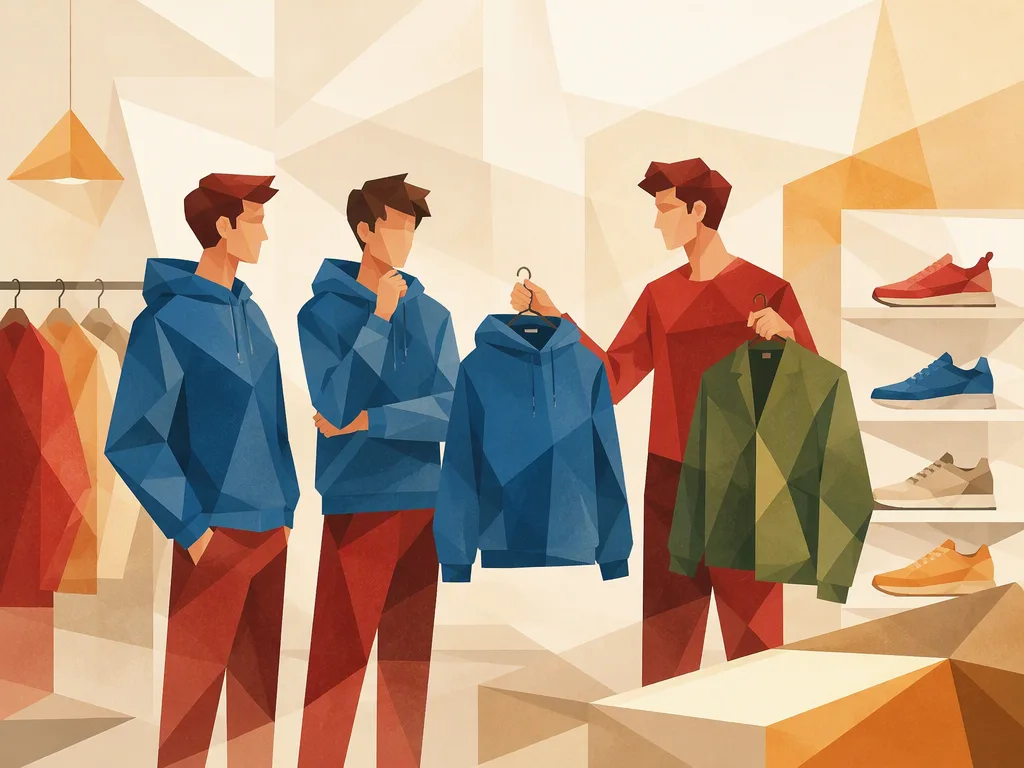
Warum Menschen Trends folgen
Entdecke, wie Freunde, soziale Medien, praktische Bedürfnisse und persönlicher Geschmack Trends im Alltag prägen.
Preview
Questions with solutions-
1. Wähle die richtige Antwort aus.
Warum möchte Maya den blauen Hoodie?
Maya: My hoodie still fits, but everyone in my group has a blue one now. I don't want to be the only person without one.
- She needs something warmer.
- She wants to feel part of the group.
- She wants to replace a damaged hoodie.
Achte darauf, was sie über die anderen Leute sagt.
Show solution
- She wants to feel part of the group.
Ähnliche Kleidung zu tragen kann Menschen helfen, sich zugehörig zu fühlen.
-
2. Wähle die richtige Antwort aus.
Warum hat Nina zu einer anderen App gewechselt?
Nina: I liked our old app, but my book club moved to a new one. They share all the meeting plans there, so I switched too.
- She wanted an app with fewer group messages.
- She wanted to try the app before her friends.
- She needed to keep up with her group's plans.
Überlege, wo der Verein Informationen teilt.
Show solution
- She needed to keep up with her group's plans.
Eine App wird nützlicher, wenn die Menschen, mit denen du kommunizierst, sie auch nutzen.
-
3. Wähle die richtige Antwort aus.
Was hat Leo zu seiner neuen Frisur inspiriert?
Leo: My favorite singer has this haircut. I loved how it looked, so I showed a picture of it at the salon.
- The appearance of someone he admires.
- Advice from the person cutting his hair.
- A request from his friends.
Wo hat er die Frisur zum ersten Mal gesehen?
Show solution
- The appearance of someone he admires.
Manchmal ahmen Menschen den Stil einer Person des öffentlichen Lebens nach, um ihre Bewunderung auszudrücken.
-
4. Wähle die richtige Antwort aus.
Was macht diesen Kochtrend für Ava nützlich?
Ava: I tried those one-pan dinners people keep sharing. Everything cooks in one pan, so there's less to wash after a busy day.
- She can stop buying vegetables.
- She has less cleaning to do.
- She can cook without heating the food.
Konzentriere dich darauf, was nach dem Kochen passiert.
Show solution
- She has less cleaning to do.
Ein Trend kann sich verbreiten, weil er ein kleines, alltägliches Problem löst.
-
5. Wähle die richtige Antwort aus.
Was reizt Jess an dem rosa Getränk?
Omar: Does that new pink drink taste good?
Jess: I'm not sure, but it looks great in photos. I want to post a picture of it on my page.- Its appearance would make a good post.
- She already knows it tastes better than other drinks.
- It costs less than her usual drink.
Was hat Jess mit dem Getränk vor?
Show solution
- Its appearance would make a good post.
Manche Trends erregen Aufmerksamkeit, weil sie sich leicht auf Fotos zeigen lassen.
-
6. Wähle die richtige Antwort aus.
Warum zieht Ben das Konzert in Betracht?
Ben: I'm not a big fan of the band, but my friends are all going. If they have an amazing night, I'll regret missing it.
- He wants to hear his favorite band.
- He expects it to be his cheapest evening out.
- He worries about missing an enjoyable experience.
Denk an das Gefühl, das er danach erwartet.
Show solution
- He worries about missing an enjoyable experience.
Die Angst, etwas zu verpassen, kann Menschen dazu bewegen, an Aktivitäten teilzunehmen, die sie sonst nicht in Betracht ziehen würden.
-
7. Wähle die richtige Antwort aus.
Warum wartet Sara damit, die Smartwatch zu kaufen?
Sara: I'd like the smartwatch everyone is talking about, but my bus pass comes first this month. Maybe I'll get the watch when it's on sale.
- She has lost interest in the watch.
- She needs to pay for something more important first.
- She is waiting for her friends to approve.
Achte darauf, welche Anschaffung zuerst kommt.
Show solution
- She needs to pay for something more important first.
Sich für einen Trend zu interessieren, bedeutet nicht, dass man es sich leisten kann, ihm sofort zu folgen.
-
8. Wähle die richtige Antwort aus.
Was zeigt dieses Gespräch über Mode?
Ella: Look at this old photo of Dad. His jacket looks like the ones in stores now!
Max: He kept it. He could wear it again and look fashionable.- Older styles can become popular again.
- Fashionable clothes must always be newly made.
- A style can only be popular once.
Vergleiche das alte Foto mit den Geschäften von heute.
Show solution
- Older styles can become popular again.
In der Mode kehren ältere Stile oft zurück, manchmal mit kleinen Änderungen.
-
9. Wähle die richtige Antwort aus.
Was hat Priya vor?
Priya: Those tiny bags look fun, but I'm not sure my things will fit. Could I borrow yours this weekend before I buy one?
- To keep her friend's bag permanently.
- To stop carrying a bag altogether.
- To test the trend before spending money.
Warum möchte sie sich zuerst eines ausleihen?
Show solution
- To test the trend before spending money.
Einen Trend kurz auszuprobieren, kann helfen zu entscheiden, ob er zu den eigenen Bedürfnissen im Alltag passt.
-
10. Wähle die richtige Antwort aus.
Wie reagiert Dana auf den Modetrend?
Dana: I like the wide pants people are wearing, but not the bright colors. I'll get a black pair that I can wear to work.
- She is rejecting every part of the trend.
- She is adapting the trend to her own situation.
- She is copying the whole look exactly.
Achte darauf, was sie beibehält und was sie verändert.
Show solution
- She is adapting the trend to her own situation.
Einem Trend zu folgen kann flexibel sein: Man kann einen Teil übernehmen und einen anderen weglassen.
-
11. Wähle die richtige Antwort aus.
Was hat es Will erleichtert, Dinge zu reparieren?
Will: I used to replace broken lamps because I didn't know where to get help. Now there's a repair table beside my grocery store, so I take them there.
- Repair help is now easy for him to reach.
- New lamps have become cheaper.
- He has learned to repair lamps without help.
Vergleiche seine früheren Schwierigkeiten mit dem neuen Standort.
Show solution
- Repair help is now easy for him to reach.
Eine Verhaltensweise kann sich leichter verbreiten, wenn Dienstleistungen vor Ort ihre Umsetzung erleichtern.
-
12. Wähle die richtige Antwort aus.
Woran orientiert sich Luis bei seiner Entscheidung?
Luis: I've never visited either cafe. That one has a long line, though. If so many people want its coffee, it might be worth trying.
- His own experience of drinking coffee there.
- Advice from someone who works there.
- The choices of other customers.
Welche Informationen hat er, bevor er hineingeht?
Show solution
- The choices of other customers.
Menschen nutzen oft die Entscheidungen einer größeren Gruppe als Anhaltspunkt, obwohl Beliebtheit keine Qualität garantiert.
-
13. Wähle die richtige Antwort aus.
Was scheint Mias Interesse zu verändern?
Mia: I didn't like those sneakers at first. But they keep appearing in videos, and now I'm starting to want a pair. The price hasn't changed.
- A lower price is making them attractive.
- Seeing them repeatedly is making them more appealing.
- Trying them on has shown her they are comfortable.
Was hat sich verändert, seit sie sie zum ersten Mal gesehen hat?
Show solution
- Seeing them repeatedly is making them more appealing.
Wiederholter Kontakt mit einem Stil kann ihn vertraut wirken lassen, was das Interesse daran steigern kann.
-
14. Wähle die richtige Antwort aus.
Was legt dieser Austausch über Trends nahe?
Alex: Everyone at my office has a small backpack. They're everywhere now!
Rae: Really? I haven't seen anyone with one where I live.- A style becomes popular everywhere at the same time.
- A style cannot be a trend if one person has not seen it.
- A style can be common in one group but rare elsewhere.
Beschreiben sie dieselbe Gruppe von Menschen?
Show solution
- A style can be common in one group but rare elsewhere.
Was wie ein weitverbreiteter Trend erscheint, spiegelt möglicherweise vor allem die Menschen und Orte um uns herum wider.
-
15. Wähle die richtige Antwort aus.
Warum könnte Lena vor dem Kauf der Schuhe eine weitere Meinung einholen wollen?
Lena: This video creator says these shoes are the best he's ever worn.
Noah: The shoe company paid him to make the video.
Lena: Then I'll check what other owners say too.- The creator has a financial reason to promote the shoes.
- The payment proves that the shoes are uncomfortable.
- The payment means the creator has never worn the shoes.
Überlege, wie eine Bezahlung eine Empfehlung beeinflussen könnte.
Show solution
- The creator has a financial reason to promote the shoes.
Eine bezahlte Empfehlung kann ehrlich sein, ist aber auch Werbung. Andere Meinungen können ein umfassenderes Bild vermitteln.