


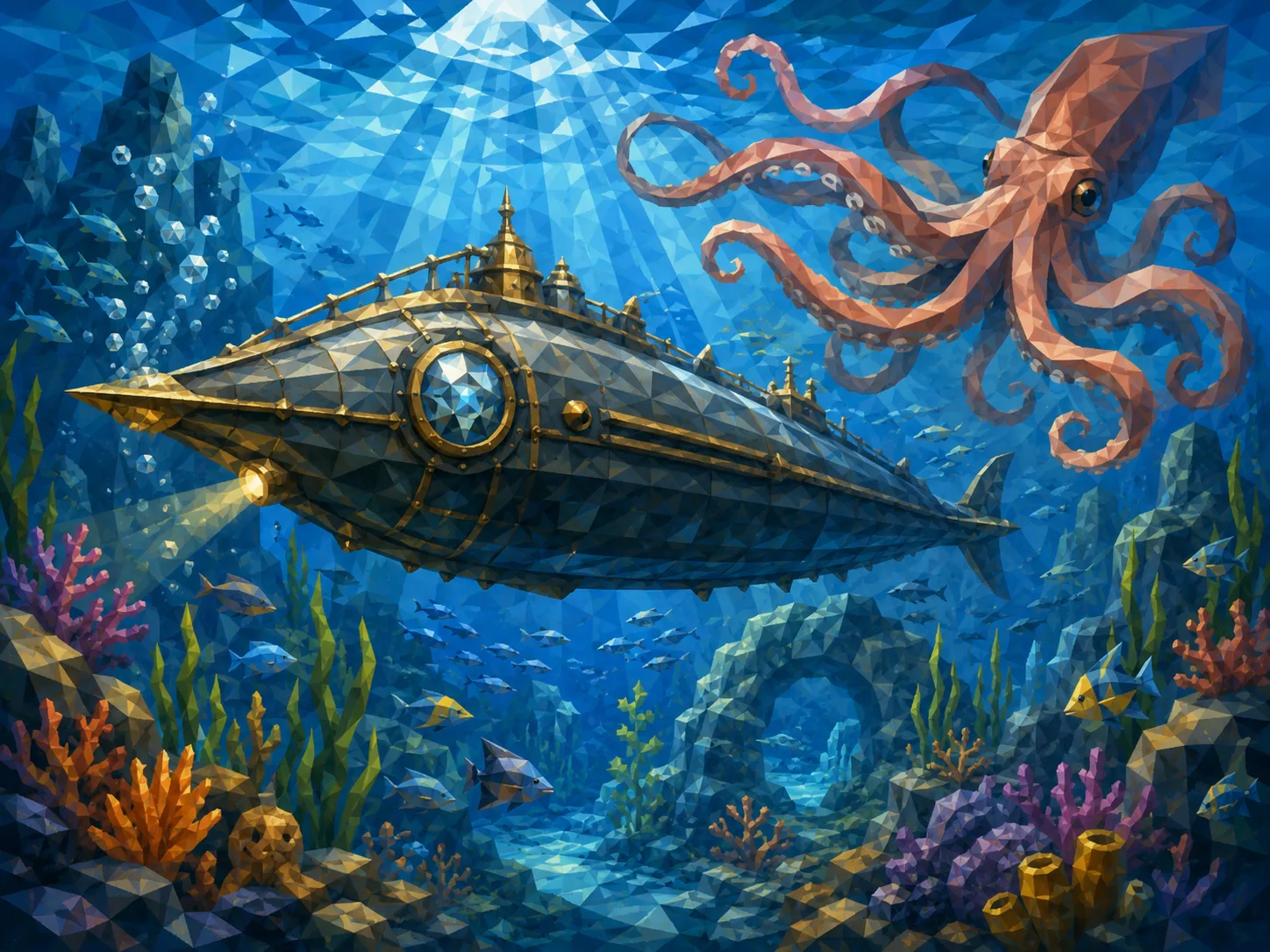
Out in the Atlantic the Nautilus rose to the surface again, off the coast of Portugal. A strong wind was blowing, and the waves washed over the platform, so after a few breaths of fresh air we went down. Ned followed me into my room, shut the door and sat looking at me in silence. Our fast crossing of the Mediterranean had ruined his plan.
“Ned,” I said, “I understand. But we need not lose hope. We are going up the coast of Portugal, and France and England are not far away. In a few days, I think, you can act safely.”
Ned looked at me even harder. At last he spoke.
“It is for tonight.”
I stood up suddenly. I could not find a word to say.
“We agreed to wait for a chance, and the chance has come. Tonight we’ll be only a few kilometers off the Spanish coast. The night will be cloudy, and the wind blows toward the shore. I have your word, Professor. At nine o’clock Captain Nemo will be in his room, probably in bed. Conseil and I will go to the central staircase. You’ll wait in the library for my signal. The oars, the mast and the sail are in the boat, and I have a wrench to undo the bolts.”
“The sea is rough.”
“We have to take the risk. Freedom is worth paying for. By ten or eleven we’ll be on land, alive or dead. Until tonight, Professor.”
He left me almost unable to speak. But what could I have said? Ned was right, and he had my word. Could I risk my friends’ future for the sake of my studies? Tomorrow Captain Nemo might take us far from all land. A loud hissing told me that the tanks were filling, and the Nautilus sank under the waves.
It was a sad day. I wanted my freedom, but I hated to leave the wonderful Nautilus and my unfinished studies. Sometimes I saw the three of us safe on shore; sometimes, against all reason, I hoped that something would stop Ned’s plan. Twice I went to look at the compass. We stayed off the coast of Portugal, heading north. So I prepared. My luggage was light: my notes, nothing more.
And Captain Nemo? I had no reason to complain about him; no guest had ever been treated more generously. Yet we had never promised to stay. He kept us by force, not by our word. I had not seen him since Santorini. Would I meet him before we left? I hoped for it and feared it at the same time.
The day seemed endless. At seven I left my dinner almost untouched, and I counted the minutes until nine. I was less afraid of failure than of being caught and brought before Captain Nemo, and seeing him angry or, worse, saddened that I had tried to leave him.
I wanted to see the salon one last time. I stood among its treasures, where I had spent so many happy hours, like a man about to go into exile forever. The door to the captain’s room was half open. I came closer: the room was empty, as plain as a monk’s. Suddenly the clock struck eight. I jumped as if an invisible eye had looked into my secret thoughts, and I hurried out.
In my room I dressed warmly: sea boots, a fur cap, a thick coat. A few minutes before nine I crossed the dark, empty salon, went into the library and stood by the door to the central staircase, waiting for Ned’s signal.
At that moment the trembling of the propeller grew weaker, and then it stopped. Then I felt a light shock: the Nautilus had come to rest on the bottom of the ocean. Ned’s signal did not come. Something had gone wrong, and I went back into the salon.
The door of the salon opened, and Captain Nemo came in. He saw me and said in a friendly voice:
“Ah, Professor, I was looking for you. Do you know the history of Spain?”
In the state I was in, I could not have said a word about it.
“Very little,” I answered.
“Even scholars have things to learn,” he said. “Sit down. I will tell you a story that will answer a question you have not been able to answer.”
I sat down, wondering whether this had anything to do with our escape.
He took me back to the year 1702. Spain was at war with England and her allies, he said, and was waiting for a great fleet from America, full of gold and silver. English ships were watching the sea, so the fleet took shelter in Vigo Bay, on the northwest coast of Spain. Because of a foolish quarrel between merchants, the gold was not unloaded but stayed on board, and on October 22, 1702, the English fleet sailed into the bay. The French admiral who was guarding the Spanish ships fought bravely, but when he saw that the treasure would fall into enemy hands, he burned and sank them all, with all their riches.
“Well?” I asked. I still did not see why this story concerned me.
“Well, Professor, we are in Vigo Bay. Now you can see its secrets for yourself.”
He led me to the window. All around the Nautilus the water was lit by our electric light. Men of the crew in diving suits were clearing away half-rotten barrels and broken boxes from among the blackened wrecks, and out of them poured bars of gold and silver, coins and jewels. The sand was covered with them. The men carried their loads to the Nautilus and went back for more. With the crew at work all around us, there could be no escape for Ned that night.
Now I understood. Here the Spanish ships had sunk, and here Captain Nemo came, whenever he needed it, to collect his millions. The gold that had been taken from the peoples of America belonged to him alone.
“Did you know, Professor,” he asked with a smile, “that the sea held such riches?”
“I know that a company has permission from the Spanish government to search for these wrecks.”
“They would have found a fortune once,” said Captain Nemo. “Not anymore.”
“Then I pity them,” I said. “But I pity even more the thousands of poor people who could have been helped by these riches. Now they will be of no use to anyone.”
The moment I said it, I felt that I had hurt him.
“Of no use!” he cried. “Do you think these riches are lost because I collect them? Do you think I gather them for myself? Do you think I don’t know that there are suffering people and oppressed peoples on this earth, poor people to comfort and victims to avenge? Don’t you understand?”
He stopped, perhaps sorry that he had said so much. But I had understood. Whatever had driven him under the sea, his heart still felt the suffering of others. And now I knew where the gold had gone that night near Crete, the island that was fighting for its freedom.