


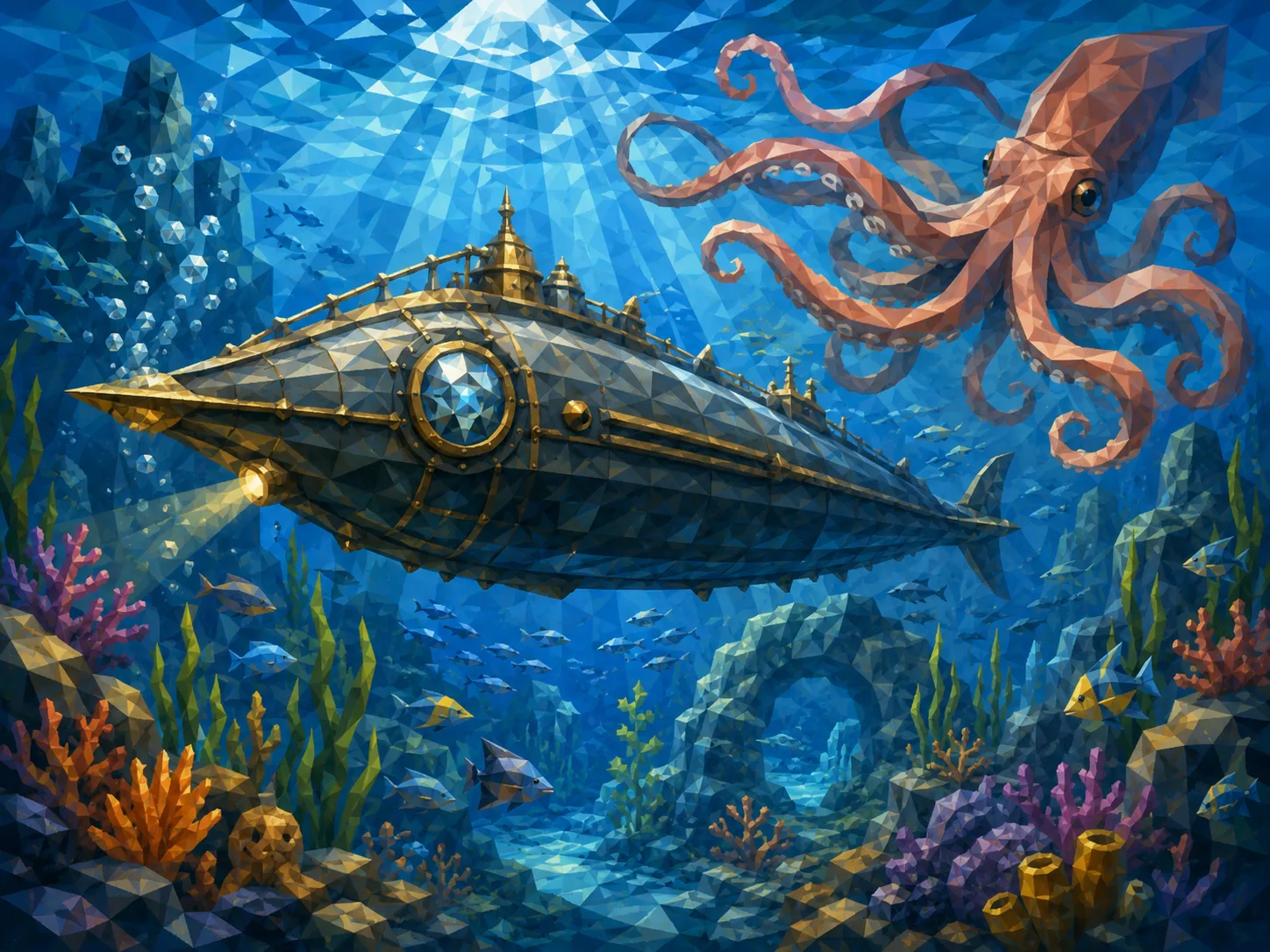
On March 22, as the long polar night began, we left the Pole. The Nautilus went down to a depth of about three hundred meters, turned north, and by evening it was moving under the great field of ice.
At three o’clock the next morning a violent shock threw me out of bed. I felt my way to the salon. The furniture was overturned, and the paintings on one side hung far out from the wall: the Nautilus was lying on its side, and it did not move. Ned and Conseil came in after me.
“We’ve hit something,” said Ned. “And the way she’s lying, I don’t think she’ll get free as easily as she did in the Torres Strait.”
Twenty minutes later Captain Nemo came in, looking worried, and studied his instruments in silence. When at last he turned toward me, I used a word he had used in the Torres Strait.
“An incident, Captain?”
“No, sir. An accident, this time.”
“Is it serious?”
“Perhaps.”
Then he explained. “An enormous block of ice, a whole mountain, has turned over. It struck the Nautilus as it fell, slid under the hull and lifted us. The pumps are emptying our tanks, and we are rising, but the block is rising with us. We may defy the laws of men, Professor, but we cannot fight the laws of nature.”
Slowly the floor became level under our feet. The shutters opened, and I saw where we were. We were floating in quiet water, but on each side of the Nautilus, about ten meters away, rose a wall of ice. Above us the ice stretched like a ceiling, and below us lay the overturned block. We were in a tunnel of ice. In the light of the ship’s lamp every edge of it shone blue like sapphires and green like emeralds, with points of fire too bright for the eye.
“How beautiful! How beautiful!” cried Conseil.
“Yes, it’s wonderful,” said Ned, “and I’m angry that I have to say it. But this sight may cost us a lot. I think we are seeing things here that God never meant men to see.”
Ned was right. At five o’clock we felt a shock at the front, and the Nautilus began to move backward: this end of the tunnel was closed. We would go out at the other end, I told my friends, trying to look more confident than I really was. Hours passed. At twenty-five past eight there was a second shock, this time behind us. I turned pale and took Conseil’s hand. Captain Nemo came in.
“The way south is closed too?” I asked.
“Yes, sir. The iceberg has moved and closed every way out.”
We were prisoners of the ice. The Captain was calm again, and he spoke like a teacher to his students.
“Gentlemen, there are two ways we may die here. The first is to be crushed; the second is to suffocate. I do not speak of hunger: our food will last longer than we will. Our tanks cannot renew the air inside the ship for much longer, and we have already been under the water for a day and a half. We must cut our way out.”
The crew measured the ice, and found that under us only about ten meters of it separated us from open water. The Nautilus came to rest on this floor of ice, and the crew put on their diving suits.
“I’m as good with a pick as with a harpoon,” Ned told me. “If the Captain wants my help, he can have it.”
Captain Nemo accepted at once. Through the salon window I watched a dozen men step out onto the ice, Ned among them, taller than the others. They began to dig a huge trench beside the ship. After two hours Ned came in, exhausted, and Conseil and I took our turn with the next group.
When I came back on board, I felt the difference at once: the air in my tank had been pure, but the air inside the Nautilus was heavy and stale. And after twelve hours of work we had dug only one meter. At that speed we would need five nights and four days. The air inside the ship would not last that long.
The next morning I noticed something worse. The side walls were slowly coming closer. Away from where the men were digging, the water was freezing, and if it froze all around us, it would crush the Nautilus like glass. I said nothing to my companions, but I told Captain Nemo.
“I know,” he answered calmly. “It is one more danger. Our only chance is to dig faster than the water freezes.”
On March 26 the walls had grown thicker again, and I lost hope. I went to Captain Nemo.
“How long will the air in the tanks last?” I asked.
He looked me in the face. “After tomorrow, they will be empty.”
I broke out in a cold sweat. Even now, as I write, I remember it so clearly that I feel my lungs empty of air. Captain Nemo stood thinking. Then a few words escaped him.
“Boiling water! If the pumps send boiling water into the sea, the water around us will grow warmer and stop freezing.”
“Let us try it,” I said.
“Let us try it, Professor.”
The machines that made our drinking water brought sea water to the boil, and the pumps sent it out into the tunnel. By night the water outside was warm enough, and the ice could not close in on us any longer.
“We will not be crushed,” said Captain Nemo. “Now only the lack of air can kill us.”
On March 27 I could hardly move or think. Conseil suffered just as much, but he never left me. He held my hand, and I heard him whisper, “Oh, if only I could stop breathing, to leave more air for master!”
Tears came to my eyes. How gladly we put on our diving suits when our turn came! Our arms ached and our hands bled, but out there we could breathe. No man stayed in the trench longer than his turn; each gave his tank to the next. Captain Nemo set the example. When his time was over, he went back into the bad air of the ship without a complaint.
By evening only two meters of ice were left, but the tanks were almost empty, and the little air that remained had to be kept for the diggers. I cannot describe that night.
The next morning, the sixth day of our imprisonment, Captain Nemo decided that the picks were too slow. The Nautilus was moved until it lay just above the trench, where the ice was now less than a meter thick. All the crew came back on board. Then water poured into the tanks until the ship grew very heavy. We waited and listened. The ice cracked like tearing paper, and the Nautilus went down.
“We are through!” Conseil whispered in my ear.
The Nautilus fell like a stone; then the pumps emptied the tanks, our fall stopped, and the propeller carried us north at full speed. But how long would we travel under the ice before we reached the open sea?
I lay on a sofa in the library. My face was purple, my lips were blue, and I could neither see nor hear. I felt that I was dying. Suddenly a little air came into my lungs. Had we reached the surface? No. Ned and Conseil, my two brave friends, had found a little air left in one tank. Instead of breathing it themselves, they had kept it for me, and while they were suffocating, they gave me life, a little at a time. I tried to push the tank away, but they held my hands.
It was eleven in the morning on March 28. Only a sheet of ice separated us from the air. The Nautilus raised its front and struck the ice from below. Again and again it backed away and rushed forward, until at last the ice gave way and the ship broke through. The hatch was thrown open, and pure air poured into every part of the Nautilus.