


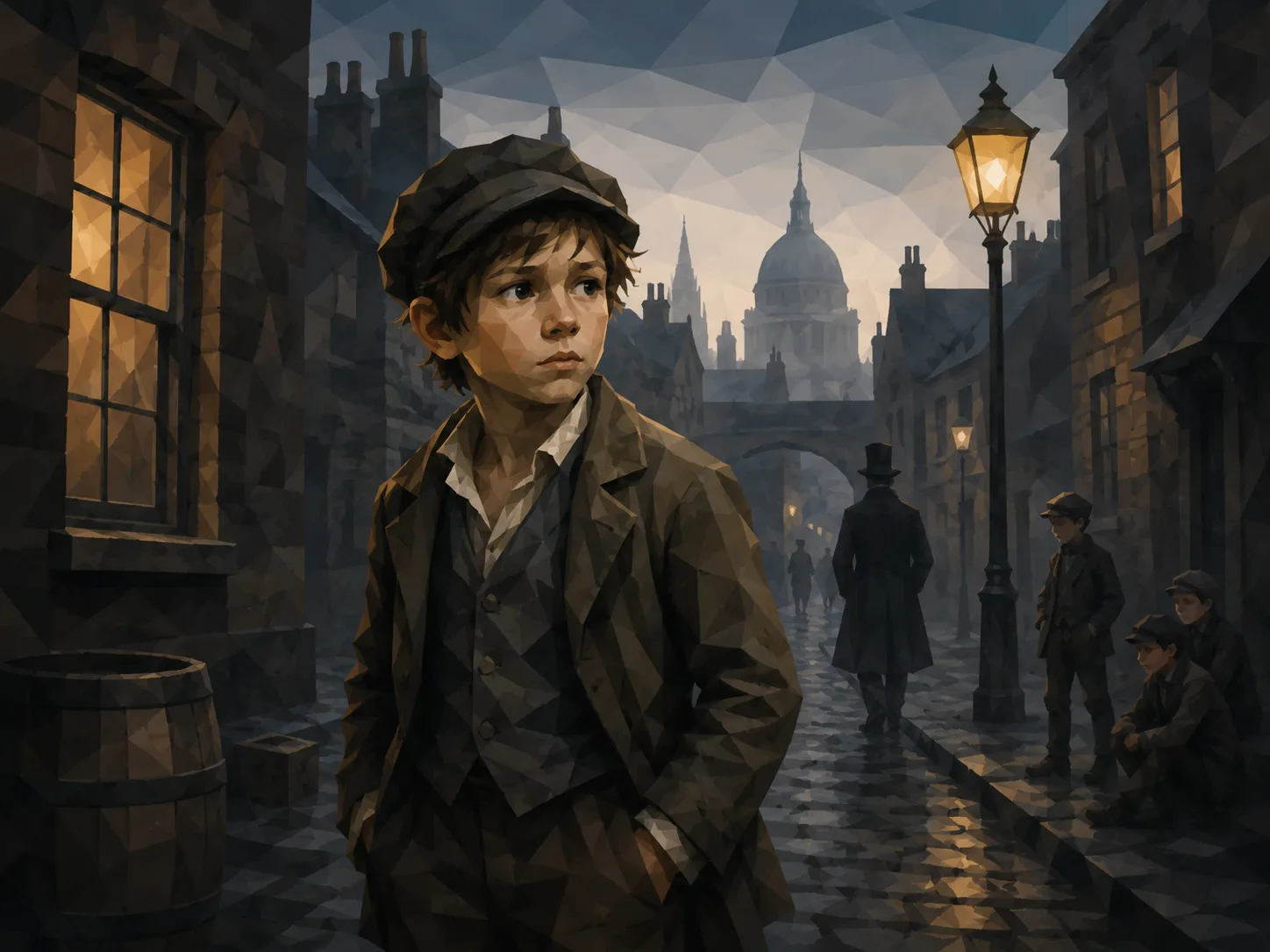
When Oliver awoke the next morning, he was surprised to find a new pair of shoes with sturdy, thick soles placed by his bedside. His old ones had been removed. At first, he felt a spark of hope, imagining that this might be a sign of his upcoming release. However, these thoughts were quickly dispelled when he sat down to breakfast with Fagin. The old man told him, in a tone that only increased his alarm, that he was to be taken to the residence of Bill Sikes that very night.
"To—to stay there, sir?" Oliver asked anxiously.
"No, no, my dear. Not to stay there," replied Fagin. "We wouldn’t like to lose you. Don’t be afraid, Oliver; you shall return to us. Ha! ha! ha! We won’t be so cruel as to send you away forever, my dear. Oh no, no!"
The old man, who was leaning over the fire toasting a piece of bread, looked around as he teased Oliver in this way. He chuckled softly, clearly aware that the boy would still be desperate to escape if he had the chance.
"I suppose," said Fagin, fixing his eyes on Oliver, "you want to know why you’re going to Bill’s house—eh, my dear?"
Oliver blushed, realizing that the old thief had been reading his thoughts, but he answered boldly that he did indeed want to know.
"Why do you think?" inquired Fagin, cleverly avoiding a direct answer.
"I really don’t know, sir," replied Oliver.
"Bah!" said Fagin, turning away with a disappointed expression after studying the boy’s face closely. "In that case, you can wait until Bill tells you himself."
Fagin seemed quite annoyed that Oliver did not show more curiosity. The truth was that, although Oliver felt extremely anxious, he was too confused by Fagin's cunning looks to ask any more questions. He had no further opportunity anyway, for Fagin remained surly and silent until nightfall, when he prepared to go out.
"You may light a candle," said Fagin, placing one on the table. "And here is a book for you to read until they come to fetch you. Good-night!"
"Good-night," Oliver replied softly.
Fagin walked toward the door, looking back over his shoulder at the boy. Suddenly stopping, he called Oliver by name. When the boy looked up, Fagin pointed to the candle, signaling for him to light it. As Oliver placed the candlestick on the table, he saw Fagin staring at him from the shadows with a dark, threatening expression.
"Take heed, Oliver! Take heed!" said the old man, shaking his hand in warning. "He’s a rough man, and he thinks nothing of violence when his temper is up. Whatever happens, say nothing, and do exactly what he tells you. Do you hear me?" Placing a heavy emphasis on his final words, his face twisted into a ghastly grin, and he left the room.
Once the old man had disappeared, Oliver leaned his head on his hand and turned over the words he had just heard. The more he thought about Fagin’s warning, the less he understood its true purpose. He could think of no reason to send him to Sikes that wouldn't be equally served by keeping him with Fagin. Eventually, he concluded that he had been chosen to perform some simple household chores for the burglar until another boy could be found. Having already suffered so much, he did not find the prospect of a change in scenery too distressing. After a few minutes of quiet reflection, he took up the book Fagin had left and began to read.
At first, he turned the pages carelessly, but he soon came across a passage that caught his attention. It was a history of the lives and trials of famous criminals, and the pages were dirty and worn from frequent use. He read of dreadful crimes that made his blood run cold: of secret murders committed on lonely roads, and of bodies hidden in deep wells that eventually yielded up their secrets, driving the murderers to madness and confession. He read of men who, lying in their beds at night, had been tempted by their own dark thoughts to commit such terrible acts that it made his skin crawl just to think of them. The descriptions were so vivid that the yellowed pages seemed to turn red with blood, and the words sounded like hollow whispers from the spirits of the dead.
In a sudden fit of terror, the boy closed the book and pushed it away. Falling to his knees, he prayed to Heaven to spare him from such deeds, declaring he would rather die immediately than be forced to commit such crimes. Gradually, he grew calmer and prayed in a low, broken voice that he might be rescued from his current dangers. He asked that if any help were possible for a poor outcast boy who had never known love, it might come to him now, while he stood alone in the midst of wickedness.
He had just finished his prayer when a rustling noise startled him.
"What’s that!" he cried, jumping up. "Who’s there?"
"It’s me. Only me," replied a trembling voice.
Oliver raised the candle and saw Nancy standing by the door.
"Put down the light," she said, turning her head away. "It hurts my eyes."
Oliver noticed that she was incredibly pale and kindly asked if she were ill. The girl threw herself into a chair and wrung her hands but did not reply.
"God forgive me!" she cried after a moment. "I never intended for this to happen."
"Has something happened?" asked Oliver. "Can I help you? I will if I can."
She rocked back and forth, gasping for breath as if she were choking.
"Nancy!" cried Oliver. "What is the matter?"
The girl beat her hands against her knees and then suddenly stopped, shivering with cold as she drew her shawl tight around her. Oliver stirred the fire to give her some warmth. After a while, she looked up and tried to act as if nothing were wrong.
"I don't know what comes over me sometimes," she said, pretending to fix her dress. "It’s this damp, dirty room, I think. Now, Oliver, are you ready?"
"Am I going with you?"
"Yes, I’ve come from Bill," she replied. "You are to come with me."
"What for?" asked Oliver, stepping back in fear.
"What for?" she echoed, looking at him for a split second before turning her eyes away again. "Oh! For no harm."
"I don't believe you," said Oliver, who had been watching her closely.
"Have it your own way, then," she replied with a forced laugh. "For no good, then."
Oliver realized he had some influence over her better feelings and considered begging her for mercy. However, he remembered it was only eleven o’clock and many people would still be in the streets; surely someone would believe his story if he called for help. With this thought in mind, he told her he was ready.
Nancy watched him narrowly and seemed to guess exactly what he was thinking.
"Hush!" she whispered, leaning over him and pointing toward the door. "You can't help yourself. I have tried my best to protect you, but it was no use. You are surrounded. If you are ever to get away from here, this is not the time."
Struck by the intensity of her manner, Oliver looked up at her in surprise. She seemed to be telling the truth; her face was white with agitation and she was trembling with earnestness.
"I saved you from being mistreated once, and I will do it again," she continued aloud. "If I hadn't come for you, someone much rougher would have been sent. I have promised that you will be quiet and silent. If you aren't, you will only harm yourself and me, too. Look at this! I have already suffered this much for you."
She pointed to several dark bruises on her neck and arms. "Remember this, and don't let me suffer any more right now. If I could help you escape, I would, but I don't have the power. They don't mean to kill you; whatever they make you do, it isn't your fault. Now, give me your hand. We must hurry!"
She grabbed Oliver’s hand and, blowing out the candle, led him up the stairs. The door was opened quickly by someone in the darkness and closed just as fast once they had passed through. A horse-drawn cab was waiting. Nancy pulled Oliver inside and drew the curtains tight. The driver immediately lashed his horse into a gallop without waiting for directions.
The girl held Oliver’s hand firmly, continuing to whisper warnings into his ear. Everything happened so quickly that they had reached Sikes’s house before Oliver could even process what was happening. For a brief moment, as they got out, he looked down the empty street and almost cried out for help. But Nancy’s voice was in his ear, begging him so desperately to remember her safety that he could not bring himself to do it. Before he could decide, the opportunity was gone; he was inside, and the door was shut.
"This way," said Nancy, finally letting go of his hand. "Bill!"
"Hello!" Sikes replied, appearing at the top of the stairs with a light. "Right on time. Come on up!"
This was an unusually warm welcome from a man like Sikes. Nancy seemed pleased by it and greeted him cordially.
"The dog has gone home with Tom," Sikes remarked as he led them up. "He would have been in the way tonight."
"That’s for the best," Nancy agreed.
"So, you’ve got the kid," Sikes said once they were in the room, closing the door behind them.
"Yes, here he is."
"Did he come quietly?"
"Like a lamb," Nancy replied.
"I'm glad to hear it," said Sikes, looking grimly at Oliver. "It’s better for him that he didn't struggle. Come here, young man; let me give you a lecture that’s best finished quickly."
Sikes pulled off Oliver’s cap and threw it into a corner. Then, gripping the boy’s shoulder, he sat down at the table and forced Oliver to stand in front of him.
"Now, first: do you know what this is?" Sikes asked, picking up a small pistol from the table. Oliver nodded.
"Well, look here," Sikes continued. "This is the gunpowder; this is the bullet; and this is the cloth for the padding." Oliver murmured that he understood, and Sikes proceeded to load the weapon with great care and precision.
"Now it’s loaded," said Sikes.
"Yes, I see, sir," replied Oliver.
"Well," said the robber, suddenly grabbing Oliver’s wrist and pressing the cold barrel of the gun against the boy’s temple. Oliver couldn't help but jump. "If you speak a single word when you're outside with me, unless I speak to you first, this bullet will be in your head without warning. So, if you do decide to speak without permission, say your prayers first."
After scowling at the boy to make sure the threat had hit home, Sikes continued. "As far as I know, nobody would miss you if you were gone. I wouldn't take all this trouble to explain things if it weren't for your own good. Do you hear me?"
"What he means," Nancy interrupted, looking sternly at Oliver to ensure he was paying attention, "is that if you interfere with this job, he will shoot you to prevent you from telling any tales later. He’s willing to take the risk of being hanged for it, just as he does for many other things every month of his life."
"That’s exactly it!" Sikes observed approvingly. "Women always know how to say things in the fewest words—except when they're arguing, of course. Now that he understands the situation, let's have some supper and get some sleep before we leave."
Nancy quickly set the table, returning with a jug of beer and a dish of food. Sikes was in surprisingly good spirits, likely because he was looking forward to the robbery. He even made a few jokes, drank all the beer in one go, and hardly swore at all during the meal.
When supper was over—though Oliver had very little appetite—Sikes drank two glasses of spirits and water and threw himself onto the bed. He ordered Nancy to wake him at exactly five o'clock. By Sikes's command, Oliver lay down in his clothes on a mattress on the floor. Nancy sat by the fire, ready to wake them at the appointed time.
For a long while, Oliver lay awake, hoping Nancy might whisper some further advice, but she remained motionless, staring into the fire. Exhausted by anxiety, he finally fell asleep.
When he woke up, the table was set for breakfast. Sikes was busy stuffing various items into the pockets of his great-coat. It was not yet daylight; the candle was still burning, and it was pitch black outside. A heavy rain was beating against the window, and the sky looked dark and stormy.
"Come on!" growled Sikes as Oliver sat up. "It's half-past five! Move quickly, or you’ll get no breakfast."
Oliver dressed quickly and, after eating a small amount, told Sikes he was ready. Nancy, without looking directly at the boy, threw him a handkerchief to tie around his neck, while Sikes gave him a rough cape to wear. Before leaving, Sikes showed Oliver the pistol in his pocket with a threatening gesture. He gripped Oliver's hand firmly, said goodbye to Nancy, and led the boy away.
As they reached the door, Oliver turned back for a second, hoping to see a kind look from the girl. But Nancy had returned to her seat and sat perfectly still, staring into the flames.