


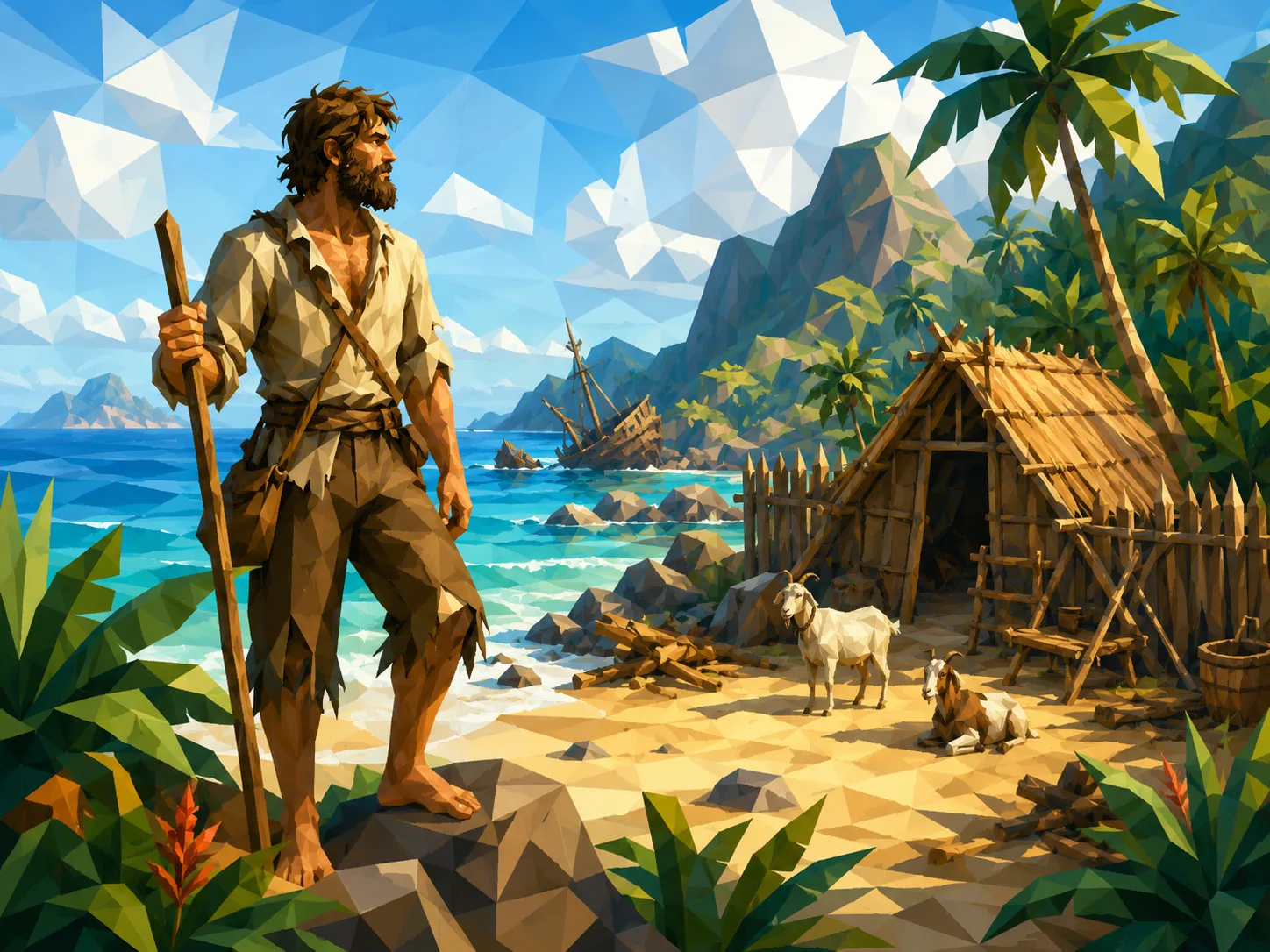
It would have made a philosopher smile to see me and my little family sitting down to dinner. There I was, the prince and lord of the entire island, with the lives of all my subjects under my absolute command. I could grant liberty or take it away as I pleased, and there were no rebels among those I ruled. I dined like a king, attended by my faithful servants! Poll, who was my favorite, was the only one permitted to speak to me. My dog, who had grown old and feeble, sat always at my right hand, while two cats sat on either side of the table, hoping for a small piece of meat from my hand as a mark of special favor.
These were not the same two cats I had originally brought from the ship; those had died years ago and I had buried them near my home. However, they had left descendants behind, and I had kept these two as pets. The rest of their kind had run wild in the woods and eventually became such a nuisance—stealing my food and entering my house—that I was forced to shoot many of them until they finally left me alone. In this plentiful manner I lived, wanting for nothing except human society; however, the time was coming when I would have more of that than I desired.
As I have mentioned, I was becoming impatient to use my boat again, though I was very reluctant to take any unnecessary risks. Sometimes I would sit for hours planning how to bring the boat around the island, while at other times I felt perfectly content to leave it where it was. Nevertheless, a strange restlessness grew in my mind. I wanted to return to the point of the island where I had last climbed the hill to observe the currents. This desire increased every day until I finally resolved to travel there by land, following the edge of the shore.
If anyone in England had met me on my journey, they would have either been terrified or burst into laughter. As I stood still to look at my reflection in the water, I could not help but smile at the thought of traveling through the English countryside in such an outfit. Let me describe my appearance to you.
I wore a tall, shapeless cap made of goat-skin, with a flap hanging down the back to protect my neck from the sun and to stop the rain from running down my collar. In this climate, there is nothing more harmful than getting wet under one's clothes. I had a short jacket of goat-skin, which reached down to the middle of my thighs, and a pair of open-kneed breeches made from the skin of an old male goat. The hair on these breeches was so long that it reached my mid-calf, almost like traditional trousers. I had no shoes or stockings, but I had fashioned a pair of crude coverings for my feet and legs, which laced up at the sides like rough boots.
I wore a broad belt of dried goat-skin, which I fastened with two leather straps instead of buckles. Hanging from this belt, where a sword might normally be, were a small saw and a hatchet. I had a second, narrower belt over my shoulder, which held two pouches—one for my gunpowder and the other for my lead shot. On my back, I carried a large basket; on my shoulder, I carried my gun; and over my head, I held a massive, clumsy umbrella made of goat-skin. Despite its appearance, the umbrella was the most essential thing I possessed, second only to my gun.
As for my face, my skin was not as dark as one might expect for a man living so close to the equator. I had once allowed my beard to grow very long, but since I possessed scissors and razors, I eventually cut it short, except for the hair on my upper lip. This I had trimmed into a large pair of moustaches in the Turkish style, like those I had seen in Sallee. They were not long enough to hang a hat on, but they were monstrous enough in shape and size that they would have been considered frightening in England.
However, my appearance was of little consequence since there was no one to see me. In this gear, I set out on a journey that lasted five or six days. I traveled along the shore toward the place where I had previously anchored my boat. Having no boat to manage this time, I took a shorter route across the land to reach the same high ground I had stood on before. Looking out at the rocks I had once struggled to sail around, I was astonished to see the sea perfectly calm and still. There were no ripples and no currents at all.
I was confused by this and decided to stay a while to observe the tides. I soon realized that the current was caused by the ebbing tide from the west joining with the flow of a great river on the mainland. Depending on the wind, this current moved closer to or farther from the shore. By evening, when the tide went out, I saw the current reappear, though this time it was nearly a mile out at sea. When I had been in my boat, it had been much closer to the shore, which was why I had been swept away.
This observation convinced me that if I watched the tides carefully, I could easily bring my boat back. But when I thought of trying it, I was filled with such terror at the memory of my previous danger that I could not bring myself to do it. Instead, I made a safer, though more difficult, decision: I would build a second canoe. That way, I would have one boat for each side of the island.
By this time, I had two "plantations" on the island. The first was my fortified tent under the rock, which I had expanded into several connected caves. The largest and driest of these was filled with my large earthen pots and fifteen great baskets containing my stores of corn. The wall I had built with stakes had grown into a thick row of trees, so dense that no one could have guessed there was a house behind it. Near this dwelling were my cornfields, which I kept well-cultivated.
My second home was my "country seat" at the bower. I kept the surrounding hedge in good repair and the trees trimmed so they would grow thick and provide a pleasant shade. In the middle of this stood my tent, made from a ship's sail. Inside, I had a couch made of animal skins and blankets. This was where I stayed whenever I was away from my main castle. Next to the bower were my enclosures for the goats. I had worked incredibly hard to make these fences secure, sticking small stakes so close together that a hand could barely fit between them. When these stakes took root and grew, they became a living wall stronger than any stone.
All this proves that I was never idle. I spared no effort to ensure I had a constant supply of meat, milk, butter, and cheese. I knew that as long as I kept my enclosures secure, I would have everything I needed, even if I were to stay on the island for forty years. In this area, I also grew my grapes, which were a vital part of my diet—not only delicious but also very healthy.
One day, at about noon, as I was walking toward my boat, I was suddenly frozen with fear. There, plain as day on the sand, was the print of a man’s naked foot. I stood there as if I had seen a ghost. I listened, I looked around, but I could hear and see nothing. I climbed a hill to look further, and I walked up and down the shore, but I found no other footprints.
I returned to the mark to see if it might have been my imagination, but there was no mistake. It was definitely a footprint—toes, heel, and the shape of the sole were all perfectly visible. I could not imagine how it had gotten there. Confused and terrified, I hurried back to my fortification. I felt as if my feet weren't even touching the ground. Every few steps, I looked behind me, mistaking every bush for a man and every tree stump for a person.
When I reached my "castle," I disappeared inside like a frightened animal fleeing to its hole. I did not sleep at all that night. My fear grew even though I was far away from the beach. At first, I thought it might be the devil, but I soon realized that made little sense. Why would the devil leave a single footprint in the sand, in a place where I might never see it, and where the tide would soon wash it away?
I eventually concluded that it must have been some of the savages from the mainland. I imagined they had wandered out to sea in their canoes and been driven to my island by the currents. I felt a surge of gratitude that I had not been on the beach when they landed, and that they had not seen my boat. If they had, they would have known someone was living here and would surely have searched for me. Terrible thoughts filled my mind—I feared they would return in greater numbers to devour me, destroy my crops, and steal my goats.
In my terror, I forgot all my religious hope and my confidence in God. I reproached myself for being lazy and for only growing enough corn for one year. I resolved that in the future, I would always have two or three years’ worth of grain in storage so that I would not starve if my fields were destroyed.
How strange and inconsistent human life is! Only a short time ago, my greatest sorrow was being cut off from mankind. I felt that seeing another human being would be the greatest blessing God could grant me. Yet now, at the mere shadow of a man’s footstep, I was trembling with fear.
After several days, I began to recover from my initial shock. I realized that I must submit to God's will and that He who had protected me so far was capable of delivering me from this new danger. These thoughts occupied me for weeks. One morning, feeling particularly anxious, I remembered a verse from the Bible: "Call upon Me in the day of trouble, and I will deliver thee." This gave me great comfort. I picked up my Bible and opened it to these words: "Wait on the Lord, and be of good cheer, and He shall strengthen thy heart." After reading this, I felt much more at peace.
One day, it occurred to me that I might have been frightened by nothing. What if the footprint was actually my own? This thought cheered me up, and I began to tell myself that I was being foolish. I had not left my castle for three days and nights, and I was starting to run out of food. Furthermore, my goats needed milking, and the poor creatures were in pain because I had neglected them.
I encouraged myself to go back outside and return to my country house. However, as I walked, I was still incredibly nervous, constantly looking behind me. To be certain, I decided to go back to the shore to measure the footprint against my own. But when I arrived at the spot, I realized two things: first, that I had not been anywhere near that part of the beach when I unloaded my boat; and second, when I placed my foot next to the print, I saw that mine was much smaller.
Fear took hold of me once again. I was convinced that the island was inhabited and that I could be attacked at any moment. In my panic, I came up with several ridiculous plans. I thought about tearing down my enclosures and letting my goats run wild so the savages wouldn't find them. I considered digging up my cornfields and destroying my bower so there would be no sign of any inhabitant.
That night was filled with anxiety. I realized that the fear of danger is often much more terrifying than the danger itself. I felt as if God had forsaken me because I had stopped trusting in His providence. However, after a sound sleep, I began to think more rationally. I concluded that even if savages did occasionally land on the island, they probably didn't stay long. They were likely driven here by the wind and would leave as soon as possible to return to the mainland. My task was to create a safer retreat in case they ever did return.
I realized that the door I had made in my cave was a weakness, as it led outside my main wall. To fix this, I decided to build a second fortification. I built a semicircular wall a short distance from my original one, using a row of trees I had planted years before. I thickened this wall with timber and old cables, and I created seven small holes through which I could point my muskets. I mounted the seven guns I had saved from the ship onto frames, like cannons, so that I could fire them all in a matter of minutes.
I spent many months finishing this wall, and then I planted nearly twenty thousand stakes in the ground outside it. Over the next few years, these grew into a wood so thick that it was completely impassable. No one could have imagined that a house lay behind it. I left no doors or paths; instead, I used two ladders to get in and out. By taking the ladders down, I ensured that no one could reach me without great difficulty.
I took every precaution that human wisdom could suggest for my preservation. As it turned out, my fears were not entirely groundless, though at the time, I was acting purely out of terror.