


Theme & Story
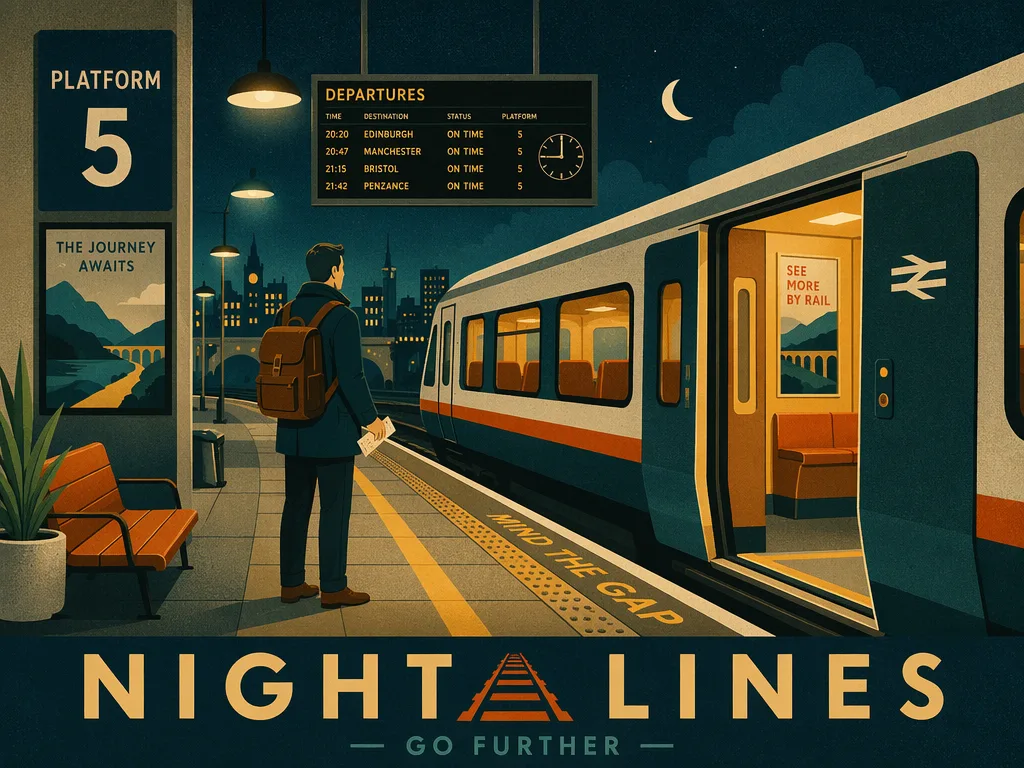
“The Station Glow” is a practical, upbeat travel song built around the experience of using public transport. The narrator walks into a terminal, checks timetables, buys a ticket, finds the correct platform, boards a train or bus, and eventually reaches the final destination.
For language learners, the song is especially useful because it tells a clear everyday story: planning a journey, buying a ticket, asking polite questions, checking information, and following transport instructions.
Metaphors & Meaning
On the surface, the lyrics are about public transportation. But the journey can also be read as a simple metaphor for moving forward in life.
- “One-way ticket, a journey to find” suggests going toward something new, perhaps without planning to return to the old situation.
- “Leaving the station, leaving worries behind” connects travel with emotional release. The station becomes a place where the speaker can start fresh.
- “Departures and arrivals” can symbolize beginnings and endings: people leaving, people returning, and life constantly moving.
- “Mind the gap” is a real safety announcement in train stations, especially famous in the London Underground. Figuratively, it can also mean: be careful during transitions, pay attention to the space between where you are and where you are going.
- terminal: a large station or building where buses, trains, or planes arrive and depart.
- timetable: a schedule showing departure and arrival times.
- “if you know what I mean”: a conversational phrase used to suggest shared understanding. Here it feels playful rather than secretive.
- ticket office: the place where you buy tickets.
- single or return: British English. A single is a one-way ticket; a return is a round-trip ticket.
- student fare: a cheaper ticket price for students.
- departure: the time when transport leaves.
- platform: the area where passengers wait for a train.
- Mind the gap: a common warning meaning “be careful of the space between the train and the platform.”
- destination: the place you are going to.
- overhead rack: a shelf above the seats for bags or luggage.
- pass: a travel card or ticket that allows you to ride.
- transfer: changing from one train, bus, or route to another.
- conductor: a railway worker who may check tickets and help passengers.
- validate the fare: check or confirm that the ticket/payment is correct.
- delay: when transport is late.
- express: a faster train or bus that stops less often.
- top-notch: informal phrase meaning excellent or very high quality.
- end of the line: literally the final stop; figuratively, the end of a process or journey.
- Present continuous for current actions: “I’m walking,” “looking,” “checking,” and “standing” describe actions happening now. This is useful for narrating a live experience.
- Short conversational answers: “A single or a return?” – “I’ll be just fine.”
- Imperatives for instructions: “Mind the gap,” “Check your destination,” “Put your luggage,” “Step on the bus,” and “Please exit the train” are command forms. They are common in signs, announcements, and travel situations.
- Polite question form: “Excuse me, is this seat taken?” is a very useful phrase. “Excuse me” softens the question and makes it polite.
- Ellipsis and repetition in lyrics: “Mind the gap...” and “Safe travels...” are incomplete sentence-like phrases, but they work musically. Songs often repeat short expressions to create rhythm and atmosphere.
- British English travel vocabulary:
The repeated phrase “Mind the gap...” gives the song a rhythmic, almost hypnotic feeling, like an announcement echoing through a station.
Vocabulary & Slang
Grammar Notes
Real speech often uses short, indirect responses. The answer is not a full grammatical reply to the question, but it sounds natural in a lyric.