


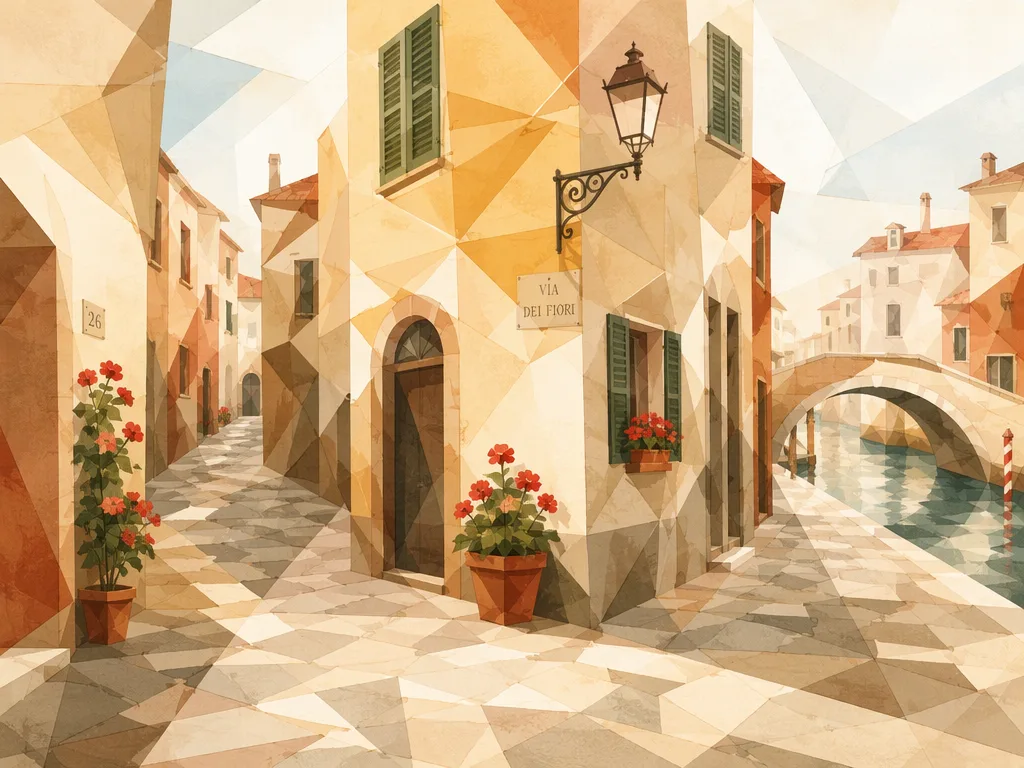
Finding Your Way in Town

Veřejná
•
10. listopadu 2026
Generujeme zvuk výslovnosti…
Může to chvíli trvat. Mezitím si klidně prozkoumejte další části sady.
0
Poslech a opakování
Přidejte alespoň 2 kartičky Voca a odemkněte Poslech a opakování i procvičování s audiem.
Ask for and understand directions in the street when you are looking for a place in an Italian town.
- Polite openings: address strangers with the polite Lei form, such as Scusi, and understand polite commands like vada (go) and giri (turn).
- Everyday places: ask for a square, the station, a pharmacy or a bus stop.
- Clear directions: catch the common phrases for straight ahead, left, right, nearby and a few minutes on foot.
Kartičky Voca
1.
Scusi.
→ scusare
Excuse me.
Scusi, mi può aiutare?
Excuse me, can you help me?
Used to politely get a stranger's attention ('Excuse me'). It is the polite 'Lei' form of 'scusare'.
2.
Mi sono perso.
I'm lost.
Mi sono perso, non trovo il mio albergo.
I'm lost, I can't find my hotel.
A man says 'Mi sono perso'; a woman says 'Mi sono persa'.
3.
cercare
to look for
Cerco via Roma, è da queste parti?
I'm looking for Via Roma, is it around here?
In Italian, 'cercare' already includes the 'for' in 'look for', so no preposition follows it.
4.
Dov'è…?
Where is…?
Scusi, dov'è il centro?
Excuse me, where is the town center?
Short for 'dove è'. For plural things, use 'Dove sono…?'.
5.
la piazza
square, plaza
Dov'è la piazza principale?
Where is the main square?
6.
la stazione
station, train station
Scusi, per andare alla stazione?
Excuse me, how do I get to the station?
'Per andare a…?' or simply 'Per la stazione?' is a very natural way to ask the way to a place.
7.
la farmacia
pharmacy, drugstore
C'è una farmacia aperta?
Is there a pharmacy open?
8.
la fermata dell'autobus
bus stop
Dov'è la fermata dell'autobus per la stazione?
Where is the bus stop for the station?
You can also simply say 'la fermata' when it is clear that you mean the bus.
9.
vicino
nearby, close
C'è un bar qui vicino?
Is there a café nearby?
'Qui vicino' means 'near here' or 'nearby'.
10.
lontano
far, far away
Il museo è lontano da qui?
Is the museum far from here?
11.
a piedi
on foot
È vicino, sono cinque minuti a piedi.
It's close, it's a five-minute walk.
Italians usually give walking distance in minutes rather than metres: 'Sono cinque minuti a piedi'.
12.
sempre dritto
straight ahead
Vada sempre dritto per questa via.
Go straight ahead down this street.
'Vada' ('Go…') is the polite 'Lei' command form of 'andare', which you will often hear in directions.
13.
a destra
on the right, to the right
La banca è lì, a destra.
The bank is over there, on the right.
14.
a sinistra
on the left, to the left
Il bar è qui a sinistra.
The café is right here on the left.
15.
girare
to turn
Dopo la chiesa, giri a destra.
After the church, turn right.
'Giri' ('Turn…') is the polite 'Lei' command form of 'girare'.
16.
il semaforo
traffic light
Al semaforo, giri a sinistra.
At the traffic light, turn left.
17.
l'incrocio
intersection
All'incrocio, vada a destra.
At the intersection, go right.
18.
l'angolo
corner
La farmacia è proprio all'angolo.
The pharmacy is right on the corner.
'All'angolo' means 'at the corner' or 'on the corner'.
19.
di fronte a
across from, in front of
La fermata è di fronte alla stazione.
The bus stop is across from the station.
'A' combines with the article that follows: 'di fronte al museo', 'di fronte alla stazione'.
20.
Grazie mille.
Thank you very much.
Grazie mille, buona giornata!
Thank you very much, have a nice day!