


By now it was growing dark and snowing heavily. As Scrooge and the Spirit moved along the streets, the bright fires roaring in kitchens and parlors everywhere were wonderful to see. Behind some windows, plates stood warming by the hearth for a cozy dinner, while heavy red curtains waited to be drawn against the cold and darkness. Outside other houses, children ran into the snow to be the first to greet arriving aunts, uncles, brothers, and cousins. Guests' shadows moved across bright window blinds, and groups of laughing young women in hoods and fur boots hurried along the snowy walks to neighbors' parties. The Ghost opened his broad hands and poured harmless joy over everything within his reach. Even the lamplighter, running ahead to dot the darkening street with specks of light before heading to his own evening celebration, laughed aloud as the Spirit passed—never guessing he had Christmas himself for company!
Then, without warning, they left the city behind for far-off places where winter seemed to rule the earth. First they stood on a bare, freezing moor scattered with huge rocks; yet inside a mud-and-stone hut, an old miner and his wife sat beside a glowing fire with generations of children and grandchildren in holiday clothes, singing an old Christmas song as the wind howled outside. Speeding onward across dark, crashing waves, they reached a lonely lighthouse built on sunken rocks far from shore, where two weather-beaten keepers warmed their rough hands by a small fire, wished each other Merry Christmas over their hot drinks, and sang bravely against the storm. Again the Spirit flew across the black ocean until, miles from any land, they stood upon a ship in the night; and there the man at the wheel, the lookout at the front of the ship, and the officers on watch all hummed a Christmas tune or spoke softly of home, sharing kinder words than on any other day of the year.
Scrooge was listening to the moaning wind and thinking how solemn it felt to move through the darkness above the deep, unknown sea, when suddenly he heard a hearty laugh. Even greater was his surprise when he recognized it as his own nephew's—and found himself standing in a bright, warm, dry room, with the Spirit smiling happily beside him.
"Ha, ha!" laughed Fred. "Ha, ha, ha!"
If you ever happen to meet a man blessed with a better laugh than Scrooge's nephew, all I can say is, introduce him to me, and I will make friends with him at once. Nothing in this world spreads faster than real, hearty laughter. As Fred held his sides, shook his head, and laughed until his face twisted, his pretty young wife laughed just as hard, and all their gathered friends roared along with them.
"He said Christmas was a humbug, as sure as I live!" cried Fred. "And he believed it too!"
"More shame for him, Fred!" said his wife warmly, though she could hardly stop smiling with her bright eyes and pretty dimpled chin.
"He's a comical old fellow," said Fred, "that's the truth, and not as pleasant as he might be. Still, his bad moods are their own punishment, and I have nothing to say against him."
"I'm sure he's very rich, Fred," his wife hinted. "At least you always tell me so."
"What good does it do him, my dear?" said Fred. "He doesn't do any good with his money. He doesn't even make himself comfortable with it. He doesn't even get the satisfaction of thinking—ha, ha, ha!—that he is ever going to benefit us with it!"
"I have no patience with him," said Fred's wife, and her sisters and all the other women in the room agreed at once.
"Oh, I have!" said Fred. "I am sorry for him. I couldn't be angry with him if I tried. Who suffers from his foolish moods? Always himself. Here he takes it into his head to dislike us and won't come and dine with us. What happens? He doesn't miss much of a dinner, anyway."
"Indeed, I think he misses a very good dinner!" interrupted his wife. Everyone else said the same—and they knew what they were talking about, for they had just finished dinner and were sitting around the fire with dessert by lamplight.
"Well, I'm very glad to hear it," said Fred cheerfully, "because I don't have much faith in these young housekeepers! What do you say, Topper?"
Topper clearly had his eye on one of Fred's wife's sisters—the plump sister wearing a lace collar, not the one with roses in her hair—for he answered that a single man was a miserable outcast with no right to express an opinion on the matter. At that, the plump sister blushed brightly.
"Do go on, Fred," cried Fred's wife, clapping her hands. "He never finishes what he begins to say! He is such a ridiculous fellow!"
Fred burst into another laugh, and even though the plump sister tried hard not to join in, soon everyone was laughing together again.
"I was only going to say," Fred went on, "that when he dislikes us and refuses to share our Christmas, he loses some pleasant hours that could do him no harm. He certainly loses better companions than he finds in his own thoughts, either in his moldy old office or his dusty rooms at home. I mean to give him the same chance every year, whether he likes it or not, because I pity him. He can complain about Christmas until he dies, but he can't help thinking better of it if I walk in smiling year after year and say, 'Uncle Scrooge, how are you?' Even if it only puts him in a good enough mood to leave his poor clerk fifty pounds, that's something—and I think I shook him a little yesterday!"
Now it was their turn to laugh at the thought of Fred shaking Scrooge! Being thoroughly good-natured, Fred didn't care what they laughed at as long as they were merry, and he passed the bottle around joyfully.
After tea, they had music. They were a musical family who knew how to sing cheerful songs together—especially Topper, who could boom along in a deep bass voice without turning red in the face or straining a single vein in his forehead. Fred's wife played wonderfully on the harp, and among other pieces she played a simple little tune—nothing grand, a melody you could learn to whistle in two minutes—that had once been dear to Scrooge's little sister Fan, who had come to take him home from school. As those gentle notes filled the room, all the memories the first Spirit had shown him returned to Scrooge's mind. He softened more and more, thinking that if he could have listened to music like that years ago, he might have planted kindness and happiness in his own life long before Jacob Marley's funeral.
They did not spend the whole evening on music, however. Soon it was time for party games, and they began with blind man's buff. Of course they did! And I no more believe Topper was really blindfolded than I believe he had eyes in his boots! In my opinion, it was a clever trick planned between him and Fred, and the Ghost of Christmas Present knew it too. The way Topper chased that plump sister in the lace collar was outrageous! Knocking over the fire tools, tripping over chairs, bumping into the piano, tangling himself in the curtains—wherever she went, there went Topper! He always knew where the plump sister was, and he refused to catch anyone else. If other guests bumped straight into him on purpose, he merely pretended to grab at them and immediately sidled off toward the plump sister again. She kept crying out that it wasn't fair—and it really wasn't! When he finally caught her in a corner where she couldn't escape, his behavior was shameless: pretending he didn't know who she was, pretending he needed to touch her hair, a certain ring on her finger, and a certain necklace around her neck just to be sure! No doubt she gave him a piece of her mind later, when someone else was blindfolded and the two of them stood whispering behind the curtains.
Fred's wife did not join the running games, but sat comfortably in a large armchair with a footstool in a cozy corner, right behind which stood the Ghost and Scrooge. Yet she joined in all the sitting-down guessing games, and beat her sisters easily, clever as they were. There must have been twenty people in that room, young and old, and every single one played—and so did Scrooge! Completely forgetting that his voice made no sound in their ears, he shouted out his guesses quite loudly and very often guessed right, for his mind was still as sharp as a needle.
The Ghost was so pleased to see Scrooge in this joyful mood, and looked at him so kindly, that Scrooge begged like a boy to stay until the guests went home. But the Spirit said that could not be done.
"Here is a new game!" cried Scrooge. "Half an hour, Spirit, only one half hour!"
It was a game called Yes and No. Fred had to think of something, and the others had to guess what it was by asking questions he could only answer with "yes" or "no." Under a lively shower of questions, they discovered he was thinking of an animal—a live animal, a rather disagreeable animal, a fierce animal that sometimes growled and grunted and sometimes talked, lived in London, walked about the streets on its own, wasn't led by anyone, didn't live in a zoo, was never killed for market, and was not a horse, donkey, cow, bull, tiger, dog, pig, cat, or bear. At every fresh question, Fred burst into another roar of laughter, until he was so tickled he had to jump up off the sofa and stamp his feet. At last the plump sister, laughing just as hard, cried out:
"I've found it out! I know what it is, Fred! I know what it is!"
"What is it?" cried Fred.
"It's your Uncle Scrooge!"
Which it certainly was! Everyone cheered and clapped in admiration, though some complained that the answer to "Is it a bear?" ought to have been "Yes," since saying "No" had led their thoughts away from Mr. Scrooge.
"He has given us plenty of fun, I'm sure," said Fred, "and it would be ungrateful not to drink his health. Here is a glass of warm spiced wine ready in my hand, so I say: 'Uncle Scrooge!'"
"To Uncle Scrooge!" cried the whole room.
"A Merry Christmas and a Happy New Year to the old man, whatever he is!" said Fred. "He wouldn't take it from me, but may he have it all the same. Uncle Scrooge!"
Scrooge had grown so light of heart that he would gladly have raised a glass in return and thanked the unsuspecting company in a speech nobody could hear, if the Spirit had given him time. But on Fred's last word, the whole scene vanished, and Scrooge and the Ghost were on their travels again.
Much they saw, far they went, and many homes they visited—always leaving comfort behind. The Spirit stood beside sickbeds, and the sick grew hopeful; in distant lands, and lonely people felt close to home; beside struggling workers, and they found strength; beside the poor, and they felt rich. In charity houses, hospitals, and prisons—every place of misery where proud people had not locked the door against him—he left his blessing and taught Scrooge his lessons.
It was a long night, or perhaps many holiday days pressed into one, for Scrooge noticed something strange. While Scrooge himself stayed unchanged, the Ghost was growing older—clearly older. Scrooge watched this change in silence until, leaving a children's Twelfth Night party and standing together in an open square, he saw that the Spirit's hair had turned gray.
"Are spirits' lives so short?" asked Scrooge.
"My life on this earth is very brief," replied the Ghost. "It ends tonight."
"Tonight!" cried Scrooge.
"Tonight at midnight. Listen—the time is drawing near."
Just then, the bells rang out for a quarter to twelve.
"Forgive me if I shouldn't ask," said Scrooge, looking closely at the Spirit's robe, "but I see something strange sticking out from beneath your robe that doesn't belong to you. Is it a foot or a claw?"
"It might well be a claw, for all the flesh there is upon it," the Spirit answered sorrowfully. "Look here."
Parting the folds of his green robe, he brought out two children—wretched, ragged, starving, and dreadful to see. They knelt at his feet and clung to the outside of his garment.
"Oh, man! Look here!" exclaimed the Ghost. "Look down here!"
They were a boy and a girl, yellow-skinned, thin, dressed in rags, scowling fiercely like wolves yet crushed down in helplessness. Where childhood should have filled out their cheeks and brightened their eyes, harsh poverty had pinched and twisted them into bitter old shapes. Scrooge stepped back in horror. Seeing them shown like this, he tried to say they were fine children, but the words stuck in his throat; it would have been too terrible a lie.
"Spirit, are they yours?" was all Scrooge could say.
"They belong to mankind," said the Ghost, looking down at them. "And they cling to me, begging for the help that mankind has refused them. This boy is Ignorance. This girl is Want. Beware of them both, and all like them—but most of all beware this boy, for on his forehead I see doom written, unless that writing is erased. Deny it!" cried the Spirit, stretching a hand toward the city. "Call those who warn you liars, use their misery for your own selfish quarrels, and wait for the end!"
"Have they no place to go?" cried Scrooge. "No refuge or help?"
"Are there no prisons?" said the Spirit, turning Scrooge's own words on him for the very last time. "Are there no workhouses?"
The bell struck twelve.
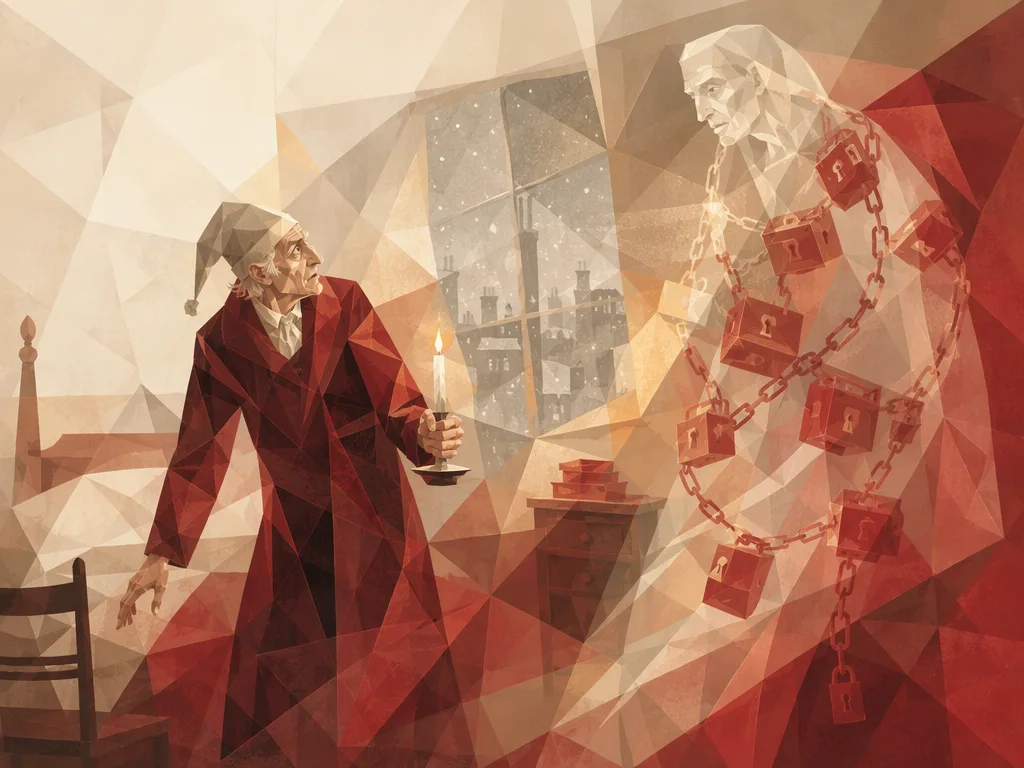
Scrooge looked around for the Ghost, and saw him no more. As the last stroke faded from the air, Scrooge remembered Jacob Marley's warning. Lifting his eyes, he saw a dark, hooded figure drifting toward him along the ground like a mist.