


Turning around, we saw a small, rat-faced man standing right in the circle of yellow light thrown by the hanging lamp. Framed in the doorway of his stall, Breckinridge was shaking his fists fiercely at the cowering figure.
"I've had enough of you and your geese!" he shouted. "You can all go to the devil! If you come bothering me again with your silly talk, I'll set the dog on you. Bring Mrs. Oakshott here and I'll answer her, but what business is it of yours? Did I buy the geese from you?"
"No, but one of them was mine all the same," whined the little man.
"Well then, ask Mrs. Oakshott for it."
"She told me to ask you."
"Well, you can ask the King of Prussia for all I care! I've had enough of it. Get out of here!" Breckinridge rushed forward angrily, and the stranger slipped away into the darkness.
"Ha! This may save us a journey to Brixton Road," whispered Holmes. "Come with me, and we will see what we can make of this fellow."
Striding past the scattered groups of people around the brightly lit stalls, Holmes quickly caught up with the little man and tapped him on the shoulder. He spun around, and even in the gaslight I could see every trace of color drain from his face.
"Who are you, then? What do you want?" he asked in a trembling voice.
"You will excuse me," said Holmes politely, "but I could not help overhearing the questions you asked the seller just now. I think I could be of help to you."
"You? Who are you? How could you know anything about it?"
"My name is Sherlock Holmes. It is my business to know what other people don't know."
"But you can know nothing about this!"
"Excuse me, I know everything about it. You are trying to trace some geese that were sold by Mrs. Oakshott of Brixton Road to a seller named Breckinridge, sold by him to Mr. Windigate of the Alpha Inn, and given by him to his club, where Mr. Henry Baker is a member."
"Oh, sir, you are the very man I have longed to meet!" cried the little fellow, stretching out his trembling hands. "I can hardly tell you how eager I am to find out about this."
Holmes hailed a passing cab. "In that case, we had better talk about it in a cozy room rather than in this windy market," he said. "First, though, please tell me whom I have the pleasure of helping."
The man hesitated for a moment, glancing sideways. "My name is John Robinson," he answered.
"No, no; the real name," said Holmes sweetly. "It is always awkward doing business under a false name."
A flush rose in the stranger's pale cheeks. "Well then," he said, "my real name is James Ryder."
"Precisely so. Head attendant at the Hotel Cosmopolitan. Please step into the cab, and I will soon be able to tell you everything you wish to know."
The little man stood looking from one to the other of us with eyes half frightened and half hopeful, like a man unsure whether he stands on the edge of good fortune or total ruin. Then he climbed into the cab, and in half an hour we were back in the sitting room at Baker Street. Not a word was spoken during the drive, yet our companion's quick, shallow breathing and the constant twisting of his hands showed the nervous strain inside him.
"Here we are!" said Holmes cheerfully as we walked into the room. "The fire looks welcome in this weather. You look cold, Mr. Ryder. Please take this chair. Let me just put on my slippers before we settle this little business of yours. Now, then! You want to know what became of those geese?"
"Yes, sir."
"Or rather, I suspect, of one particular goose. It was one bird you were interested in—white, with a black bar across its tail."
Ryder shook with emotion. "Oh, sir," he cried, "can you tell me where it went?"
"It came here."
"Here?"
"Yes, and a most remarkable bird it turned out to be. I don't wonder that you took such an interest in it. It laid an egg after it was dead—the brightest little blue egg that ever was seen. I keep it here in my collection."
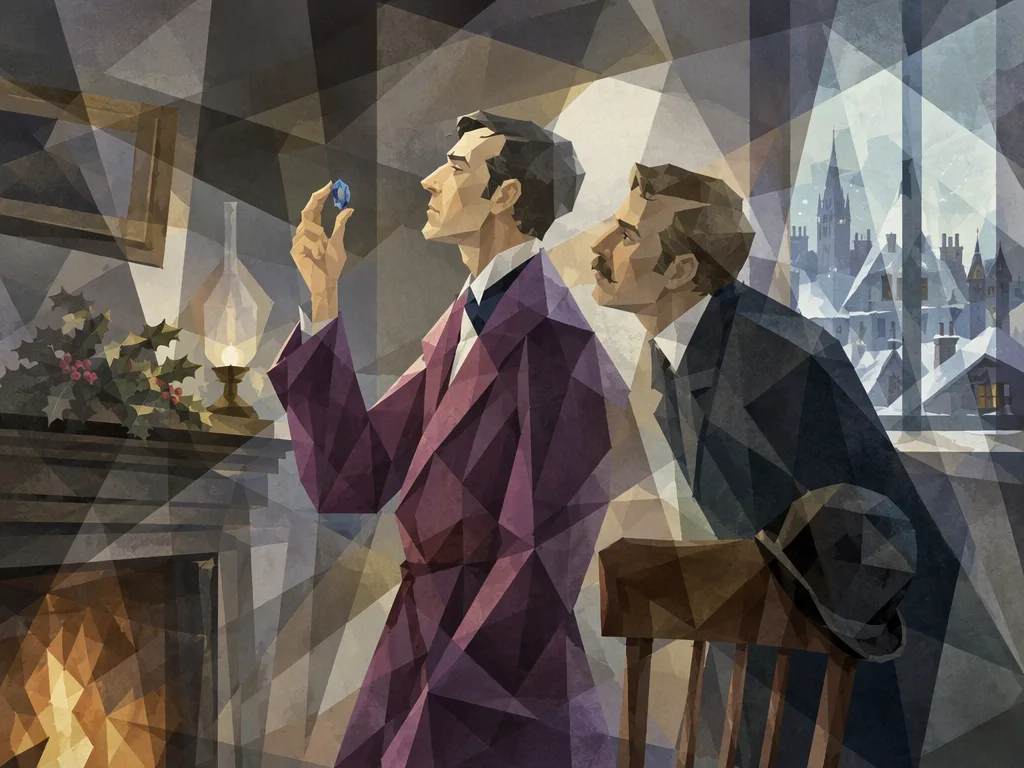
Our visitor staggered to his feet and gripped the mantelpiece with his right hand. Holmes unlocked his strongbox and held up the blue carbuncle. It shone like a star, with a cold, brilliant light.
Ryder stood staring with a tight, pale face, uncertain whether to claim the stone or deny all knowledge of it.
"The game's up, Ryder," said Holmes quietly. "Steady, man, or you'll fall into the fire! Help him back into his chair, Watson. He doesn't have the nerve to carry off serious crime. Give him a splash of brandy. There! Now he looks a little more human. What a weak little creature he is, to be sure!"
Ryder had nearly collapsed, but the brandy brought a hint of color back to his cheeks. He sat staring in terror at his accuser.
"I hold almost every link in my hands, and all the proof I could possibly need," Holmes said, "so there is little left that you must tell me. Still, we may as well clear up that little bit to make the whole story complete. You had heard about this blue stone of the Countess of Morcar's?"
"It was Catherine Cusack who told me about it," Ryder replied in a dry, cracking voice.
"I see—her ladyship's maid. The temptation of sudden wealth so easily gained was too much for you, as it has been for better men before you. Yet you showed no mercy in the means you chose. It seems to me, Ryder, that there is the making of an ugly villain in you. You knew that this plumber, Horner, had been in prison for robbery before, and that suspicion would fall on him all the more easily. So what did you do? You arranged some small repair job in the lady's room—you and your partner Cusack—and made sure Horner was the man sent for. Then, once he had left, you broke open the jewel box, raised the alarm, and had that unlucky man arrested. After that—"
Ryder suddenly threw himself down onto the rug and grabbed Holmes's knees. "For God's sake, have mercy!" he shrieked. "Think of my father! Think of my mother! It would break their hearts! I never went wrong before! I never will again! I swear it—I'll swear it on a Bible! Oh, don't take it into court! For heaven's sake, don't!"
"Get back into your chair!" said Holmes sternly. "It is easy to beg and crawl now, yet you thought little enough of poor Horner standing in court for a crime he knew nothing about."
"I will run away, Mr. Holmes! I will leave the country, sir! Then the charge against him will fall apart."
"Hmm. We will talk about that. First, let us hear a true account of the next part. How did the stone get inside the goose, and how did the goose reach the market? Tell us the truth, for your only hope of safety lies there."
Ryder ran his tongue across his dry lips. "I will tell you just as it happened, sir," he said. "Once Horner was arrested, I felt I had to get away with the stone right away, because I never knew when the police might decide to search me and my room. Nowhere in the hotel felt safe. I went out as if on an errand, and headed straight for my sister's house. She married a man named Oakshott and lives in Brixton Road, where she raises poultry for the market. All the way there, every man I met looked like a policeman or a detective to me. Even though it was a bitter night, sweat was pouring down my face before I reached Brixton Road. My sister asked what was wrong and why I was so pale, and I told her the jewel robbery at the hotel had shaken me. Then I went into the backyard, smoked a pipe, and wondered what to do next.
"I have an old friend named Maudsley who fell into bad ways and just got out of prison. We had once talked together about thieves and how they got rid of stolen goods. I knew Maudsley would keep my secret, because I knew one or two things about him too. So I decided to go straight on to Kilburn, where he lived, and trust him with the whole affair. He could show me how to turn the stone into money. But how was I to carry it there safely? I thought of the terror I had felt on the walk from the hotel. At any moment I might be stopped and searched, with the stone sitting in my vest pocket. I was leaning against the wall and watching the geese waddle around my feet when an idea suddenly struck me—a plan that would beat the cleverest detective alive.
"Some weeks earlier, my sister had told me I could have my pick of her geese for a Christmas present, and I knew she always kept her word. I would take my goose right then, and carry the stone to Kilburn inside it! Behind a small shed in the yard, I cornered one of the birds—a big, fine white one with a black bar across its tail. I caught it, pried its beak open, and pushed the stone down its throat as far as my finger could reach. The bird gave a gulp, and I felt the stone slide down and settle inside it. Then the creature flapped and struggled, and out came my sister to see what the noise was. As I turned to speak to her, the bird broke loose and fluttered off among the others.
"'Whatever were you doing with that bird, Jem?' she asked.
"'Well,' I said, 'you promised me one for Christmas, and I was feeling which was the fattest.'
"'Oh,' she said, 'we've set yours aside for you—Jem's bird, we call it. It's that big white one over there. There are twenty-six of them: one for you, one for us, and two dozen for the market.'
"'Thank you, Maggie,' I said, 'but if it's all the same to you, I'd rather have the one I was holding just now.'
"'The other is a good three pounds heavier,' she said, 'and we fattened it especially for you.'
"'Never mind. I'll have the other, and I'll take it now,' I said.
"'Oh, just as you like,' she said, a little annoyed. 'Which one do you want, then?'
"'That white one with the black bar across its tail, right in the middle of the flock.'
"'Oh, very well. Kill it and take it with you.'
"Well, I did as she said, Mr. Holmes, and I carried the bird all the way to Kilburn. I told my friend what I had done, since he was an easy man to tell a trick like that to. He laughed until he nearly choked, and we got a knife and opened the goose. My heart turned to water, for there was no sign of the stone, and I knew some terrible mistake had happened. I left the bird behind, rushed back to my sister's, and hurried into the backyard. Not a single bird was left.
"'Where are they all, Maggie?' I cried.
"'Gone to the dealer's, Jem.'
"'Which dealer?'
"'Breckinridge, in Covent Garden.'
"'Was there another one with a black bar across its tail?' I asked. 'Just like the one I chose?'
"'Yes, Jem. There were two with barred tails, and I could never tell them apart.'
"Of course I saw it all then, and I ran as fast as my legs could carry me to this man Breckinridge. He had sold the whole lot at once, and he would not tell me a single word about where they had gone. You heard him yourselves tonight. He has answered me like that every time. My sister thinks I am going mad. Sometimes I think I am myself. And now—now I am a marked thief, without ever having touched a penny of the wealth I sold my good name for! God help me! God help me!" He buried his face in his hands and burst into bitter sobs.
A long silence fell over the room, broken only by Ryder's heavy breathing and the steady tapping of Sherlock Holmes's fingertips on the edge of the table. Then my friend stood up and threw open the door.
"Get out!" he said.
"What, sir? Oh, Heaven bless you!"
"No more words. Get out!"
No more words were needed. There was a rush, a clatter on the stairs, the bang of the front door, and the sharp sound of running footsteps fading down the street.
"After all, Watson," said Holmes, reaching up for his clay pipe, "I am not hired by the police to make up for their mistakes. If Horner were in danger, it would be another matter. However, this fellow will never appear in court against him, and the case must fall apart. I suppose that I am breaking the law, but it is just possible that I am saving a soul. This fellow will not go wrong again; he is too terribly frightened. Send him to jail now, and you make him a jailbird for life. Besides, it is the season of forgiveness. Chance has put a very strange and amusing puzzle in our way, and solving it is its own reward. If you will have the goodness to ring the bell, Doctor, we will begin another investigation, in which also a bird will be the chief feature."