


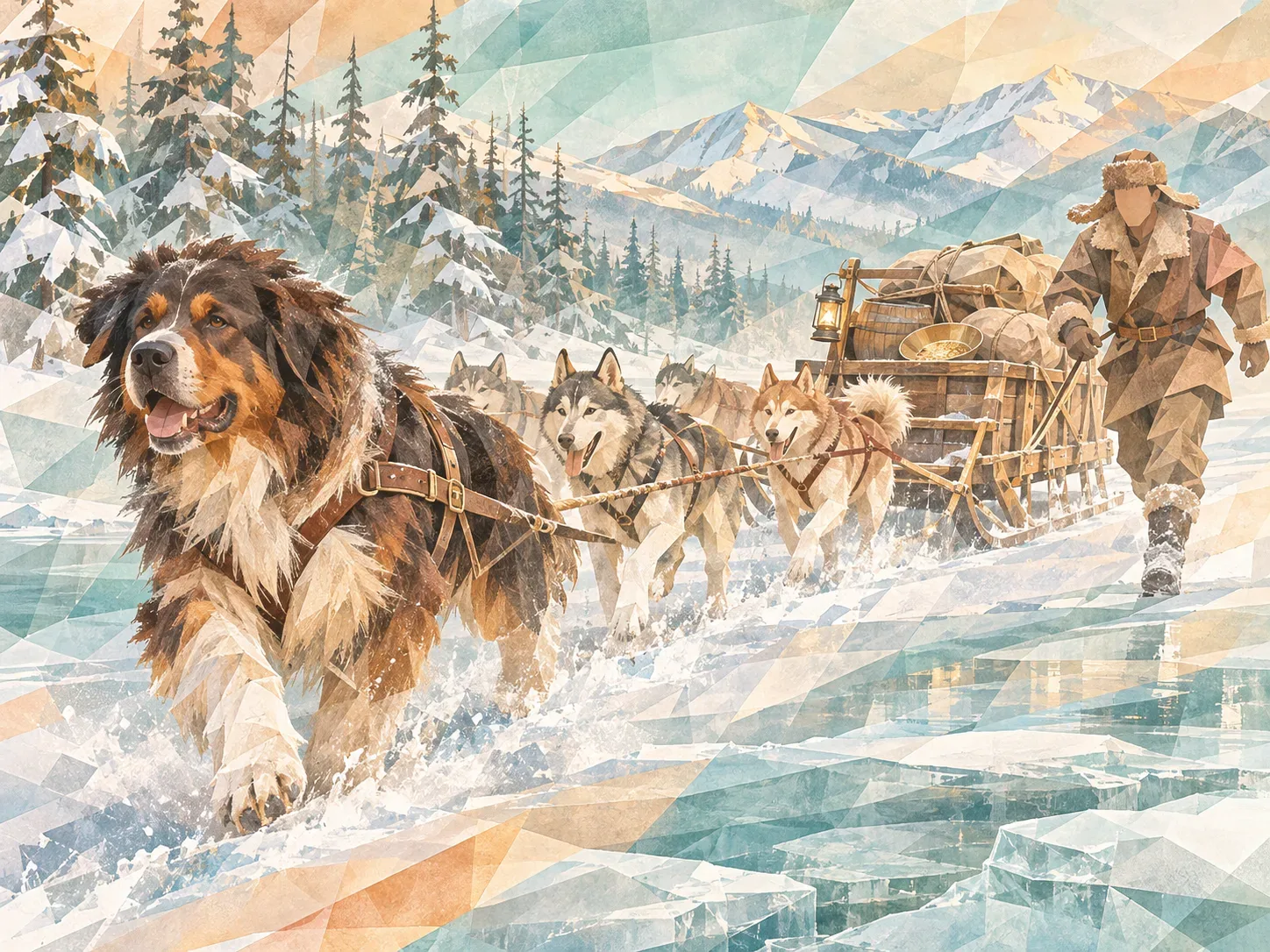
Buck did not read the newspapers, or he would have known that trouble was coming. Trouble was coming not only for him, but for every big, strong dog with thick, warm hair along the coast from Seattle to San Diego. Men searching in the dark North had found a yellow metal. Ships and trains were spreading the news, and thousands of men were rushing north. Those men wanted heavy dogs, with strong muscles for hard work and thick fur to protect them from the frost.
Buck lived in a big house in the sunny Santa Clara Valley in California. Judge Miller's place, it was called. The house stood back from the road among tall trees, with wide, cool porches around all four sides. Behind it were large stables, workers' cottages, gardens, fruit trees, and green fields. There was also a big swimming tank where the Judge's sons swam every morning and cooled off on hot afternoons.
Buck was born here, and here he had lived his four years. There were other dogs on the farm, of course, but they did not count. Twenty little fox terriers barked from the yards at Toots, the Japanese pug, and Ysabel, the Mexican hairless dog. Those two stayed inside the house, guarded by maids with brooms and mops.
Buck was neither a house dog nor a yard dog. The whole place was his. He jumped into the swimming tank and went hunting with the Judge's sons. He walked with the Judge's daughters, Mollie and Alice, in the cool morning and evening air. On winter nights he lay at the Judge's feet before the roaring library fire. He carried the Judge's grandsons on his back, rolled them in the grass, and watched over their games. He walked proudly past the terriers and ignored Toots and Ysabel, because he was king of Judge Miller's place, people included.
His father, Elmo, had been a huge St. Bernard and the Judge's faithful friend. Buck's mother, Shep, was a Scottish shepherd dog, so Buck was not as big as his father, but he still weighed one hundred and forty pounds. Hunting and swimming kept him lean and hard, and he carried himself like a king who had never known fear.
That was Buck in the fall of 1897, when the rush for gold pulled men from everywhere into the frozen North. Buck did not read the newspapers, and he did not know that Manuel, one of the gardener's helpers, was dangerous. Manuel loved to gamble, and he believed he had a system for winning, but it only lost him money. His pay as a helper was never enough for both his gambling and his wife and many children.
One evening, the Judge was away at a meeting, and his sons were busy at a sports club. Nobody saw Manuel walk Buck through the fruit trees on what Buck thought was an evening stroll. Nobody saw them reach College Park, a small railway station. A rough-looking stranger was waiting in the dark, and money clinked between their hands.
"You might tie him up before you hand him over," the stranger said roughly.
Manuel doubled a thick rope around Buck's neck under his brass collar. "Twist it, and you'll choke him plenty," he said, and the stranger grunted yes.
Buck accepted the rope calmly. It was strange, yet he trusted men he knew. When the stranger took the ends of the rope, however, Buck gave a low, threatening growl. Proudly, he believed that one growl was enough to stop the man. Instead, the rope snapped tight and cut off his breath.
In sudden rage, Buck leaped at the man. The stranger caught him by the throat, twisted skillfully, and threw Buck onto his back. Then the rope pulled tighter and tighter. Buck struggled wildly, his tongue hanging out and his wide chest fighting for air. Never in all his life had he been so badly treated, and never in all his life had he been so angry. At last his strength failed, his eyes grew dim, and he knew nothing when a train stopped and the two men threw him into the baggage car.
When Buck woke up, his tongue hurt badly, and the floor shook under him. A train whistle shrieked at a crossing. He knew that sound—he had traveled in baggage cars with the Judge many times. Buck opened his eyes, filled with the rage of a stolen king. The man grabbed for his throat, but Buck was faster. His jaws clamped onto the man's hand and held tight until the man choked him senseless again.
A train worker came running at the noise. "Yes, he has fits," the kidnapper said, hiding his bleeding hand. "I'm taking him up to San Francisco for my boss. A good dog doctor there thinks he can cure him."
Later that night, in a small shed behind a saloon on the San Francisco waterfront, the kidnapper told his story. His hand was wrapped in a bloody cloth, and his right pants leg was ripped from knee to ankle.
"All I get is fifty dollars for it," he grumbled. "And I wouldn't do it again for a thousand in cash."
"How much did the other man get?" asked the saloon-keeper.
"A hundred," the kidnapper answered. "Wouldn't take a cent less."
"That makes a hundred and fifty," the saloon-keeper said. "And he's worth it."
The kidnapper unwrapped the bloody cloth and looked at his torn hand. "If I don't get sick from this bite—"
"You'll live long enough to hang," the saloon-keeper laughed. "Here, give me a hand before you go."
Dazed and in terrible pain, Buck still tried to fight them. But they threw him down and choked him again and again while they filed through his heavy brass collar and pulled it off. Then they took off the rope and flung him into a narrow wooden crate.
There Buck lay through the weary night, nursing his anger and hurt pride. He could not understand what these strangers wanted or why they locked him in a box. Whenever the shed door rattled open, he jumped to his feet, hoping to see the Judge or his sons. Each time, only the fat face of the saloon-keeper looked in by candlelight, and the happy bark in Buck's throat turned into a fierce growl.
In the morning, four rough, dirty men carried the crate out. Buck stormed at them through the bars, and they laughed and poked sticks at him until he saw they wanted him to snap. Then he lay down in angry silence and let them lift the crate into a wagon. Over the next hours, he passed through many hands—from wagon to ferry boat, across the bay, and into an express car at a huge train station.
For two days and two nights the train dragged his car north, and for two days and two nights Buck neither ate nor drank. Because he growled at the train workers, they teased him, barking, meowing, and laughing whenever he crashed against the bars. Hunger mattered less than thirst; his dry, swollen throat burned, and the cruel treatment drove him into a fever.
One thing gave him hope: the rope was off his neck. They would never get another rope around his neck. After two days and nights of misery, his eyes turned red and wild. Not even the Judge would have known him, and the train workers breathed with relief when they finally pushed his crate off the train at Seattle.