


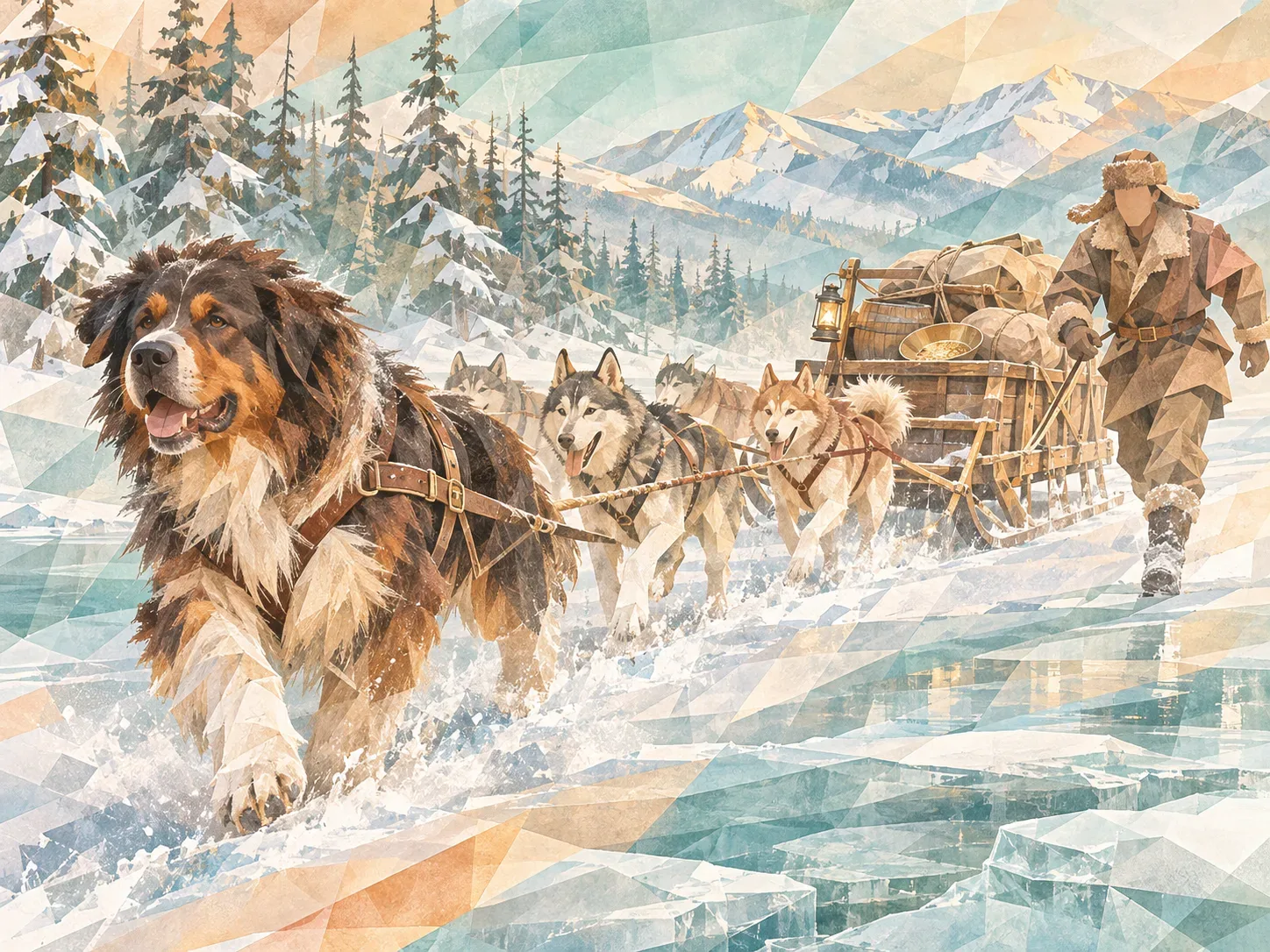
As Buck ran on, he grew more and more sure of the new stir in the land. Life was moving through the woods now, different from anything that had been there all summer. The birds talked of it, the squirrels called out about it, and even the breeze seemed to whisper warnings. Several times he stopped and sniffed the morning air deeply, catching a smell that made him leap forward faster than ever. He felt a heavy fear that something terrible was happening, or had already happened. Crossing the last ridge toward camp, he slowed down and crept with care.
Three miles from camp, he found a fresh trail that made his neck hair rise and ripple. It led straight toward camp and John Thornton. Buck hurried on silently, every sense stretched tight, reading every sign of what had happened—but the trail did not tell him how it ended. The forest had gone terribly quiet. The birds had flown away, and the squirrels were hiding. He saw only one gray squirrel, flattened tight against a dead gray branch like part of the wood.
Sliding forward like a shadow, Buck felt his nose pulled hard to one side by a sharp new smell. He followed it into the bushes and found Nick. The huge black dog lay dead on his side where he had crawled, an arrow sticking straight out from both sides of his body.
A hundred yards further on, Buck found one of the sled dogs Thornton had bought in Dawson, dying right on the trail. Buck went around him without stopping. From camp came the faint sound of many voices rising and falling in a singing chant. Creeping low to the edge of the clearing, Buck found Hans lying on his face, his body full of arrows.
In that same instant, Buck looked out at where the hut of branches had been—and saw what made the hair stand straight up on his neck and shoulders. A wave of blinding rage swept over him. He did not know he was growling, yet a terrible roar tore from his throat. For the last time in his life, fury overpowered his caution, and it was his great love for John Thornton that made him lose his head.
The Yeehats were dancing around the broken hut when they heard a fearful roar and saw a huge, terrible animal rush out of the woods at them—like nothing they had ever seen. Buck hit them like a storm. He leaped at the first man—the Yeehat chief—and tore open his throat, killing him at once. Without stopping, he sprang at a second man and killed him too. Nothing could stop him. He charged through the middle of the crowd, snapping and striking so fast that their arrows missed him completely. The hunters were packed so tightly together that they shot one another. One young hunter threw a spear at Buck in midair, and it hit another hunter in the chest and killed him.
Panic seized the Yeehats. Shouting that the Evil Spirit had come, they ran in terror toward the woods. Buck hunted them through the trees, pulling them down like deer as they ran. It was a dark day for the Yeehats. They scattered far across the country, and a week passed before those left alive met in a lower valley to count their dead.
Tired of the chase, Buck returned to the ruined camp. He found Pete dead in his blankets, killed in the first moment of surprise. The ground showed John Thornton's fierce fight, and Buck followed his smell right down to the edge of a deep pool. There lay Skeet, her head and front feet in the water, faithful to the last. The muddy pool hid what lay beneath, yet Buck followed Thornton's tracks into the water, and no tracks led away.
All day Buck sat sadly by the pool or walked restlessly around the camp. He knew what death was, and he knew John Thornton was dead. It left a great emptiness inside him, like hunger, that ached and ached and could never be filled with food.
At times, looking at the dead Yeehats, he forgot his pain and felt a fierce new pride—greater than any he had ever known. He had killed men, the greatest prey of all, and he had done it against the law of club and fang, which said that a man with a club was master. He sniffed the bodies curiously. How easily they had died! A husky dog was harder to kill than these men. Without their arrows, spears, and clubs, they were no match for him at all. From then on, he would never fear men again unless they held weapons in their hands.
Night came, and a full moon rose high above the trees, filling the valley with pale, ghostly light. As Buck watched by the pool, he felt another new life stirring in the forest, different from the Yeehats. He stood up, listening and smelling the air.
Far away drifted a faint, sharp yelp, followed by a chorus of yelps. Closer and louder they grew. Again Buck knew those cries from that other world deep in his memory. He walked to the center of the clearing and listened. It was the call—the many-voiced call—sounding clearer and stronger than ever before. And now he was ready to obey. John Thornton was dead. The last tie was broken. Man and the claims of man no longer held him.
Following the moose herds, just as the Yeehats had done, the wolf pack had crossed over from the forest country into Buck's valley. Into the moonlit clearing they poured like a silver flood. In the center stood Buck, still as stone, waiting for them.
The wolves stopped in surprise and fear at his great size and stillness. After a moment, the boldest wolf leaped straight at him. Like a flash Buck struck and broke its neck. He stood motionless again while the dying wolf rolled behind him. Three others tried it one after another, and all three jumped back bleeding from deep cuts on their throats and shoulders.
At that, the whole pack rushed forward together, crowding and blocking one another in their rush to pull him down. Buck's amazing speed saved him. Spinning on his back legs, snapping and slashing, he guarded every side at once. Still, their numbers pushed him back past the pool and down into the stream bed, until he hit a high gravel bank. He worked along it into a sharp corner that the men had cut while digging for gold. Protected on three sides, he had only to face the front.
So fiercely did he defend that corner that after half an hour the wolves gave up and drew back. All of them panted in the moonlight, their white teeth shining. Some lay down with ears forward; others stood watching him, and a few drank from the pool.
Then one wolf, long and thin and gray, stepped carefully forward in a friendly way. Buck knew him at once: it was the wild brother with whom he had run for a day and a night. The wolf whined softly, and as Buck whined back, they touched noses.
Next, an old, scarred wolf came forward. Buck pulled back his lips to snarl, then touched noses with him instead. At once the old wolf sat down, pointed his nose at the moon, and broke into the long wolf howl. The others sat down and howled too. Now the call came clear and strong. Buck also sat down and howled.
When the howl ended, Buck stepped out of his corner, and the pack crowded around him, half friendly and half fierce, sniffing him over. Then the leaders lifted the pack cry and sprang into the woods. The wolves swept in behind, yelping together—and Buck ran with them, side by side with his wild brother, yelping as he ran.
And here may well end the story of Buck. Not many years passed before the Yeehats saw a change in the timber wolves of that country. Some were seen with splashes of brown on their heads and noses, and a line of white down the center of their chests.
More wonderful still, the Yeehats tell of a Ghost Dog that runs at the head of the pack. They are afraid of this Ghost Dog, for he is more clever than they are. In fierce winters he steals from their camps, takes meat from their traps, kills their dogs, and faces their bravest hunters.
The tale grows worse. There are hunters who never return to camp, and hunters found dead with their throats torn open and wolf prints around them larger than the prints of any wolf. Every fall, when the Yeehats follow the moose herds, there is one valley they never enter. And women grow sad around the fire when they tell how the Evil Spirit chose that valley for his home.
In the summers, however, one visitor comes to that valley without the Yeehats knowing. He is a great wolf with a rich, shining coat, like other wolves and yet unlike them all. Alone he crosses from the pleasant forest country and walks into an open clearing among the trees. There a yellow stream of gold flows out from rotted bags and sinks into the earth, with tall grass growing through it and dark moss hiding it from the sun. Here he stands quietly for a time, lets out one long, sad howl, and leaves.
Yet he is not always alone. When the long winter nights come and the wolves follow their meat into the lower valleys, he may be seen running at the head of the pack through the pale moonlight or the northern lights, leaping high above the others, his great throat open as he sings a song of the younger world, which is the song of the pack.