


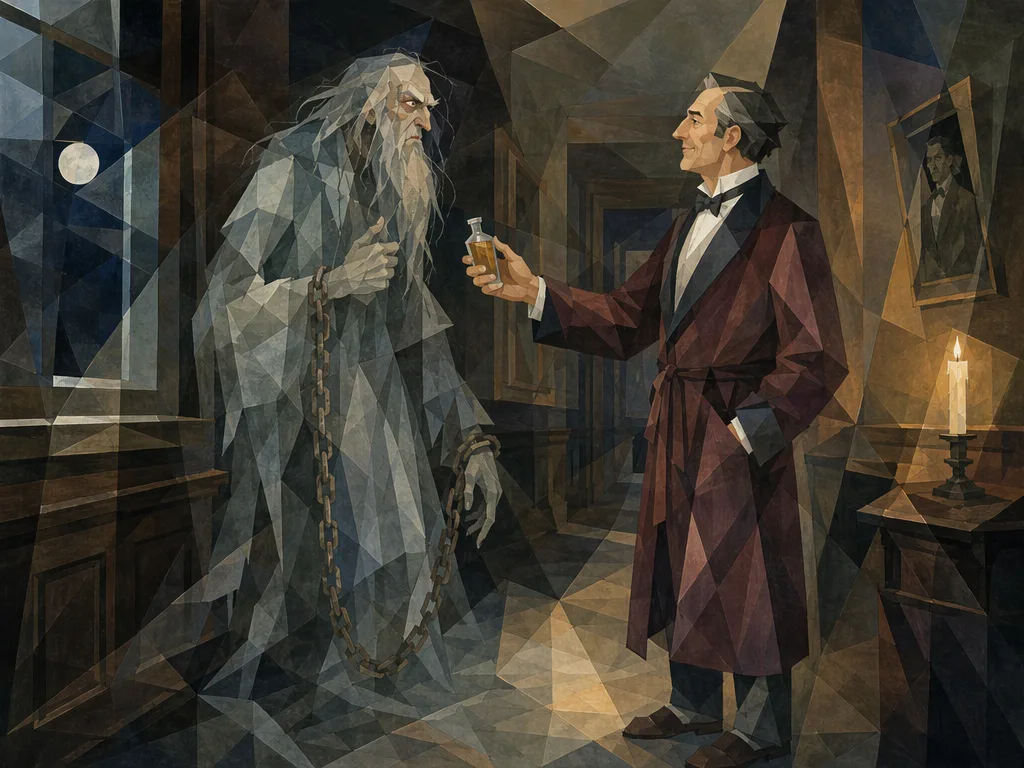
Four days after these strange events, a funeral set out from Canterville Chase at about eleven o'clock at night. The hearse was pulled by eight black horses, each wearing a great bunch of black ostrich feathers on its head. The lead coffin was covered by a rich purple cloth with the Canterville family crest sewn on it in gold. Beside the hearse and the carriages walked the servants with lighted torches, and the whole procession was wonderfully impressive.
Lord Canterville, who had come specially from Wales for the funeral, was the chief mourner and rode in the first carriage along with Virginia. Behind them came the American ambassador and his wife, then Washington, the twins, and the young Duke. In the last carriage sat Mrs. Umney. Everyone felt that since the ghost had frightened her for more than fifty years, she had a right to see the last of him.
A deep grave had been dug in a corner of the churchyard, right under the old yew tree, and the Reverend Augustus Dampier read the service in a deep, respectful voice. When the ceremony ended, following an old Canterville family custom, the servants put out their torches. As the coffin was lowered into the grave, Virginia stepped forward and laid on it a large cross made of pink and white almond blossoms.
Just as she did so, the moon came out from behind a cloud and flooded the little churchyard with quiet silver light. From a nearby wood, a nightingale began to sing. Virginia thought of the ghost's description of the Garden of Death. Her eyes filled with tears, and she hardly spoke a word during the drive home.
The next morning, before Lord Canterville returned to London, Mr. Otis asked to speak with him about the jewels the ghost had given Virginia. They were truly magnificent, especially a ruby necklace in an old gold setting. They were so valuable that Mr. Otis felt serious doubts about letting his daughter keep them.
"My lord," he said, "I know that in this country, old family property belongs to the estate and cannot simply be given away. It is quite clear to me that these jewels are, or should be, family heirlooms belonging to your estate. I must beg you, therefore, to take them to London with you as part of your property that has come back to you in strange circumstances. As for my daughter, she is only a child and, I am glad to say, has very little interest in useless luxuries. Mrs. Otis, who is an excellent judge of art, tells me these stones have great value and would sell for a very high price. Under these circumstances, Lord Canterville, I am sure you see how impossible it would be for me to let any member of my family keep them. Such fine ornaments may fit the dignity of the British aristocracy, but they would be completely out of place among people brought up on the simple principles of a republic. Perhaps I should mention that Virginia is very eager for you to let her keep the box itself as a keepsake of your unfortunate ancestor. Since the box is extremely old and somewhat damaged, perhaps you will agree to her request. For my own part, I confess I am quite surprised to find a child of mine showing any sympathy for the Middle Ages."
Lord Canterville listened seriously to the ambassador's speech, pulling his gray mustache now and then to hide a smile. When Mr. Otis finished, Lord Canterville shook his hand warmly.
"My dear sir," he said, "your charming little daughter did my unlucky ancestor, Sir Simon, a very great service. My family and I owe her deep thanks for her wonderful courage. The jewels are clearly hers. Indeed, I believe that if I were heartless enough to take them from her, the wicked old fellow would be out of his grave in two weeks, giving me no peace at all! As for their being heirlooms, nothing is an heirloom unless it is named in a will or other legal document, and nobody knew these jewels existed. I assure you I have no more claim on them than your butler does, and when Miss Virginia grows up, I am sure she will be pleased to have pretty things to wear. Besides, you forget, Mr. Otis—you bought the furniture and the ghost along with the house! Anything that belonged to the ghost became yours at once. Whatever Sir Simon may have done in the corridor at night, in the eyes of the law he was really dead, and you paid for his property."
Mr. Otis was quite upset by Lord Canterville's refusal and begged him to change his mind. However, the kind nobleman stayed firm and finally persuaded the ambassador to let Virginia keep the ghost's gift.
In the spring of 1890, when the young Duchess of Cheshire was presented to the Queen after her marriage, everyone admired her jewels. For Virginia received the coronet, which is the reward of all good little American girls, and she married her young suitor as soon as he came of age. They were both so charming, and they loved each other so much, that everyone was delighted by the match—except an old marchioness with seven unmarried daughters, who had given three expensive dinner parties trying to catch the Duke for one of them, and, strange to say, Mr. Otis himself. Mr. Otis was extremely fond of the young Duke personally, but in theory he objected to titles. In his own words, he feared that amid the soft comforts of a pleasure-loving aristocracy, the simple principles of a republic might be forgotten. Still, his objections were completely set aside, and I believe that when he walked up the aisle of St. George's, Hanover Square, with his daughter leaning on his arm, there was not a prouder man in the whole length and breadth of England.
After their honeymoon was over, the Duke and Duchess went down to Canterville Chase. On the afternoon after they arrived, they walked over to the lonely churchyard by the pine woods. At first there had been a great deal of difficulty about what to carve on Sir Simon's gravestone, but in the end they had decided to carve only his initials and the verse from the library window. The Duchess had brought some lovely roses, which she laid upon the grave. After standing beside it for some time, they walked slowly into the ruined old abbey church nearby.
There the Duchess sat down on a fallen stone pillar, while her husband lay on the grass at her feet, smoking a cigarette and looking up into her beautiful eyes. Suddenly he threw his cigarette away, took hold of her hand, and said, "Virginia, a wife should have no secrets from her husband."
"Dear Cecil! I have no secrets from you."
"Yes, you have," he answered, smiling. "You have never told me what happened to you when you were locked up with the ghost."
"I have never told anyone, Cecil," said Virginia seriously.
"I know that, but you might tell me."
"Please don't ask me, Cecil, I cannot tell you. Poor Sir Simon! I owe him a great deal. Yes, don't laugh, Cecil, I really do. He made me see what life is, and what death means, and why love is stronger than both."
The Duke rose and kissed his wife lovingly.
"You can have your secret as long as I have your heart," he murmured.
"You have always had that, Cecil."
"And you will tell our children someday, won't you?"
Virginia blushed.