


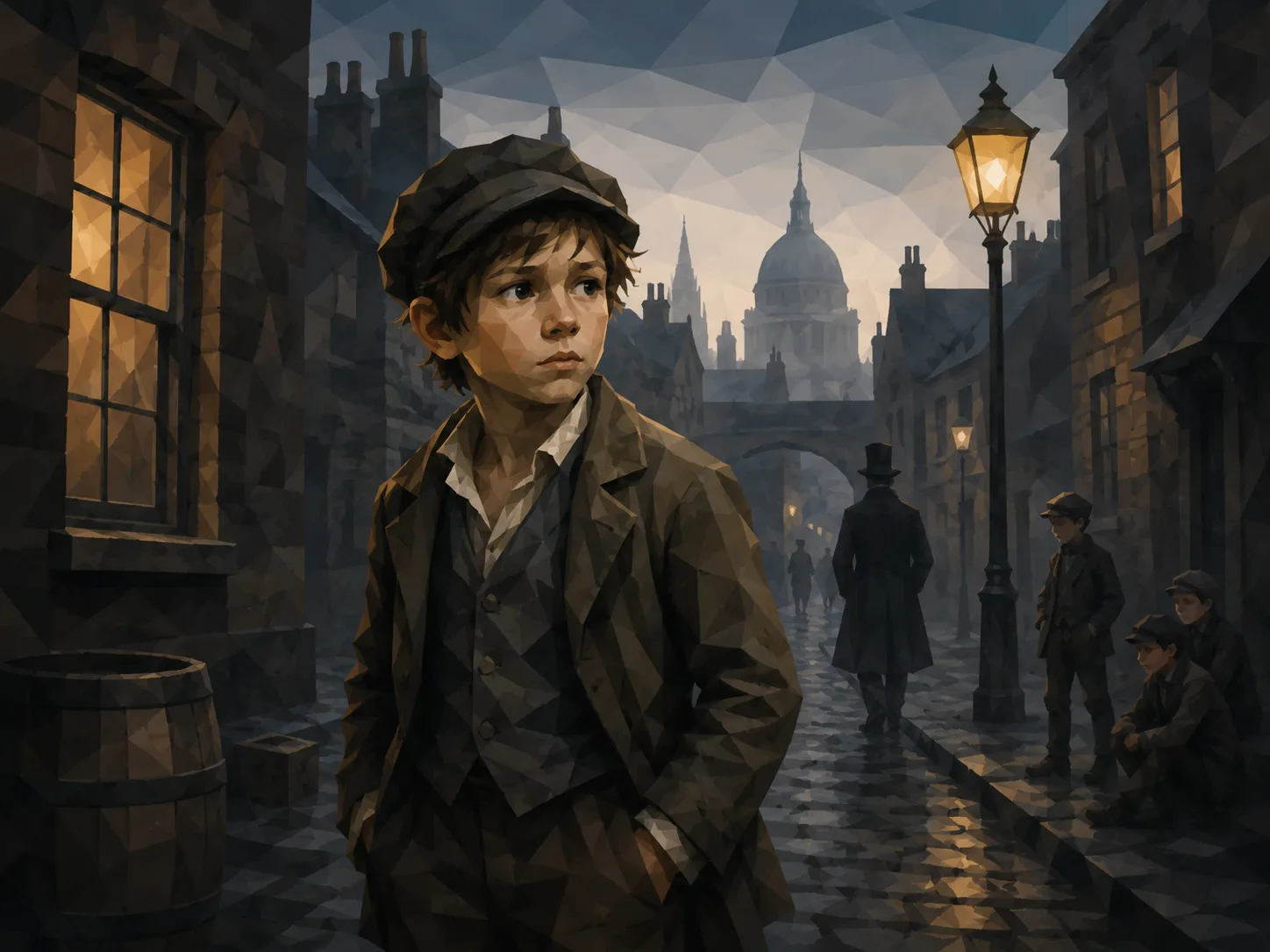
The courtroom was filled from floor to ceiling with a sea of human faces. Inquisitive and eager eyes peered from every available inch of space. From the wooden rail in front of the dock to the furthest corners of the high galleries, every gaze was fixed on one man—Fagin. Surrounded by people on all sides, he seemed to stand in the center of a vast circle of gleaming, watchful eyes.
He stood there in the glare of the lights, with one hand resting on the wooden barrier before him and the other cupped to his ear. His head was thrust forward, allowing him to catch every word that fell from the lips of the presiding judge, who was currently delivering his final instructions to the jury. Occasionally, Fagin turned his eyes sharply toward the jurors to observe the effect of any small point made in his favor. When the evidence against him was stated with terrifying clarity, he looked toward his lawyer in a silent, desperate appeal for help. Aside from these signs of anxiety, he did not move. He had remained almost perfectly still since the trial began. Now that the judge had finished speaking, he stayed in that same strained position, staring as though he were still listening.
A slight movement in the court brought him back to reality. Looking around, he saw that the jurors had turned toward each other to discuss their verdict. As his gaze wandered to the gallery, he could see people leaning over one another to catch a glimpse of his face. Some were using opera glasses to see him more clearly, while others whispered to their neighbors with expressions of pure disgust. A few people seemed indifferent to him, looking instead at the jury and wondering why they were taking so long. Yet, in not a single face—not even among the many women present—could he find the slightest hint of sympathy. Everyone seemed to share one goal: to see him condemned.
As he took this in with one bewildered glance, a deathlike silence returned to the room. He looked back and saw that the jurors had turned to face the judge again.
They only requested permission to leave the room to deliberate in private.
Fagin looked anxiously into their faces, one by one, as they passed by, trying to guess their decision. It was a useless effort. The jailer touched him on the shoulder, and he followed mechanically to the end of the dock to sit down. He only noticed the chair because the man pointed to it.
He looked up at the gallery again. Some people were eating snacks, while others fanned themselves with handkerchiefs, as the crowded room had become very hot. He noticed a young man sketching his face in a notebook and wondered if the drawing was accurate. He watched as the artist broke his pencil and sharpened it with a knife, observing the scene with the detached curiosity of an idle spectator.
In the same way, when he looked at the judge, his mind began to wonder about the style of the judge’s robes, how much they cost, and how he put them on. He noticed an old, heavy-set gentleman on the bench who had left thirty minutes earlier and had just returned. Fagin wondered if the man had gone to eat his dinner, what he had eaten, and where. He followed these trivial thoughts until a new object caught his eye.
This did not mean his mind was free from the overwhelming fear of the grave opening at his feet. That fear was always there, but it remained vague and general, as he was unable to focus his thoughts directly on it. Consequently, even while he trembled and felt a burning heat at the thought of his approaching death, he found himself counting the iron spikes on the rail before him. He wondered how the tip of one had been broken off and whether they would ever fix it. Then, his mind would jump to the horrors of the gallows—only to stop and watch a man sprinkling water on the floor to cool the room—before returning once more to thoughts of his execution.
At last, a cry for silence echoed through the room. The jury returned and passed close by him. He could read nothing from their expressions; they might as well have been made of stone. A perfect stillness followed. Not a sound was heard—not even a breath.
"Guilty."
The building rang with a tremendous shout, followed by another and another. Then came loud groans from the crowd outside, gathering strength like rolling thunder. It was a roar of joy from the public, celebrating the news that he would be executed on Monday.
The noise subsided, and he was asked if he had anything to say before the death sentence was passed. He had returned to his listening pose, looking intently at the speaker, but the question had to be repeated twice before he seemed to hear it. Even then, he only muttered that he was an old man—a very old man—and then fell silent again.
The judge put on the black cap, a sign of the death sentence, and the prisoner remained in the same position. A woman in the gallery screamed at the sight of this solemn ritual. Fagin looked up quickly, appearing annoyed by the interruption, and leaned forward even more attentively. The judge’s speech was grave and impressive; the sentence itself was terrifying to hear. Yet Fagin stood like a marble statue, without moving a single muscle. His haggard face was still thrust forward, his jaw hanging open, when the jailer put a hand on his arm and signaled him to leave. He gazed stupidly around for a second and then obeyed.
He was led through a stone room beneath the court, where other prisoners were waiting. They crowded around the bars of a gate, and as Fagin passed, they fell back to let the people in the yard see him. The crowd hissed and shouted insults at him. Fagin shook his fist and would have spat on them, but his guards hurried him through a dark passage into the interior of the prison.
There, he was searched to ensure he had no way of ending his own life. Once this was finished, they led him to one of the "condemned cells" and left him there—alone.
He sat on a stone bench that served as both a seat and a bed. Staring at the ground with bloodshot eyes, he tried to organize his thoughts. Eventually, he began to remember fragments of what the judge had said. Although it had seemed he couldn't hear a word at the time, the memory now fell into place. To be hanged by the neck until he was dead—that was the end.
As darkness fell, he began to think of all the men he had known who had died on the scaffold, many of them because of him. They appeared in his mind so quickly that he could hardly count them. He had watched some of them die and had even joked about the fact that they died with prayers on their lips. He remembered the rattling noise of the trapdoor and how quickly strong men turned into dangling heaps of clothes.
He wondered if some of them had stayed in this very cell. It was very dark; he wondered why they hadn't brought a light. Scores of men must have spent their last hours here. It felt like sitting in a vault filled with ghosts—the faces he knew, hidden beneath the executioner's hood. "Light! Light!" he cried.
Finally, when his hands were raw from beating against the heavy door, two men appeared. one carried a candle, and the other brought in a mattress. The prisoner was to be left alone no longer.
Then came the night—dark, silent, and miserable. Other people are glad to hear a church clock strike, for it signals the coming of a new day. To him, the bells brought only despair. The sound of every iron bell carried one hollow message: Death. The cheerful bustle of the morning, which reached even his cell, felt like a mockery.
Saturday night arrived. He had only one night left to live. Then Sunday dawned.
It was not until the night of this last awful day that the full intensity of his desperate situation truly hit him. It wasn't that he had ever really expected mercy, but he had never been able to process the probability of dying so soon. He had spoken very little to the two men guarding him. He had sat there, awake but lost in a nightmare. Now, he jumped up every minute, his skin burning with fever, pacing back and forth in a fit of fear and rage. He became so terrifying to look at that the two guards decided to watch him together rather than sitting alone with him.
He cowered on his stone bed and thought of the past. He had been injured by the crowd on the day of his arrest, and his head was wrapped in a linen bandage. His red hair hung over his pale face, and his eyes shone with a terrifying light. Eleven o'clock! The clock struck again before the sound of the previous hour had even faded. At eight o’clock the next morning, he would be the center of his own funeral.
The thick walls of Newgate prison have hidden much misery from the world, but they never held a sight as dreadful as that. If the people passing by in the street could have seen him, they would not have slept well that night. Groups of people gathered at the prison gates, asking if any stay of execution had been received. When the answer was "no," they pointed out the door he would walk through and where the scaffold would be built.
The area in front of the prison was cleared, and black wooden barriers were set up to manage the expected crowd. It was then that Mr. Brownlow and Oliver appeared at the gate, carrying an official order to visit the prisoner.
“Is the boy coming too, sir?” the guard asked. “It’s not a sight for children.”
“It is not, indeed,” Mr. Brownlow replied. “But my business with this man is closely connected to the boy. Since Oliver has seen him at the height of his power and villainy, I believe it is best—despite the pain—that he should see him now.”
They were led through dark, winding passages toward the cells.
“This is where he will pass through,” the man said, stopping in a gloomy hallway where workmen were preparing for the morning in silence. He showed them a stone kitchen and pointed to a door. Through a grating above, they could hear the sound of hammers and boards being moved. They were building the gallows.
They passed through several heavy gates and entered a passage with a row of strong doors. The jailer knocked on one of them. The two guards came out, and the visitors entered the cell.
The criminal was sitting on his bed, rocking back and forth. His expression was more like that of a trapped animal than a man. His mind was wandering back to his old life, and he muttered to himself, unaware of their presence.
“Good boy, Charley—well done,” he mumbled. “Oliver too, ha! ha! Oliver is quite the gentleman now. Take that boy to bed!”
The jailer took Oliver’s hand and told him not to be afraid.
“Take him to bed!” Fagin cried. “He was the cause of all this. Bolter’s throat, Bill; never mind the girl—cut Bolter’s throat as deep as you can!”
“Fagin,” said the jailer.
“That’s me!” Fagin cried, suddenly looking like he was back in the courtroom. “An old man, my Lord; a very old man!”
“Fagin,” the jailer said, holding him down. “There is someone here to see you.”
“I won’t be here much longer,” Fagin replied, his face filled with rage and terror. “What right do they have to butcher me?”
He caught sight of Oliver and Mr. Brownlow and shrank back into the corner, demanding to know what they wanted.
“You have some papers,” Mr. Brownlow said, stepping forward, “which were given to you for safety by a man named Monks.”
“It’s all a lie,” Fagin replied. “I don’t have any.”
“For the love of God,” Mr. Brownlow said solemnly, “do not lie now, when you are so close to death. Tell me where they are. Sikes is dead, and Monks has confessed. Where are the papers?”
“Oliver,” Fagin cried, beckoning the boy. “Let me whisper to you.”
“I am not afraid,” Oliver said quietly, letting go of Mr. Brownlow’s hand.
“The papers,” Fagin whispered, drawing Oliver close, “are in a canvas bag, hidden in a hole in the chimney in the top front room. I want to talk to you, my dear.”
“Yes,” Oliver replied. “But first, let me say a prayer with you. Kneel with me and we will pray.”
“Outside, outside,” Fagin said, pushing the boy toward the door. “Tell them I’ve gone to sleep—they’ll believe you. You can help me escape. Now, come on!”
“Oh! God forgive this wretched man!” the boy cried, bursting into tears.
“That’s right,” Fagin said. “That will help us. If I tremble as we pass the gallows, don’t worry, just hurry on!”
“Have you nothing else to ask him, sir?” the jailer inquired.
“No,” Mr. Brownlow replied. “Nothing will make him realize the reality of his situation now.”
The guards returned to the cell.
“Hurry, hurry,” Fagin cried. “Faster, faster!”
The men grabbed him and pulled Oliver away. Fagin struggled with desperate strength for a moment, then let out scream after scream that echoed through the massive walls and rang in their ears until they reached the yard outside.
Oliver nearly fainted after this terrifying scene and was too weak to walk for some time.
Day was dawning when they finally left the prison. A huge crowd had already gathered. People were leaning out of windows, smoking and playing cards to pass the time. The crowd was pushing and joking, full of life and energy. In the middle of it all stood one dark object—the black stage, the beam, and the rope—the hideous machinery of death.