


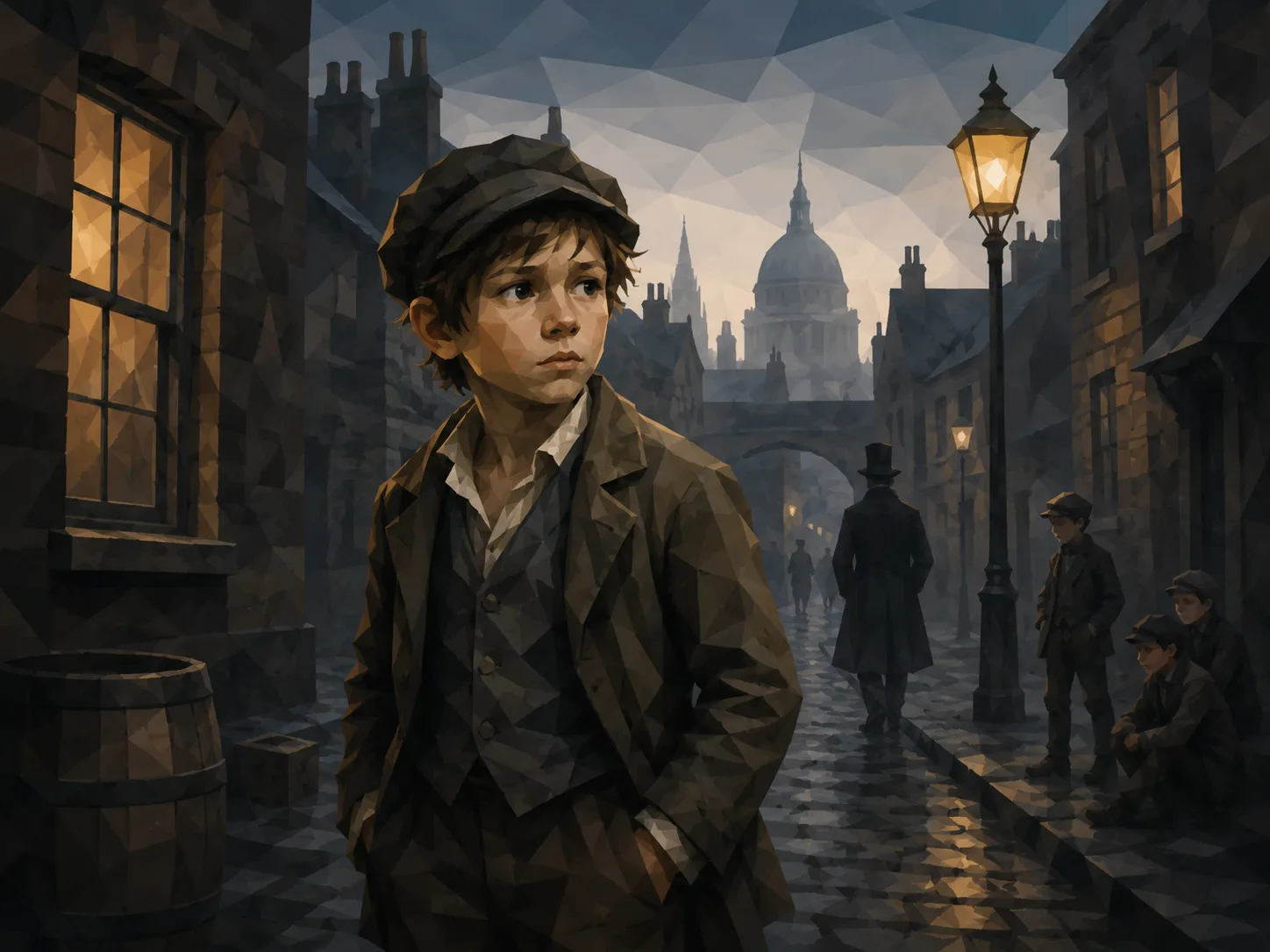
It was late the following morning when Oliver awoke from a sound, deep sleep. No one else was in the room except for the old man, who was boiling some coffee in a saucepan for breakfast. He whistled softly to himself as he stirred it continuously with an iron spoon. Every now and then, he would pause to listen whenever he heard the slightest noise from below; once he had satisfied himself that all was well, he would resume his whistling and stirring as before.
Although Oliver had stirred, he was not yet fully awake. There is a particular drowsy state, between sleeping and waking, when one dreams more in five minutes with half-open eyes than in five nights of deep, unconscious slumber. In such moments, the mind is half-aware of its surroundings, yet it feels as though it has been liberated from the physical body, capable of leaping across time and space.
Oliver was in precisely this condition. Through his half-closed eyes, he saw the old man and heard the low whistling, along with the sound of the spoon scraping against the sides of the saucepan. Yet, at the same time, his mind was busy interacting with almost everyone he had ever known.
When the coffee was ready, the old man moved the saucepan to the side of the fireplace. Standing there indecisively for a few moments, as if he were unsure of how to occupy himself, he eventually turned around and called Oliver by name. The boy did not answer and, to all appearances, remained fast asleep.
After convincing himself of this, the old man stepped gently toward the door and fastened it. He then reached down and pulled a small box from what appeared to Oliver to be a hidden trapdoor in the floor. He placed it carefully on the table, his eyes glistening with excitement as he raised the lid to peer inside. Dragging an old chair to the table, he sat down and took out a magnificent gold watch, which sparkled with jewels.
“Aha!” the old man whispered, shrugging his shoulders and twisting his features into a hideous grin. “Clever boys! Loyal to the end! They never told the authorities where the goods were. They never betrayed old Fagin! And why should they? It wouldn’t have loosened the rope or stopped the execution for a single minute. No, no, no! Fine fellows indeed!”
With these and other muttered reflections, he placed the watch back in its place of safety. At least six more watches were pulled from the box and examined with equal pleasure, along with rings, brooches, bracelets, and other articles of jewellery. The materials were so magnificent and the craftsmanship so elaborate that Oliver did not even know the names of such items.
Having replaced these trinkets, the old man took out another object—one so small that it lay hidden in the palm of his hand. There seemed to be a tiny inscription on it, for he laid it flat on the table and, shading it with his hand, studied it long and earnestly. At length, he put it down as if despairing of success, and, leaning back in his chair, muttered:
“What a wonderful thing the death penalty is! Dead men never repent; dead men never reveal inconvenient stories. Ah, it is a fine thing for our trade! Five of them hanged in a row, and none left to turn coward or betray the rest!”
As he uttered these words, his bright, dark eyes, which had been staring vacantly ahead, fell upon Oliver’s face. The boy’s eyes were fixed on his in silent curiosity; although the old man recognized this for only the briefest moment, it was enough to show him that he had been observed.
He closed the lid of the box with a loud crash and, grabbing a bread knife from the table, stood up furiously. He was trembling violently, however; even in his alarm, Oliver could see that the knife quivered in the air.
“What’s that?” the old man demanded. “Why are you watching me? Why are you awake? What have you seen? Speak out, boy! Quick—for your life!”
“I couldn’t sleep any longer, sir,” Oliver replied meekly. “I am very sorry if I have disturbed you.”
“You weren’t awake an hour ago?” the old man asked, scowling fiercely at the boy.
“No! No, truly!” Oliver replied.
“Are you certain?” the man cried, with an even more threatening look and an aggressive posture.
“Upon my word, I was not, sir,” Oliver replied earnestly. “I really wasn't, sir.”
“Tush, tush, my dear!” the old man said, abruptly resuming his former friendly manner. He played with the knife for a moment before laying it down, as if to suggest he had only picked it up in a moment of fun. “Of course I know that, my dear. I only tried to frighten you. You’re a brave boy, Oliver. Ha! ha!” He rubbed his hands together with a chuckle, though he continued to glance uneasily at the box.
“Did you see any of these pretty things, my dear?” he asked, placing his hand upon the box after a short pause.
“Yes, sir,” Oliver replied.
“Ah!” the old man said, turning rather pale. “They—they’re mine, Oliver; my modest property. They are all I have to live on in my old age. People call me a miser, my dear. Only a miser; that’s all.”
Oliver thought the old gentleman must indeed be a miser to live in such a filthy place with so many gold watches. However, considering that the old man’s kindness toward the Dodger and the other boys might cost him a great deal of money, he merely gave him a respectful look and asked if he might get up.
“Certainly, my dear, certainly,” the old gentleman replied. “Wait. There’s a pitcher of water in the corner. Bring it here, and I’ll give you a basin to wash in.”
Oliver got up, walked across the room, and leaned down to pick up the pitcher. When he turned his head, the box had disappeared.
He had barely finished washing and tidying the room when the Dodger returned. He was accompanied by a very lively young friend whom Oliver had seen smoking the previous night; he was formally introduced as Charley Bates. The four of them sat down to a breakfast of coffee, hot rolls, and ham, which the Dodger had brought home hidden in the top of his hat.
“Well,” said the old man, glancing slyly at Oliver while addressing the Dodger, “I hope you’ve been hard at work this morning, my dears?”
“Very hard,” the Dodger replied.
“As hard as can be,” added Charley Bates.
“Good boys, good boys!” said the old man. “What have you got, Dodger?”
“A couple of wallets,” replied the young gentleman.
“Are they well-lined?” the old man inquired eagerly.
“Fairly well,” the Dodger replied, producing two wallets—one green and the other red.
“Not as heavy as they might be,” the old man remarked, after examining the insides carefully, “but very neat and well-made. He’s an ingenious workman, isn't he, Oliver?”
“Very much so, indeed, sir,” said Oliver. At this, Mr. Charles Bates laughed loudly, much to the confusion of Oliver, who saw nothing funny in the remark.
“And what have you brought, my dear?” Fagin asked Charley Bates.
“Handkerchiefs,” replied Master Bates, producing four of them.
“Well,” the old man said, inspecting them closely, “they are very good quality. However, you haven’t removed the owner's marks well, Charley; we shall have to pick the stitches out with a needle, and we’ll teach Oliver how to do it. Shall we, Oliver?”
“If you please, sir,” Oliver replied.
“You’d like to be able to make handkerchiefs as easily as Charley Bates, wouldn't you, my dear?” the old man asked.
“Very much indeed, if you’ll teach me, sir,” Oliver replied.
Master Bates found something so incredibly amusing in this reply that he burst into another fit of laughter. Unfortunately, he was drinking coffee at the time, and he nearly choked as he struggled to breathe.
“He is so terribly naive!” Charley said once he had recovered, offering an apology for his rude behavior.
The Dodger said nothing, but he smoothed Oliver’s hair over his eyes and told him he would know better in time. Observing that Oliver was blushing, the old gentleman changed the subject by asking if there had been a large crowd at the execution that morning. This made Oliver wonder even more, for it was clear from the boys' replies that they had both been there. He naturally wondered how they could have found the time to be so industrious at their work while also attending a public hanging.
When the breakfast was cleared away, the cheerful old gentleman and the two boys played a very curious game. The old man placed a snuff-box in one pocket, a wallet in another, and a watch in his waistcoat. He even pinned a fake diamond into his shirt and buttoned his coat tight. Then, carrying a walking stick, he trotted up and down the room, imitating the way elderly gentlemen walk through the streets. Sometimes he stopped at the fireplace or the door, pretending to stare intently into shop windows. He would look around constantly for fear of thieves, slapping his pockets to ensure he hadn’t lost anything. He did this in such a funny and natural manner that Oliver laughed until tears ran down his face.
All this time, the two boys followed him closely. They moved so nimbly that they remained out of his sight every time he turned around. At last, the Dodger stepped on his toes while Charley Bates bumped into him from behind. In that single moment, they took everything from him—the snuff-box, the wallet, the watch, and even the handkerchief—with extraordinary speed. If the old gentleman felt a hand in his pocket, he cried out, and the game began again.
Later, two young ladies named Bet and Nancy came to visit. They were somewhat untidily dressed, but they were very lively and friendly. Oliver thought they were very nice girls indeed. They stayed for a long time, and the conversation became quite cheerful. Eventually, Charley Bates remarked that it was time to "pad the hoof," which Oliver correctly guessed meant it was time to leave. The Dodger, Charley, and the two young ladies went away together, after the old man had kindly given them some money to spend.
“There, my dear,” said Fagin. “That’s a pleasant life, isn't it? They have gone out for the day.”
“Have they finished their work, sir?” Oliver inquired.
“Yes,” said the old man, “unless they should unexpectedly come across more work while they are out. Take them as your role models, Oliver. Do everything they tell you, and follow their advice—especially the Dodger’s. He will be a great man, and he will make you one too, if you follow his example. Is my handkerchief hanging out of my pocket, my dear?”
“Yes, sir,” said Oliver.
“See if you can take it out without me feeling it, just as you saw them do during our game.”
Oliver held the bottom of the pocket with one hand and lightly drew the handkerchief out with the other.
“Is it gone?” cried the old man.
“Here it is, sir,” said Oliver, showing it.
“You’re a clever boy!” said the old gentleman, patting Oliver’s head approvingly. “I’ve never seen a sharper lad. Here is a shilling for you. If you continue this way, you’ll be a great man. Now, come here, and I’ll show you how to remove the marks from the handkerchiefs.”
Oliver wondered what picking pockets had to do with becoming a great man. However, believing that the old man must know best, he followed him to the table and was soon deeply involved in his new studies.