


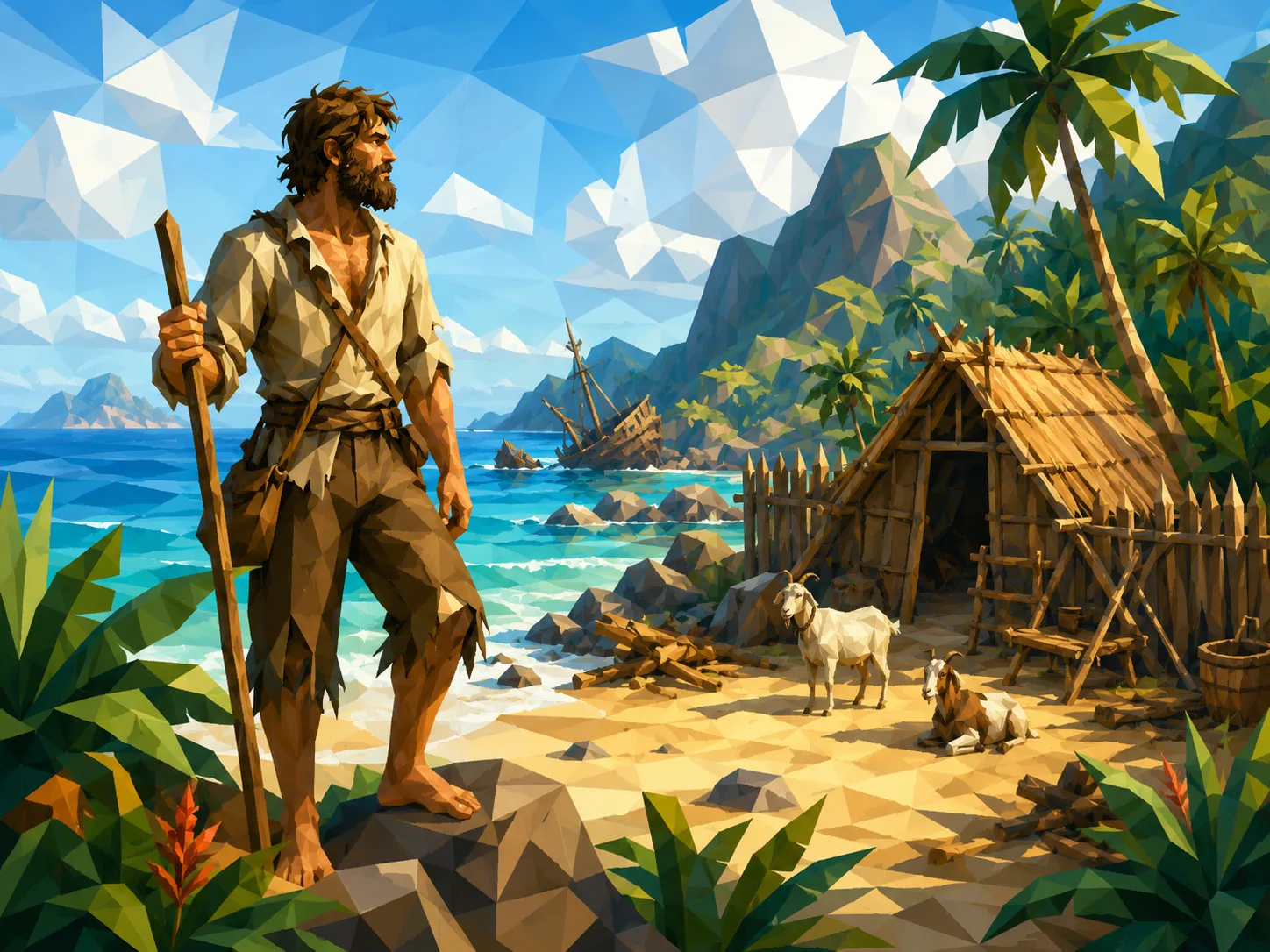
September 30, 1659.—I, Robinson Crusoe, having been shipwrecked during a violent storm, reached the shore of this miserable, unfortunate island. I have named it "The Island of Despair." Everyone else on the ship has drowned, and I myself was nearly dead when I reached land.
I spent the remainder of the day mourning my terrible circumstances. I had no food, no shelter, no clothes, no weapons, and no place to hide. Seeing no hope of rescue, I expected nothing but death—believing I would either be devoured by wild animals, murdered by savages, or starved to death. As night approached, I slept in a tree for fear of wild creatures. Although it rained all night, I slept soundly.
October 1.—In the morning, I was greatly surprised to see that the high tide had lifted the ship and driven it much closer to the shore. On one hand, this was a comfort; seeing the ship upright and intact, I hoped that if the wind died down, I might go on board and recover some food and necessities. On the other hand, it renewed my grief. I realized that if we had all stayed on board, my comrades might have been saved, or at least we could have used the ship’s timber to build a boat to escape. I spent much of the day troubled by these thoughts. Eventually, seeing that the ship was almost on dry sand, I swam out to it. It continued to rain that day, though the wind had stopped.
From the 1st of October to the 24th.—I spent these days making several trips to the ship to salvage everything I could. I transported the goods to the shore on rafts during each high tide. It rained frequently during this period, which seemed to be the rainy season.
October 20.—I accidentally overturned my raft and all the goods on it. However, because the water was shallow and the items were heavy, I was able to recover most of them once the tide went out.
October 25.—It rained heavily all day and night, accompanied by strong gusts of wind. During this storm, the ship was smashed to pieces and disappeared. Nothing remained of her except the wreck, which could only be seen at low tide. I spent the day covering and securing the goods I had saved so that the rain would not ruin them.
October 26.—I walked along the shore for most of the day, searching for a place to build my home. I was primarily concerned with protecting myself from nocturnal attacks by wild animals or men. Towards evening, I found a suitable spot under a hollow rock and marked out a semicircle for my camp. I resolved to strengthen this area with a wall made of double piles, filled with cables on the inside and turf on the outside.
From the 26th to the 30th.—I worked tirelessly to move all my goods to my new home, despite the heavy rain.
October 31.—In the morning, I went out into the island with my gun to find food and explore. I killed a she-goat, and her kid followed me home. I eventually had to kill the kid as well, as it refused to eat.
November 1.—I set up my tent under the rock and slept there for the first night. I made the tent as large as possible and drove stakes into the ground to hang my hammock.
November 2.—I arranged all my chests and boards to form a fence around me, just inside the line I had marked for my fortification.
November 3.—I went out with my gun and shot two birds that resembled ducks; they turned out to be excellent food. In the afternoon, I began working on a table.
November 4.—This morning, I began to organize my schedule. I decided when to work, when to hunt, when to sleep, and when to rest. Every morning, if it didn’t rain, I walked out with my gun for two or three hours. Then I worked until about eleven o’clock, at which point I ate my meal. From twelve to two, I slept, as the weather was excessively hot. In the evening, I returned to my work. I spent this day and the next working on my table. I was a poor carpenter at first, but necessity and time soon turned me into a skilled mechanic.
November 5.—I went out with my gun and my dog and killed a wild cat. Her fur was soft, but her flesh was useless. I preserved the skins of every creature I killed. On my way back along the shore, I saw many types of sea birds I didn’t recognize. I was also startled by two or three seals, which escaped into the sea before I could get a closer look.
November 6.—After my morning walk, I finished my table. Although I wasn't entirely satisfied with it, I soon learned how to improve my craftsmanship.
November 7.—The fair weather finally arrived. From the 7th to the 12th (except for the 11th, which was Sunday), I worked on making a chair. It was a difficult task, and I had to take it apart several times before I achieved a tolerable shape.
Note: I soon stopped observing Sundays, as I forgot to mark them on my wooden post and lost track of the days.
November 13.—It rained today, which was refreshing and cooled the earth. However, the rain was accompanied by terrifying thunder and lightning. I was deeply afraid that a lightning strike might ignite my gunpowder. As soon as the storm passed, I decided to divide my powder into many small parcels so that a single accident wouldn't destroy my entire supply.
November 14, 15, 16.—I spent these three days making small wooden boxes to hold about a pound or two of powder each. I hid these boxes in various secure places far away from each other. During this time, I also killed a large bird that was good to eat, though I didn't know what species it was.
November 17.—I began to dig into the rock behind my tent to create more space for storage.
Note: I lacked three essential things for this work: a pickaxe, a shovel, and a wheelbarrow. I had to stop my digging to figure out how to make these tools. For a pickaxe, I used heavy iron bars from the ship. The shovel, however, was absolutely necessary, and I didn't know how to proceed without one.
November 18.—While searching the woods, I found a tree that the Brazilians call "iron-wood" because it is incredibly hard. With great effort, and nearly ruining my axe, I cut a piece and brought it home. Because the wood was so hard, it took me a long time to carve it into the shape of a shovel. It lacked an iron edge at the bottom, so it wouldn't last as long as an English shovel, but it served its purpose well enough.
I still needed a way to carry the earth I dug out. I couldn't make a basket because I hadn't found any flexible twigs, and I had no idea how to construct a wheel for a wheelbarrow. Instead, I made a wooden tray, similar to the ones used by laborers to carry mortar. These tools took me four days to complete, excluding my morning hunts.
November 23.—With my tools finished, I spent the next eighteen days widening and deepening my cave so it could hold my goods more conveniently.
Note: I intended for this cave to serve as a warehouse, a kitchen, a dining room, and a cellar. I continued to sleep in my tent, but during the rainy season, I covered the area with rafters and large leaves to create a thatched roof that would keep me dry.
December 10.—I thought the cave was finished, but suddenly a large amount of earth collapsed from the roof. It terrified me; if I had been under it, I would have been buried alive. I had to carry all the loose earth back out and, more importantly, I had to prop up the ceiling with posts to prevent further collapses.
December 11.—I set up two thick posts with boards across the top to support the roof. Over the next week, I added more posts and partitions, which helped organize the space into different rooms.
December 17.—I spent the next few days putting up shelves and nails to hang my belongings. My home was finally starting to look orderly.
December 20.—I moved everything into the cave and began to furnish it. I made another table and used some boards to create a kitchen dresser.
December 24–25.—Heavy rain. I could not leave the cave.
December 27.—I killed a young goat and injured another. I brought the injured one home and bandaged its broken leg.
N.B.—I took such good care of it that the leg healed perfectly. The goat became tame and stayed near my door. This gave me the idea of breeding animals so that I would have a source of food once my gunpowder ran out.
January 1.—It was still very hot. I went out early and late but rested during the day. In the valleys, I discovered many wild goats, but they were very shy. I decided to see if my dog could hunt them.
Jan. 2.—I set my dog on the goats, but they turned and faced him. My dog, sensing the danger, refused to go near them.
Jan. 3.—I began building my outer wall. Because I was still afraid of being attacked, I resolved to make it thick and strong.
N.B.—It took me from January 2nd to April 14th to finish this wall, even though it was only about twenty-four yards long. It was a semi-circle that protected the entrance to my cave. The labor involved was indescribable, especially cutting the heavy piles in the woods and driving them into the ground.
When the wall was finished, I covered the outside with turf. From a distance, no one would have guessed that a human lived there. This proved to be very important later on.
During this time, I continued to hunt for food. I discovered wild pigeons that nested in the rocks. I tried to raise some young ones, but they flew away when they grew older because I had no grain to feed them. However, I often found their nests and used the young birds for meat.
As I managed my household, I realized I lacked many things. I tried to make a wooden barrel, but I couldn't join the pieces tightly enough to hold water. I also had no candles, so I had to go to bed as soon as it got dark, usually by seven o'clock. Eventually, I made a lamp by using goat tallow and a clay dish I had baked in the sun, with a piece of old rope as a wick. It didn't provide a steady light, but it was better than darkness.
While searching through my things, I found a small bag that had once contained grain for poultry. The rats had eaten all the corn, leaving nothing but dust and husks. I shook the bag out near the rock, intending to use it for something else.
It was just before the great rains that I did this. About a month later, I saw some green stalks growing out of the ground. I was astonished when, after a while, ten or twelve ears of perfect green barley appeared—exactly like the barley in England.
It is impossible to describe my shock. Up until then, I had not been a religious man. I viewed everything that happened to me as a matter of chance. But seeing barley grow in a climate where I thought it was impossible, and not knowing how it got there, made me believe that God had performed a miracle to sustain me. This thought brought tears to my eyes. My wonder increased when I also found stalks of rice growing nearby.
However, when I remembered shaking out the bag of chicken feed, my religious wonder began to fade. I realized it was a natural occurrence. Yet, I should have remained just as thankful, for it was a strange providence that a few grains had survived the rats and landed in a shaded spot where they could grow. If I had thrown them anywhere else, the sun would have destroyed them.
I carefully harvested the grain in June and saved every seed, hoping that in a few years I would have enough to make bread. It wasn't until the fourth year that I actually ate any of it.
April 14.—I finally finished the wall. I didn't build a door; instead, I used a ladder to climb over the wall and then pulled the ladder in after me. I felt completely secure.
April 16.—The very next day, a disaster nearly killed me. While I was in the cave, the earth began to crumble from the roof and the hill above. Two of my support posts cracked with a terrifying noise. Fearing a collapse, I ran to my ladder and climbed over the wall. As soon as I reached firm ground, I realized it was a terrible earthquake. The ground shook three times, with shocks strong enough to topple the strongest buildings. A huge piece of a cliff fell into the sea with a deafening crash. The ocean was tossed into a frenzy, and the shocks felt even stronger under the water.
The experience left me dazed and nauseated. I was filled with horror, thinking that the hill would collapse and bury all my goods—and my soul—at once. After the third shock, I sat on the ground, disconsolate. I still had no truly religious thoughts, only a brief "Lord have mercy on me!" which I forgot as soon as the danger seemed to pass.
Suddenly, the sky turned dark and a dreadful hurricane began. The wind tore trees up by the roots and the sea turned to foam. This lasted for three hours. When it finally calmed down and began to rain, I realized that the storm was a consequence of the earthquake and that the danger of more tremors was likely over.
I went back into my cave, though I was still nervous. The rain was so violent that it threatened to flood the cave, so I had to cut a drainage hole through my fortification. To calm my nerves, I took a small sip of rum.
For the next few days, I stayed inside and considered my situation. I realized that if the island was prone to earthquakes, living in a cave was dangerous. I would have to build a small hut in an open area and surround it with a new wall. The fear of being buried alive was constant, yet I was reluctant to leave the home I had worked so hard to build and hide.
April 21.—I resolved to stay where I was for the time being, but I decided I would eventually build a new fortified camp in a safer location.
April 22.—I began to consider how to execute this plan, but my tools were too dull to cut the hard wood I needed. I had a large grindstone, but I couldn't turn it and hold the tools at the same time. This problem troubled me deeply. Finally, I contrived a way to turn the stone using a foot pedal, leaving my hands free. This machine took a full week to build.
April 28, 29.—I spent these two days sharpening my tools.
April 30.—I realized my supply of biscuits was running low, so I limited myself to just one a day. This made me very sad.
May 1.—At low tide, I saw a barrel and some pieces of the ship's wreck washed up on the shore by the hurricane. The wreck itself seemed to have been lifted higher out of the water. I found that the barrel contained gunpowder, but it was ruined by water and had become as hard as stone. Nevertheless, I rolled it onto the shore and continued searching the sands for more supplies.