


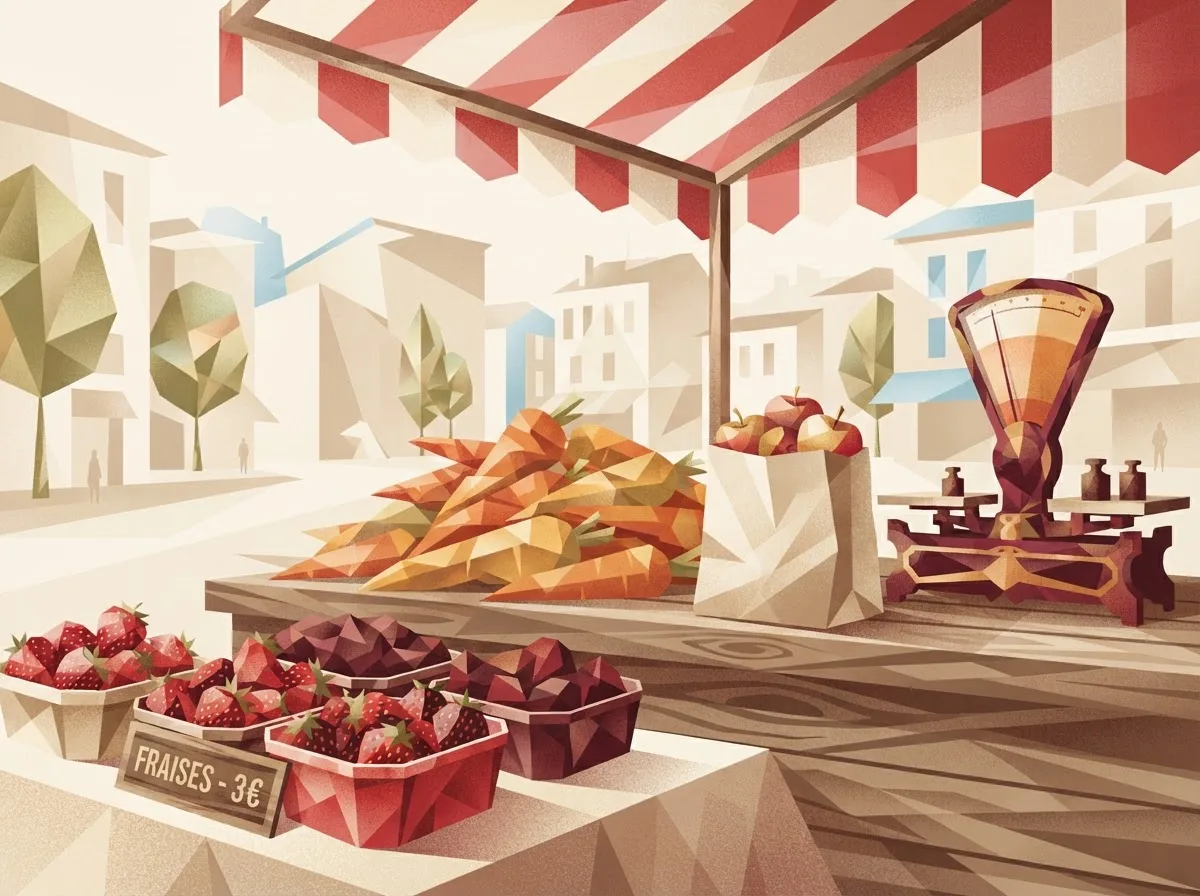
At the French Market: Fruit and Vegetables
Shop for fruit and vegetables at a French market. Practice asking for quantities with « un kilo de » and « une barquette de », asking the price with « C'est combien ? », and answering the vendor's « Et avec ceci ? ».
Preview
Questions with solutions-
1. Elige la respuesta correcta.
You want to know the price of some peaches. What do you ask?
- C'est combien ?
- C'est qui ?
- C'est où ?
- C'est quand ?
« combien » means "how much" or "how many".
Show solution
- C'est combien ?
« C'est combien ? » means "How much is it?". « qui » means who, « où » means where and « quand » means when.
-
2. Completa el espacio en blanco.
Ask for a kilo of tomatoes.
Je voudrais un kilo ___ tomates, s'il vous plaît.
- de
- des
- du
- les
After a quantity like « un kilo », French uses one short little word, always the same.
Show solution
Je voudrais un kilo de tomates, s'il vous plaît.
After a quantity, French uses just « de »: « un kilo de tomates », « un kilo de pommes ». Not « des » or « du ».
-
3. Elige la respuesta correcta.
Choose the correct sentence.
- Je voudrais un kilo d'oranges.
- Je voudrais un kilo de oranges.
- Je voudrais un kilo de les oranges.
- Je voudrais un kilo oranges.
« oranges » starts with a vowel.
Show solution
- Je voudrais un kilo d'oranges.
« de » becomes « d' » before a vowel: « un kilo d'oranges », « un kilo d'abricots ».
-
4. Completa el espacio en blanco.
You want a small punnet of strawberries.
Une ___ de fraises, s'il vous plaît.
- barquette
- kilo
- bouteille
- litre
The word must be feminine (« une ») and suit soft fruit.
Show solution
Une barquette de fraises, s'il vous plaît.
« une barquette » is a small punnet or tray, used for strawberries, cherries or cherry tomatoes. « kilo » and « litre » are masculine (« un kilo »), and « une bouteille » is a bottle.
-
5. Completa el espacio en blanco.
Ask for potatoes by weight.
Je voudrais un ___ de pommes de terre.
- kilo
- barquette
- bouteille
- verre
Look at « un »: the missing word is masculine.
Show solution
Je voudrais un kilo de pommes de terre.
« un kilo de pommes de terre » = a kilo of potatoes. « barquette » and « bouteille » are feminine, and you don't buy potatoes by the glass (« verre »)!
-
6. Completa los espacios en blanco.
Order a kilo of carrots and a punnet of cherries.
Je voudrais ___ kilo de carottes et ___ barquette de cerises.
- un
- une
- le
- la
« kilo » is masculine, « barquette » is feminine.
Show solution
Je voudrais un kilo de carottes et une barquette de cerises.
« un kilo » (masculine) and « une barquette » (feminine). « un » and « une » mean "a", whereas « le » and « la » mean "the".
-
7. Ordena las palabras.
Ask the price of a kilo of apples.
- de
- C'est
- pommes ?
- combien,
- le kilo
Start with the question « C'est combien », then say what you mean.
Show solution
C'est combien, le kilo de pommes ?
« C'est combien, le kilo de pommes ? » = How much is a kilo of apples? At the market, prices are often given per kilo.
-
8. Elige la respuesta correcta.
The vendor answers « Ça fait trois euros. » What did you ask?
— … ?
— Ça fait trois euros.- C'est combien ?
- Vous avez des pommes ?
- Et avec ceci ?
- Où est le marché ?
« Ça fait trois euros » gives a price.
Show solution
- C'est combien ?
« Ça fait trois euros » means "That comes to three euros", so it answers « C'est combien ? ».
-
9. Elige la respuesta correcta.
The vendor wants to know if you need anything else. What does she say?
- Et avec ceci ?
- C'est combien ?
- Bonjour, monsieur !
- Ça fait deux euros.
« ceci » means "this".
Show solution
- Et avec ceci ?
« Et avec ceci ? » literally means "And with this?". Vendors say it to ask "Anything else?".
-
10. Elige la respuesta correcta.
The vendor asks « Et avec ceci ? ». You don't need anything else. What do you say?
- C'est tout, merci.
- Je m'appelle Paul.
- Il fait beau.
- J'ai vingt ans.
« tout » means "all".
Show solution
- C'est tout, merci.
« C'est tout, merci. » = That's all, thanks. If you do want something else, you can just ask for another item: « Une barquette de fraises, s'il vous plaît. »
-
11. Ordena las palabras.
Ask for a punnet of strawberries, politely.
- de
- Une
- s'il vous plaît.
- barquette
- fraises,
Quantity first, then « de », then the fruit.
Show solution
Une barquette de fraises, s'il vous plaît.
The pattern is quantity + « de » + fruit: « une barquette de fraises ». Adding « s'il vous plaît » makes it polite.
-
12. Escucha y escribe la respuesta.
Listen to the vendor and type what she says.
It's the vendor's question for "Anything else?".
Show solution
- Et avec ceci ?
« Et avec ceci ? » — the « c » in « ceci » sounds like an « s ».
-
13. Escucha y escribe la respuesta.
Listen to the customer and type the order.
Quantity + « de » + fruit + polite ending.
Show solution
- Un kilo de pommes, s'il vous plaît.
« Un kilo de pommes, s'il vous plaît. » = A kilo of apples, please.