


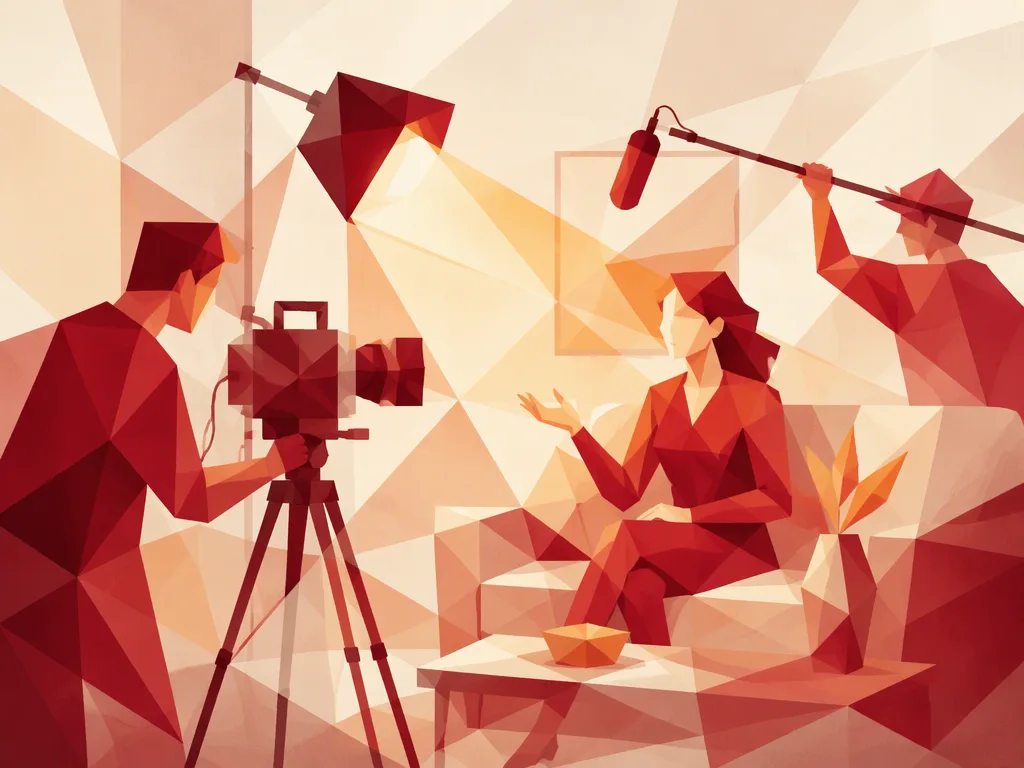
Detrás de cámaras de una película
Explora cómo los equipos de producción cinematográfica planifican escenas, filman actuaciones y dan forma a las historias mediante la edición y el sonido.
Preview
Questions with solutions-
1. Elige la respuesta correcta.
¿Dónde suelen encontrar los actores sus diálogos?
Before filming begins, the actors learn the words their characters will say.
- In the filming schedule
- In the script
- In the cast list
Necesitan un documento que contenga la historia y las conversaciones.
Show solution
- In the script
Un guion incluye los diálogos de los personajes y descripciones de lo que sucede en cada escena.
-
2. Elige la respuesta correcta.
Who usually guides this part of the performance?
An actor says a line angrily. Someone asks her to try again in a calmer voice.
- The costume designer
- The camera operator
- The director
This person helps actors bring the story to life.
Show solution
- The director
Directors guide performances, including how actors speak, move, and react.
-
3. Elige la respuesta correcta.
¿En qué lugar sería más fácil grabar el habla con claridad?
The team needs an outdoor location for a quiet conversation between two characters.
- A street with very little traffic
- A street beside a busy airport
- A street where workers are repairing the road
Piensa en los sonidos que podrían tapar las voces de los actores.
Show solution
- A street with very little traffic
Al elegir un lugar, el ruido de fondo importa, no solo la apariencia del lugar.
-
4. Completa el espacio en blanco.
Before filming a chase, the team makes a series of drawings showing the planned camera shots. This visual plan is a ___.
- soundtrack
- storyboard
- cast list
Muestra cómo se verán en pantalla las partes de la historia.
Show solution
Before filming a chase, the team makes a series of drawings showing the planned camera shots. This visual plan is a storyboard.
Un guion gráfico ayuda al equipo a planificar las posiciones de la cámara y la acción antes de que comience la filmación.
-
5. Completa el espacio en blanco.
To show a small tear clearly, the camera frames only the actor's face in a ___.
- close-up
- wide shot
- long shot
El rostro ocupa la mayor parte de la imagen.
Show solution
To show a small tear clearly, the camera frames only the actor's face in a close-up.
Los primeros planos llaman la atención sobre pequeños detalles, como una lágrima o un cambio en la expresión.
-
6. Elige la respuesta correcta.
¿Por qué añadir esta luz?
A scene takes place at night. The crew lights the actor's face gently while keeping the room dark.
- To make the scene look like a sunny afternoon
- To make every part of the room equally bright
- To let viewers see the actor's expression
La escena debe seguir pareciendo nocturna.
Show solution
- To let viewers see the actor's expression
Una escena nocturna puede usar luces colocadas cuidadosamente sin que todo el entorno se vea muy iluminado.
-
7. Elige la respuesta correcta.
How do these versions help the editor?
The director films a conversation once with long pauses and again with short pauses.
- They prove that the longer version must be used.
- They offer different paces and moods for the scene.
- They make both versions appear together without editing.
Pauses can change how a conversation feels.
Show solution
- They offer different paces and moods for the scene.
Each recording of a scene is called a take. Different takes give the editor useful choices.
-
8. Elige la respuesta correcta.
¿Cuál es la razón más probable de este plan de filmación?
The opening and final scenes happen in the same cafe. The crew films both during one visit.
- To reduce the time and cost of using the location
- To make viewers see the ending before the beginning
- To avoid editing either scene afterward
Piensa en volver al café con todo el equipo.
Show solution
- To reduce the time and cost of using the location
Las películas suelen filmarse en un orden distinto al de la historia para aprovechar mejor las locaciones y el tiempo de las personas.
-
9. Completa el espacio en blanco.
A character's cup is full in one shot and empty a moment later, with no time to drink. This mismatch is a ___ error.
- lighting
- sound
- continuity
Los detalles deben coincidir a medida que continúa la acción.
Show solution
A character's cup is full in one shot and empty a moment later, with no time to drink. This mismatch is a continuity error.
La continuidad consiste en mantener los detalles coherentes entre tomas para que la acción se perciba como conectada.
-
10. Elige la respuesta correcta.
¿Qué pasó con el fondo?
An actor performs in front of a green wall. In the finished movie, a mountain appears behind her.
- The wall was painted during her performance.
- The green background was replaced with another image.
- A light shining on the wall created the mountain.
El equipo puede cambiar parte de la imagen grabada después.
Show solution
- The green background was replaced with another image.
Una pantalla verde permite al equipo agregar un fondo que no estaba presente durante la filmación.
-
11. Elige la respuesta correcta.
¿Qué está creando el artista de sonido?
A sound artist watches a forest scene and steps on dry leaves in time with the character's steps.
- Background music for the forest scene
- New spoken lines for the character
- Footstep sounds that match the movement
Observa lo que el artista está haciendo con las hojas.
Show solution
- Footstep sounds that match the movement
Muchos sonidos cotidianos de las películas se graban por separado para que sean más claros y más fáciles de controlar.
-
12. Elige la respuesta correcta.
¿Por qué podría el editor eliminar esta escena?
Two characters have a long conversation about the weather. It adds no important information and does not affect what happens next.
- To keep the story moving
- To change the weather in the remaining scenes
- To recover the money already spent filming it
Considera qué aporta la escena a la experiencia del espectador.
Show solution
- To keep the story moving
La edición da forma al ritmo de una historia. Incluso una escena bien actuada puede eliminarse si hace que la película avance más lentamente.
-
13. Elige la respuesta correcta.
¿Qué puede sugerir la música?
A person walks down an empty hallway. Slow, tense music begins, although nothing dangerous is visible.
- The character must be listening to that music.
- Something dangerous might happen.
- The hallway is definitely safe.
La música puede preparar a los espectadores para un suceso que aún no han visto.
Show solution
- Something dangerous might happen.
La música puede crear tensión antes de que aparezca el peligro. No es necesario que los personajes la escuchen.
-
14. Elige la respuesta correcta.
What does the knock add to the scene?
A character looks toward a closed door. We hear a knock, but the movie does not show anyone outside.
- It shows exactly what the visitor looks like.
- It proves that the character has opened the door.
- It suggests that someone is outside, out of sight.
A sound can give information about something outside the picture.
Show solution
- It suggests that someone is outside, out of sight.
Sounds from outside the camera's view can make the story's world feel larger than the screen.
-
15. Elige la respuesta correcta.
¿Cuál es la conexión más clara que sugieren estas tomas?
An editor shows a burning house, then a person's worried face. No one speaks, and the person's location is not shown.
- The person may be worried about the fire.
- The person is certainly responsible for the fire.
- The person is certainly trapped inside the house.
Distingue entre lo que sugieren las imágenes y lo que realmente demuestran.
Show solution
- The person may be worried about the fire.
Colocar tomas una junto a otra puede crear una conexión sin diálogo, pero no demuestra todos los detalles.