


Cambio climático: entender los conceptos básicos
Explora cómo funciona el cambio climático, cómo afecta la vida cotidiana y qué nos pueden decir las proyecciones climáticas.
Preview
Questions with solutions-
1. Elige la respuesta correcta.
What do these long-term patterns describe?
Weather records averaged over several decades show that a coastal town has wet winters and dry summers.
- The town's climate
- The town's weather forecast for next week
- The town's most extreme recorded storm
Show solution
- The town's climate
Climate includes typical conditions, seasonal patterns, and variability over many years—not just average temperature.
-
2. Completa el espacio en blanco.
¿Cómo afectan los gases de efecto invernadero a la energía de la Tierra?
Greenhouse gases allow much of the Sun's light to pass through but absorb some of the ___ that Earth gives off.
- visible light
- infrared radiation
- ultraviolet radiation
Piensa en la energía que libera una superficie cálida.
Show solution
Greenhouse gases allow much of the Sun's light to pass through but absorb some of the infrared radiation that Earth gives off.
Este efecto invernadero natural mantiene la Tierra más cálida de lo que estaría sin estos gases. Agregar más gases de efecto invernadero aumenta el calentamiento.
-
3. Elige la respuesta correcta.
Why does burning these fuels increase atmospheric carbon dioxide?
Coal, oil, and natural gas contain carbon that was stored underground for millions of years.
- It removes carbon dioxide by using up atmospheric oxygen.
- It transfers atmospheric carbon into long-term underground stores.
- It moves carbon from underground stores into the air.
Show solution
- It moves carbon from underground stores into the air.
When these fuels are burned, carbon in the fuel combines with oxygen to form carbon dioxide.
-
4. Completa el espacio en blanco.
Even without adding water from melting land ice, warmer oceans can raise sea levels because seawater ___ as it warms.
- expands
- contracts
- becomes denser
Show solution
Even without adding water from melting land ice, warmer oceans can raise sea levels because seawater expands as it warms.
El agua de mar más cálida ocupa más espacio. Tanto esta expansión térmica como el derretimiento del hielo terrestre contribuyen al aumento del nivel del mar.
-
5. Elige la respuesta correcta.
¿Qué acción es un ejemplo de adaptación al cambio climático?
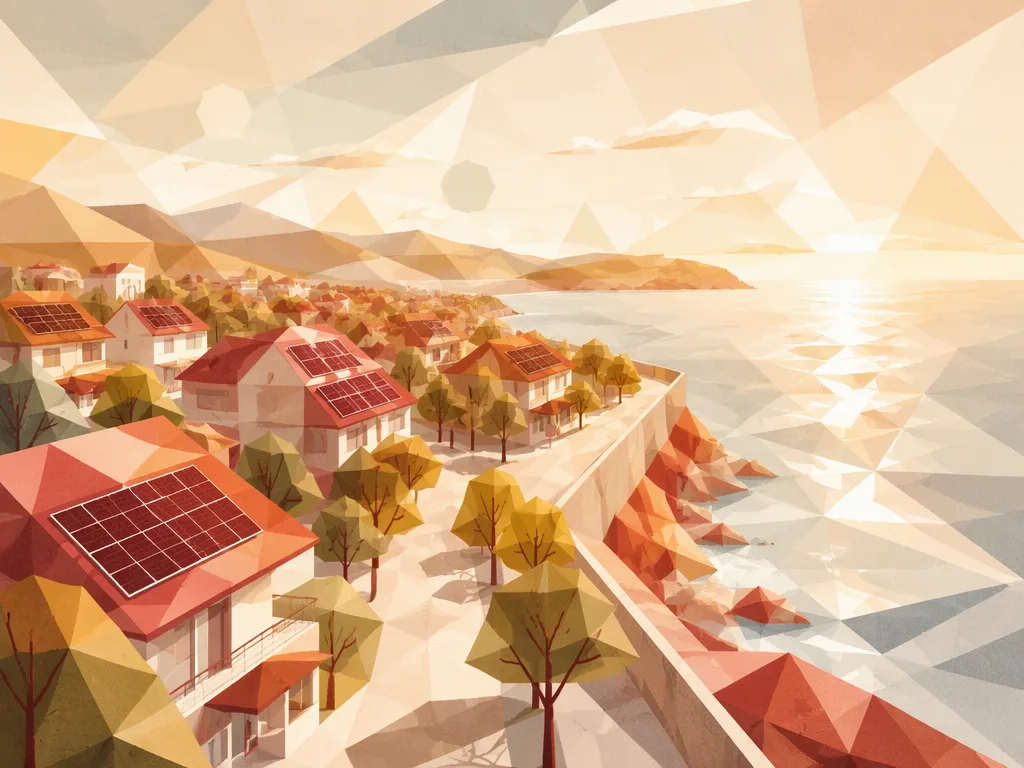
A coastal town raises flood walls, adds solar panels, and insulates homes to reduce heating fuel use.
- Adding solar panels
- Raising flood walls
- Reducing heating fuel use
¿Qué acción ayuda a la localidad a afrontar los impactos del cambio climático en lugar de reducir sus causas?
Show solution
- Raising flood walls
La adaptación reduce los daños causados por los impactos del cambio climático. La mitigación aborda las causas, principalmente mediante la reducción de las emisiones de gases de efecto invernadero.
-
6. Elige la respuesta correcta.
¿Qué sucede a medida que se disuelve más dióxido de carbono en el agua de mar?
The ocean absorbs some of the carbon dioxide released into the atmosphere.
- The water becomes less acidic.
- The water's acidity stays unchanged.
- The water becomes more acidic.
Show solution
- The water becomes more acidic.
El dióxido de carbono disuelto forma un ácido débil. Este cambio puede dificultar que algunos animales marinos formen sus conchas.
-
7. Elige la respuesta correcta.
¿Cómo puede esto afectar las precipitaciones durante las tormentas?
Warmer air can contain more water vapor before becoming saturated.
- It can make heavy rainfall more intense.
- It guarantees more rainy days in every region.
- It makes heavy rainfall less intense by keeping water in the air.
Show solution
- It can make heavy rainfall more intense.
Una mayor cantidad de humedad disponible puede aumentar la intensidad de las lluvias. Sin embargo, las precipitaciones locales también dependen de los vientos y los patrones meteorológicos, por lo que algunas regiones pueden volverse más secas.
-
8. Completa el espacio en blanco.
When bright sea ice melts, it exposes darker ocean water. The darker surface absorbs more sunlight, which can cause ___ warming.
- less
- no further
- additional
Bright ice reflects more sunlight than dark ocean water.
Show solution
When bright sea ice melts, it exposes darker ocean water. The darker surface absorbs more sunlight, which can cause additional warming.
This is a reinforcing feedback loop: an initial change triggers effects that strengthen that change.
-
9. Elige la respuesta correcta.
What should be included for the most complete comparison of their greenhouse gas emissions?
Two buses travel the same route for the same number of years. One runs on diesel; the other runs on electricity.
- Only emissions released from their exhaust pipes during use
- Emissions from manufacturing, energy supply, use, and disposal
- Emissions from manufacturing and disposal, excluding energy use
Consider what happens before, during, and after the buses are used.
Show solution
- Emissions from manufacturing, energy supply, use, and disposal
A life-cycle comparison includes more than exhaust emissions. For an electric bus, the way its electricity is generated also matters.
-
10. Elige la respuesta correcta.
What has the company achieved?
A company cuts most of its carbon dioxide emissions and then removes from the atmosphere an amount equal to what it still releases.
- No carbon dioxide released at all
- More carbon dioxide removed than released
- Net-zero carbon dioxide emissions
Separate the amount released from the final balance after removals.
Show solution
- Net-zero carbon dioxide emissions
Net zero means emissions and removals are in balance. It does not mean emissions have stopped or past emissions have been erased.
-
11. Elige la respuesta correcta.
¿Qué conclusión respalda esta comparación?
Climate simulations using only natural influences do not reproduce the global warming observed in recent decades. Those that also include human influences match the trend much better.
- Human influences help explain recent global warming.
- Natural influences alone explain the recent warming trend.
- Human influences affect short-term weather but not long-term climate.
Observa qué simulaciones coinciden mejor con los cambios que se han medido realmente.
Show solution
- Human influences help explain recent global warming.
Las emisiones de gases de efecto invernadero generadas por los seres humanos son la principal causa del calentamiento global reciente. Los factores naturales siguen influyendo en el clima.
-
12. Elige la respuesta correcta.
Why can both projections be scientifically useful?
Two climate projections use the same model but different future emission pathways. They show different amounts of warming by the end of the century.
- They record two warming trends that have already occurred.
- They explore outcomes under different assumptions about future emissions.
- They show that future warming is independent of emissions.
A projection describes what could happen under particular conditions.
Show solution
- They explore outcomes under different assumptions about future emissions.
A projection depends on its assumptions; it is not a prediction of what will definitely happen. Different pathways help show how future emissions can affect climate risks.