


Accidentes comunes
Explora pequeños accidentes cotidianos y aprende formas útiles de describir lo que pasó.
Preview
Questions with solutions-
1. Elige la respuesta correcta.
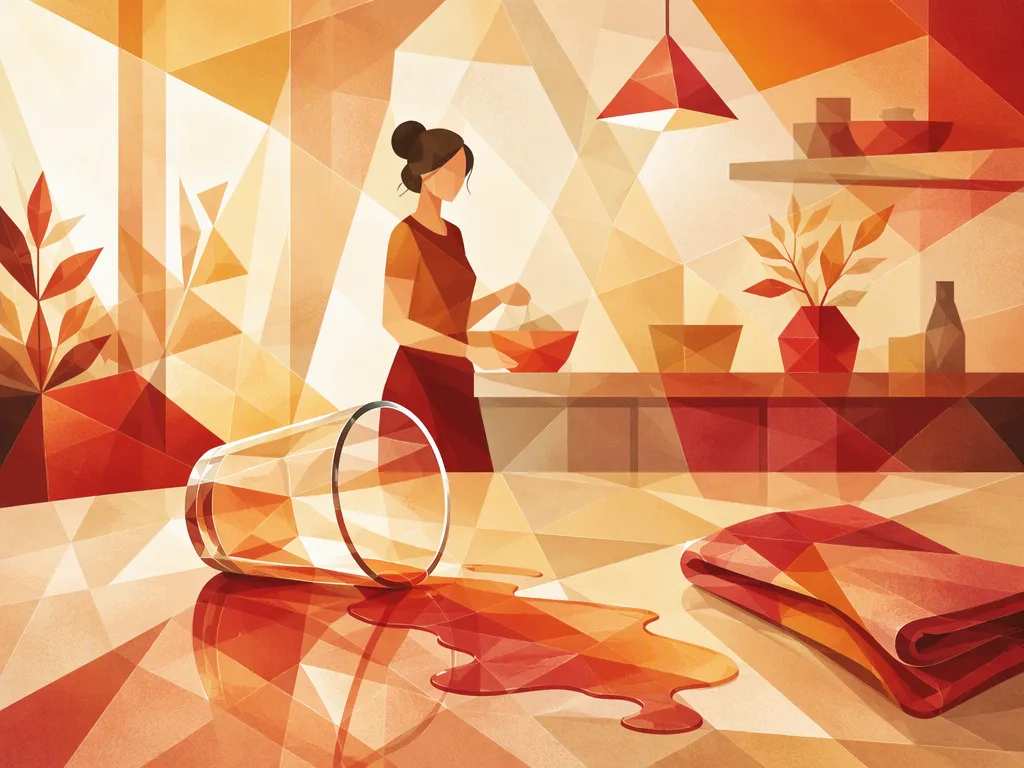
¿Qué le pasó al jugo?
Lily knocked over her cup. Now there's juice all over the table.
- She spilled it.
- She drank it.
- She poured it into a glass.
El jugo ya no está dentro del vaso.
Show solution
- She spilled it.
Usamos “spill” cuando un líquido se sale accidentalmente de su recipiente.
-
2. Elige la respuesta correcta.
How did Ben hurt his finger?
Ben was cutting an apple. The knife slipped, and now his finger is bleeding.
- He burned his finger.
- He cut his finger.
- He twisted his finger.
Think about the sharp edge of a knife.
Show solution
- He cut his finger.
“Cut” can describe both cutting food and an injury from something sharp.
-
3. Elige la respuesta correcta.
What happened to Ana's hand?
Ana accidentally touched a very hot pan, and now her hand is red and really hurts.
- She bruised her hand.
- She cut her hand.
- She burned her hand.
The injury came from heat.
Show solution
- She burned her hand.
A hot object or hot liquid can cause a burn.
-
4. Elige la respuesta correcta.
¿Qué les pasó a las llaves de Omar?
The keys fell out of Omar's hand. He can see them on the floor by his feet.
- He dropped them.
- He lost them.
- He threw them.
Las llaves se cayeron por accidente y Omar sabe dónde están.
Show solution
- He dropped them.
“Drop” significa dejar caer algo. “Throw” describe la acción de lanzar algo por el aire a propósito.
-
5. Elige la respuesta correcta.
¿Qué puede decir Eva sobre el plato?
The plate fell onto the kitchen floor. It's now in three separate pieces.
- It's scratched.
- It's broken.
- It's bent.
El plato ya no está en una sola pieza.
Show solution
- It's broken.
“Broken” describe algo dañado que ya no está entero o no funciona.
-
6. Elige la respuesta correcta.
¿Qué parte del cuerpo de Jack golpeó el estante?
Jack stood up under a low shelf and bumped his head.
- His shoulder.
- His back.
- His head.
Piensa en la parte más alta de su cuerpo al ponerse de pie.
Show solution
- His head.
Cuando se usa “bump” con una parte del cuerpo, significa golpearla contra algo, generalmente por accidente.
-
7. Elige la respuesta correcta.
¿Cómo se cayó Maya?
The bathroom floor was wet. Maya's feet slid across it, and she fell.
- She slipped.
- She tripped over a bag.
- She fell off a chair.
Sus pies se movieron sobre una superficie mojada.
Show solution
- She slipped.
“slip” significa que tus pies se deslizan y pierdes el equilibrio.
-
8. Elige la respuesta correcta.
¿Qué le pasó a Leo?
Leo's foot caught on a bag in the hallway, and he fell forward.
- He slipped on a wet floor.
- He tripped over the bag.
- He fell down the stairs.
Algo detuvo su pie mientras caminaba.
Show solution
- He tripped over the bag.
Puedes “trip over” algo que está en el suelo, como una bolsa o un cable suelto.
-
9. Elige la respuesta correcta.
What is the dark mark on Nina's leg?
Nina hit her leg against a table yesterday. There's a dark purple mark, but the skin isn't cut.
- A burn.
- A cut.
- A bruise.
Hitting something can leave a colored mark without breaking the skin.
Show solution
- A bruise.
A bruise can change color as it gets better.
-
10. Elige la respuesta correcta.
¿Cómo puede Tom describir su lesión?
Tom fell on a rough sidewalk. His knee rubbed against it, and a little skin came off.
- I scraped my knee.
- I twisted my knee.
- I burned my knee.
La superficie áspera le raspó parte de la piel.
Show solution
- I scraped my knee.
Una raspadura es una lesión superficial. Las raspaduras en las rodillas son comunes después de una caída.
-
11. Elige la respuesta correcta.
¿Qué puede decir Sam sobre el accidente?
Sam stepped off the curb. His foot turned sideways, and now his ankle hurts.
- I cut my heel.
- I twisted my ankle.
- I scraped my toes.
Su pie giró en una dirección poco natural.
Show solution
- I twisted my ankle.
“Twisted my ankle” describe el accidente sin indicar exactamente qué tan grave es la lesión.
-
12. Elige la respuesta correcta.
What does Rosa mean?
“I caught my finger in the door when it closed. Ouch!”
- Her finger touched a hot door handle.
- Her finger was cut by a sharp key.
- Her finger was trapped as the door shut.
Her finger was in the way when the door closed.
Show solution
- Her finger was trapped as the door shut.
Here, “caught” means trapped, not catching something that was thrown, like a ball.
-
13. Elige la respuesta correcta.
¿Qué significa “Watch out!” aquí?
A ball is flying toward Dan. His friend shouts, “Watch out!”
- Be careful! Something could hit you.
- You can relax. The danger has passed.
- Stay there. Nothing is coming toward you.
El amigo quiere evitar un accidente.
Show solution
- Be careful! Something could hit you.
“Watch out!” es una advertencia rápida sobre un peligro cercano.
-
14. Elige la respuesta correcta.
Did Alex fall down the stairs?
Alex says, “I nearly fell down the stairs, but I grabbed the railing and stayed on my feet.”
- Yes, but he wasn't hurt.
- No, he stopped himself from falling.
- Yes, and he hurt his arm.
Notice “nearly” and “stayed on my feet.”
Show solution
- No, he stopped himself from falling.
“Nearly” means almost. The fall came close to happening, but it did not happen.
-
15. Elige la respuesta correcta.
What happened in Chris's fall?
“I fell outside the store. I didn't hurt myself, but my jacket caught on a sharp edge and tore.”
- His arm was cut.
- His phone was broken.
- His jacket was torn.
Chris was not injured, but something he was wearing was damaged.
Show solution
- His jacket was torn.
“Tore” is the past form of “tear.” Torn clothing has a hole or opening in the fabric.