


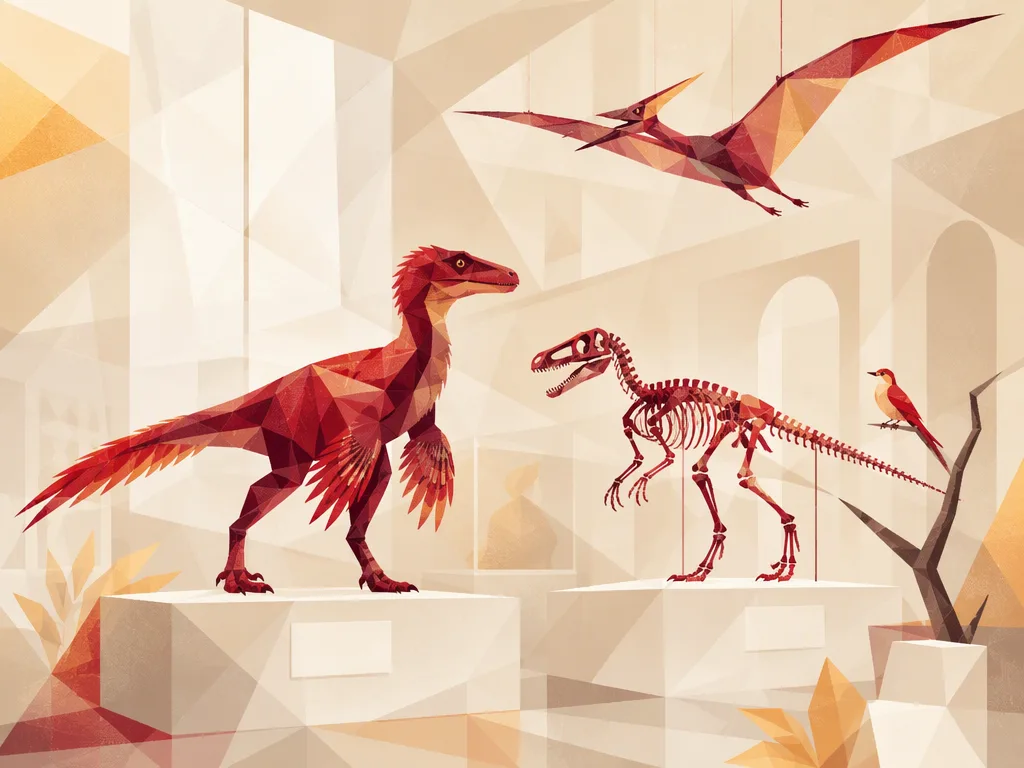
Dinosaurios: hechos vs. ficción
Explora los descubrimientos sobre dinosaurios, datos sorprendentes y mitos del cine. Descubre qué pueden —y qué no pueden— decirnos los fósiles.
Preview
Questions with solutions-
1. Elige la respuesta correcta.
How was the real past different?
A movie shows people running away from a living T. rex.
- T. rex lived long before humans appeared.
- Early humans hunted T. rex with simple tools.
- T. rex disappeared shortly after the first humans appeared.
Show solution
- T. rex lived long before humans appeared.
Movies sometimes mix time periods. T. rex died out millions of years before humans appeared.
-
2. Elige la respuesta correcta.
¿Qué comía principalmente el Triceratops?
Triceratops had three horns, a large head, and a sharp beak.
- Other dinosaurs
- Plants
- Fish
Show solution
- Plants
Sus cuernos no lo convertían en un animal carnívoro. Su pico cortaba plantas y sus dientes las partían en pedazos más pequeños.
-
3. Elige la respuesta correcta.
¿Qué animales pertenecen al grupo de dinosaurios que sobrevive hasta hoy?
Most dinosaur groups died out long ago, but one group is still alive.
- Lizards
- Crocodiles
- Birds
Show solution
- Birds
Las aves evolucionaron a partir de pequeños dinosaurios carnívoros. Un gorrión forma parte del árbol genealógico de los dinosaurios.
-
4. Elige la respuesta correcta.
¿Qué eran los pterosaurios?
Pterosaurs had wings and lived at the same time as many dinosaurs.
- Flying reptiles related to dinosaurs
- Dinosaurs with wings made of feathers
- Early birds with unusually large beaks
Vivir en la misma época no hace que los animales pertenezcan al mismo grupo.
Show solution
- Flying reptiles related to dinosaurs
Los pterosaurios eran un grupo aparte. Sus alas estaban hechas de piel en lugar de plumas.
-
5. Elige la respuesta correcta.
What do fossils tell us about the real animal's height?
Movies often show a Velociraptor standing as tall as an adult.
- It was much taller than an adult.
- It was about as tall as an adult.
- It was much shorter than an adult.
Show solution
- It was much shorter than an adult.
A real Velociraptor stood roughly knee-high. Its long tail made it much longer than it was tall.
-
6. Elige la respuesta correcta.
¿Qué imagen de la vida de los dinosaurios concuerda con estos descubrimientos?
Dinosaur fossils occur in rocks formed in ancient deserts as well as forests.
- All dinosaurs lived in wet swamps.
- Different dinosaurs lived in different environments.
- Dinosaurs could live only beside the ocean.
Show solution
- Different dinosaurs lived in different environments.
Las selvas de las películas muestran solo uno de los posibles entornos. Los dinosaurios vivían en muchos tipos de lugares.
-
7. Elige la respuesta correcta.
What does this discovery tell us about feathers?
A fossil of a small dinosaur shows that it had feathers, but its arms were too short for flight.
- Having feathers did not always mean an animal could fly.
- Every dinosaur with feathers could fly.
- Feathers appeared only after dinosaurs died out.
Show solution
- Having feathers did not always mean an animal could fly.
Feathers can also help keep an animal warm. Flight is not their only use.
-
8. Elige la respuesta correcta.
¿Podrían estos dos dinosaurios haberse encontrado en la naturaleza?
Stegosaurus lived in the Jurassic period. T. rex lived much later, in the Cretaceous period.
- Yes, because all dinosaurs lived at the same time.
- Yes, if they lived beside the same river.
- No, because they lived at different times.
Compara los períodos de tiempo, no los lugares.
Show solution
- No, because they lived at different times.
La era de los dinosaurios duró muchísimo tiempo. Muchos dinosaurios famosos nunca vivieron en la misma época.
-
9. Elige la respuesta correcta.
Which event does this evidence support?
Scientists found a huge impact crater in Mexico and material from the impact in a rock layer found around the world.
- A long ice age dug out the crater.
- A large asteroid hit Earth.
- A series of volcanoes formed the impact crater.
Show solution
- A large asteroid hit Earth.
The impact sent dust into the sky. Less sunlight killed off plants and helped cause a mass extinction.
-
10. Elige la respuesta correcta.
¿Cómo se convierten muchos huesos enterrados en fósiles?
Many dinosaur fossils feel more like rock than fresh bone.
- Minerals fill spaces or replace material in the bones.
- Heat melts the bones into new rock.
- The bones dry out and remain completely unchanged.
Show solution
- Minerals fill spaces or replace material in the bones.
El agua subterránea puede transportar minerales al interior de los huesos enterrados. Este proceso puede preservar su forma durante millones de años.
-
11. Elige la respuesta correcta.
What does this fossil show about the dinosaur's teeth?
A dinosaur jaw has a small new tooth growing below an older tooth.
- It had only one set of teeth for its whole life.
- It was losing all its teeth permanently.
- New teeth could replace older teeth.
Show solution
- New teeth could replace older teeth.
Many dinosaurs replaced their teeth throughout their lives. People normally have only two sets.
-
12. Elige la respuesta correcta.
How did these dinosaurs probably hold their tails while walking?
Many sets of dinosaur tracks show clear footprints but no marks from a tail.
- They dragged their tails behind them.
- They held their tails off the ground.
- They rested their weight on their tails with each step.
Think about what would leave a mark between the footprints.
Show solution
- They held their tails off the ground.
Old pictures often show dinosaurs dragging their tails. A raised tail could help a two-legged dinosaur balance.
-
13. Elige la respuesta correcta.
¿Qué pueden ayudar a estimar estos anillos a los científicos?
Some dinosaur bones contain growth rings, a little like the rings inside tree trunks.
- How old the animal was when it died
- How many meals the animal ate
- How many eggs the animal laid
Show solution
- How old the animal was when it died
El crecimiento puede ralentizarse durante parte del año, dejando una línea dentro del hueso.
-
14. Elige la respuesta correcta.
What do these marks show on their own?
Scientists found T. rex tooth marks on the bones of a plant-eating dinosaur.
- The T. rex must have killed this animal itself.
- T. rex only ate animals that were already dead.
- The T. rex may have bitten it before or after it died.
A bite mark does not tell us exactly when the bite happened.
Show solution
- The T. rex may have bitten it before or after it died.
Many meat-eating animals both hunt and eat animals they find already dead. Bite marks alone cannot tell those behaviors apart.
-
15. Elige la respuesta correcta.
What do scientists know about how a T. rex really sounded?
A movie gives a T. rex a deep, lion-like roar.
- Its size proves that it roared like a lion.
- What it actually sounded like is still unknown.
- Its teeth tell us exactly how its roar sounded.
Show solution
- What it actually sounded like is still unknown.
Living relatives, such as birds and crocodiles, offer clues about possible sounds. A movie roar is still a creative choice.