


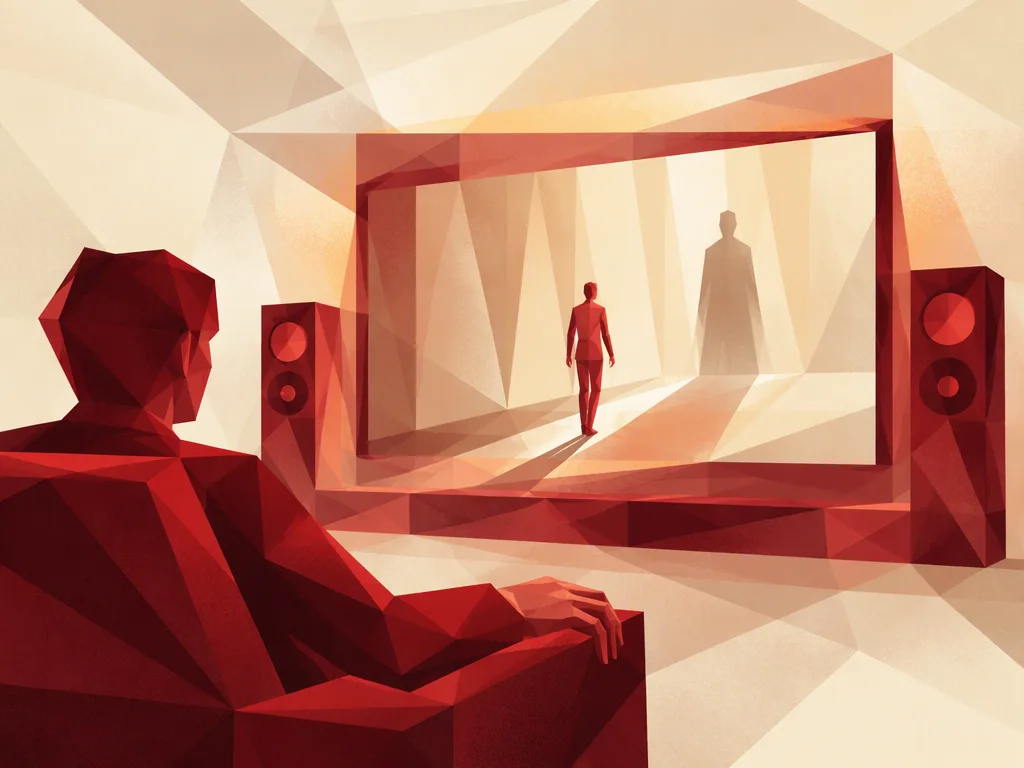
Cómo las películas manipulan nuestras emociones
Descubre cómo la música, el montaje y la narración moldean lo que sentimos y lo que esperamos que suceda después.
Preview
Questions with solutions-
1. Elige la respuesta correcta.
A character walks through an ordinary hotel hallway. Nothing looks unusual, but the music changes from a gentle melody to low, threatening notes. What does the music encourage the audience to expect?
- The character is finally able to relax.
- Something dangerous may be about to happen.
- The character is remembering a happy visit.
- The danger has passed and the scene is ending.
Compare what you hear with what you see.
Show solution
- Something dangerous may be about to happen.
Music can create expectations before the image confirms them, making an ordinary place suddenly feel unsafe.
-
2. Elige la respuesta correcta.
During a chase, the film cuts rapidly between running feet, a ticking clock, and a train pulling away. The shots become shorter as the character approaches the platform. What effect does this editing create?
- It makes the station feel peaceful and familiar.
- It gives viewers more time to study each detail.
- It increases the sense of urgency.
- It suggests that the chase is a distant memory.
Think about how much time you have to take in each image.
Show solution
- It increases the sense of urgency.
Shorter shots give viewers less time to process what they see, so editing can make an event feel faster without changing the action itself.
-
3. Elige la respuesta correcta.
After receiving disappointing news, a character says, "I'm fine." The camera moves close to her face and holds on her trembling lips. What does this close-up draw attention to?
- The feelings that her words are trying to hide.
- The distance between her and the other characters.
- The arrangement of objects throughout the room.
- The exact wording of the news she received.
Observa la diferencia entre sus palabras y su expresión.
Show solution
- The feelings that her words are trying to hide.
Los pequeños movimientos faciales pueden comunicar sentimientos que el diálogo deja sin expresar. Un primer plano hace que esos detalles sean más fáciles de notar.
-
4. Elige la respuesta correcta.
The audience sees an intruder hide behind a curtain. Moments later, the homeowner enters, unaware that anyone is there. Why can this scene create suspense before either person makes a move?
- The homeowner has already discovered the intruder.
- The audience knows that the intruder will be caught.
- Both characters are waiting for the same planned meeting.
- The audience knows about a danger that the homeowner does not.
Compare what the audience knows with what the homeowner knows.
Show solution
- The audience knows about a danger that the homeowner does not.
This knowledge gap is called dramatic irony. Knowing more than a character can make viewers feel less secure, not more.
-
5. Elige la respuesta correcta.
At the end of an episode, a detective opens a door and says, "I know who did it." The screen goes black before the name is revealed. What makes this ending a cliffhanger?
- It settles the mystery before the episode ends.
- It stops at a crucial moment while leaving the mystery unresolved.
- It returns to an earlier event to explain the detective's childhood.
- It shows that the identity of the criminal no longer matters.
Consider what the audience is still waiting to learn.
Show solution
- It stops at a crucial moment while leaving the mystery unresolved.
A cliffhanger delays resolution at a moment of high interest, carrying suspense beyond the final scene.
-
6. Elige la respuesta correcta.
A song plays while two characters argue in a car. One character reaches toward the dashboard and turns off the radio; the song immediately stops. What does this reveal about the music?
- It exists only for the audience and cannot be heard by the characters.
- It represents a song that one character is silently remembering.
- It comes from a source within the scene that the characters can hear.
- It signals that the argument is taking place in a dream.
Fíjate en quién controla el sonido y cómo.
Show solution
- It comes from a source within the scene that the characters can hear.
El sonido que proviene del mundo de la historia suele llamarse sonido diegético. A diferencia de la música de fondo, los personajes pueden oírlo.
-
7. Elige la respuesta correcta.
A film repeatedly switches between a stranded hiker waiting on a mountain and a rescue team climbing toward him. There is no sign of a flashback. What connection does this back-and-forth editing encourage viewers to make?
- The two events are happening at the same time and are connected.
- The rescue was completed before the hiker became stranded.
- The hiker is remembering a climb he made with the rescue team.
- The scenes show different versions of the same person's journey.
Piensa en por qué la película vuelve una y otra vez a ambos lugares.
Show solution
- The two events are happening at the same time and are connected.
Esta técnica, llamada montaje alterno, conecta espacios separados y puede hacer que los espectadores anticipen un encuentro o un rescate.
-
8. Elige la respuesta correcta.
A rescue worker refuses to enter a flooded tunnel, and another character accuses her of not caring. Later, a flashback shows that she nearly drowned as a child. How does this new information change our understanding of her refusal?
- It establishes that the tunnel presents no real danger.
- It reveals that she has already rescued everyone inside.
- It confirms that she feels no concern for other people.
- It connects her behavior to a frightening past experience.
¿La escena retrospectiva cambia lo que ocurrió o cómo lo interpretamos?
Show solution
- It connects her behavior to a frightening past experience.
Una escena retrospectiva puede cambiar nuestra valoración de una acción anterior sin cambiar la acción en sí. Un nuevo contexto puede generar empatía.
-
9. Elige la respuesta correcta.
An editor uses the same shot of a man's neutral face in two versions of a scene. In one version, it follows a shot of a meal; in the other, a shot of a funeral. Viewers describe him as hungry in the first and sad in the second. What best explains the difference?
- The actor changes his expression between the two versions.
- The face directly reveals two emotions without help from other images.
- The surrounding shots influence how viewers interpret the same expression.
- The order of the images plays no role in how viewers understand the face.
The shot of the face stays exactly the same.
Show solution
- The surrounding shots influence how viewers interpret the same expression.
Viewers create meaning by connecting neighboring shots. Editing can suggest an emotion that the actor's expression does not clearly show.
-
10. Elige la respuesta correcta.
A critic describes a scene as "ironic": cheerful dance music plays while a character cruelly betrays a close friend. What contrast is the critic referring to?
- The music suggests happiness while the action shows cruelty.
- The music and the action both express the same joyful mood.
- The cheerful music reveals that the betrayal happened long ago.
- The music expresses the betrayed friend's pleasure at the event.
Compare the emotional message of the music with the action.
Show solution
- The music suggests happiness while the action shows cruelty.
Music does not always match a scene's mood. A deliberate clash can create irony or make disturbing behavior feel even more unsettling.
-
11. Elige la respuesta correcta.
A film follows a thief who steals to support his younger sister. We see his fear and their close relationship, but we never meet the people he steals from. How does this limited viewpoint guide the audience's sympathy?
- It proves that his actions cause no harm to anyone.
- It highlights his struggles while leaving his victims' experiences unseen.
- It gives equal attention to his needs and his victims' losses.
- It prevents viewers from learning why he steals.
Notice whose experiences receive attention and whose do not.
Show solution
- It highlights his struggles while leaving his victims' experiences unseen.
A film can make a character's motives understandable without proving their behavior is right. Access to a character's viewpoint is not the same as moral approval.
-
12. Elige la respuesta correcta.
Early in a film, a father struggles to sing his daughter's favorite song and stops halfway through. After they repair their troubled relationship, he sings it to her in full. Why does the final song work as an emotional payoff?
- It warns of a future conflict that the story has not yet shown.
- It interrupts the present to show how their argument began.
- It repeats an earlier moment without changing its emotional meaning.
- It completes an earlier unfinished moment in a way that reflects their changed relationship.
Busca una conexión entre la canción inconclusa y la relación reparada.
Show solution
- It completes an earlier unfinished moment in a way that reflects their changed relationship.
Un detalle anterior sirve como preparación cuando una escena posterior le da un nuevo significado. Completar la canción hace que la relación reparada se perciba como algo tangible.