


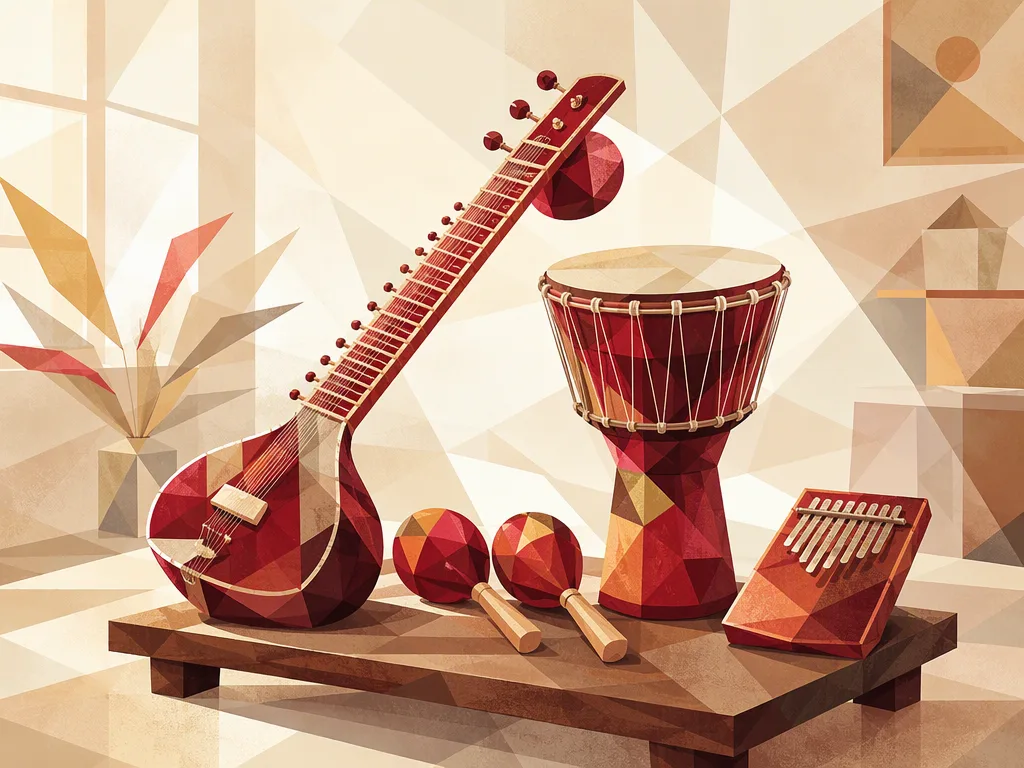
Instrumentos musicales de todo el mundo
Explora cómo se tocan los instrumentos, de dónde vienen y qué hace que sus sonidos sean especiales.
Preview
Questions with solutions-
1. Completa el espacio en blanco.
A guitar player usually ___ the strings with their fingers or a small pick.
- plucks
- bows
- blows into
- shakes
Show solution
A guitar player usually plucks the strings with their fingers or a small pick.
A pick is a small tool used to catch and release the strings, making them move and produce sound.
-
2. Elige la respuesta correcta.
Which part of the violin does the bow touch?
A violin player holds the instrument under their chin and moves a bow to produce a note.
- The keys
- The strings
- The drumhead
- The mouthpiece
Show solution
- The strings
The hairs on the bow catch the strings as the bow moves across them, helping the player produce a long, steady note.
-
3. Elige la respuesta correcta.
Which instrument family does the flute belong to?
Most modern flutes are made of metal, but their sound comes from air moving inside a tube.
- Strings
- Brass
- Woodwinds
- Percussion
The material alone does not decide the family.
Show solution
- Woodwinds
A woodwind instrument does not have to be made of wood. How it produces sound is more important.
-
4. Completa el espacio en blanco.
A drum belongs to the ___ family because it is usually played by hitting it.
- string
- woodwind
- brass
- percussion
Show solution
A drum belongs to the percussion family because it is usually played by hitting it.
Los instrumentos de percusión se pueden golpear, sacudir o raspar. Los tambores son solo una parte de esta gran familia.
-
5. Elige la respuesta correcta.
¿Cómo se suelen tocar las maracas?
Maracas are common in Latin American music. Their hollow bodies contain small seeds or beads.
- By shaking them
- By blowing into them
- By drawing a bow across them
- By pressing keys on them
Show solution
- By shaking them
Las semillas o cuentas golpean las paredes interiores y producen un leve sonido de cascabeleo.
-
6. Completa el espacio en blanco.
The sitar is a string instrument strongly linked with classical music from ___.
- Japan
- India
- China
- Indonesia
Show solution
The sitar is a string instrument strongly linked with classical music from India.
Un sitar tiene cuerdas adicionales que pueden sonar junto con las cuerdas principales, incluso cuando el músico no las toca.
-
7. Elige la respuesta correcta.
¿Qué instrumento se está tocando?
A musician blows into a long wooden tube, producing a deep, steady sound. The instrument comes from Aboriginal traditions in Australia.
- A trumpet
- A clarinet
- A didgeridoo
- A flute
Show solution
- A didgeridoo
El didgeridoo está especialmente vinculado con los pueblos aborígenes del norte de Australia.
-
8. Elige la respuesta correcta.
¿Dónde debe golpear el músico para obtener el sonido grave descrito?
A djembe is a West African hand drum. A relaxed hand striking the center gives a deep sound; a strike near the edge can give a higher, sharper sound.
- Near the edge of the drumhead
- On the wooden side of the drum
- In the center of the drumhead
Show solution
- In the center of the drumhead
Un djembé puede producir varios sonidos diferentes, lo que permite al músico crear un ritmo variado con un solo tambor.
-
9. Completa el espacio en blanco.
In Trinidad and Tobago, musicians developed the steelpan from large ___ barrels.
- wooden
- plastic
- clay
- metal
The instrument's name gives a clue about its material.
Show solution
In Trinidad and Tobago, musicians developed the steelpan from large metal barrels.
Differently shaped areas of a steelpan produce different notes when hit, so it can play a melody.
-
10. Elige la respuesta correcta.
¿Por qué el acordeonista sigue empujando la sección central y tirando de ella?
An accordion needs flowing air to make sound. Its middle section opens and closes like a folding fan.
- To move air through the instrument
- To tighten and loosen its strings
- To strike a stretched drumhead
- To shake loose beads inside it
Show solution
- To move air through the instrument
El aire hace vibrar unas pequeñas piezas de metal llamadas lengüetas. Las teclas y los botones controlan qué notas suenan.
-
11. Elige la respuesta correcta.
¿Cómo suele producir notas una persona que toca la kalimba?
A kalimba is an African instrument with thin metal strips fixed to a wooden board or box. The player holds it in both hands.
- By blowing across the metal strips
- By plucking the metal strips with the thumbs
- By moving a bow across the wooden body
- By pressing foot pedals below the box
Los dedos de quien toca sostienen el instrumento, dejando libres los pulgares.
Show solution
- By plucking the metal strips with the thumbs
La kalimba suele llamarse piano de pulgar, aunque tiene láminas de metal en lugar de teclas de piano.
-
12. Elige la respuesta correcta.
¿Qué sería lo más probable que ocurriera si se quitaran las calabazas?
A West African balafon has wooden bars above hollow, dried gourds. The bars make sound when hit, and air moving inside the gourds adds to that sound.
- The bars would make no sound at all.
- The sound would become louder.
- The sound would become quieter.
Las barras producen las notas; las calabazas refuerzan el sonido.
Show solution
- The sound would become quieter.
Las calabazas actúan como pequeñas cajas de resonancia, lo que ayuda a que las notas lleguen más lejos.
-
13. Elige la respuesta correcta.
¿Qué permite que las notas sigan sonando mientras el músico toma aire?
A bagpipe player blows air into a bag, then squeezes the bag to push air through the pipes.
- Air drawn in through the finger holes
- Air already stored in the bag
- Air stored in the player's mouth
Show solution
- Air already stored in the bag
Las gaitas están estrechamente asociadas con Escocia, pero también se tocan distintos tipos en muchas otras regiones.
-
14. Elige la respuesta correcta.
¿Qué tipo de tubo agregaría una nota más grave?
Panpipes are played in the Andes. In a set of tubes with the same width, shorter tubes make higher notes and longer tubes make lower notes.
- A tube longer than the others
- A tube shorter than the others
- A tube the same length as an existing tube
Show solution
- A tube longer than the others
Cada tubo produce su propia nota, por lo que los músicos mueven la boca de un tubo a otro para tocar una melodía.
-
15. Elige la respuesta correcta.
Which description explains the piano's link to both string and percussion instruments?
Inside a piano, pressing a key makes a small hammer hit a string. The string then vibrates and produces the note.
- Its notes come from strings that are plucked.
- Its notes come from stretched skin that is struck.
- Its notes come from strings that are struck.
Think about both the part that sounds and the action that starts it.
Show solution
- Its notes come from strings that are struck.
The keyboard is the player's control system. Hidden inside, hammers and strings do the sound-making work.