


La ciencia de las cosas cotidianas
Explora por qué el hielo se derrite, las sombras crecen y los objetos cotidianos se comportan de maneras sorprendentes.
Preview
Questions with solutions-
1. Elige la respuesta correcta.
¿Por qué el hielo se vuelve líquido?
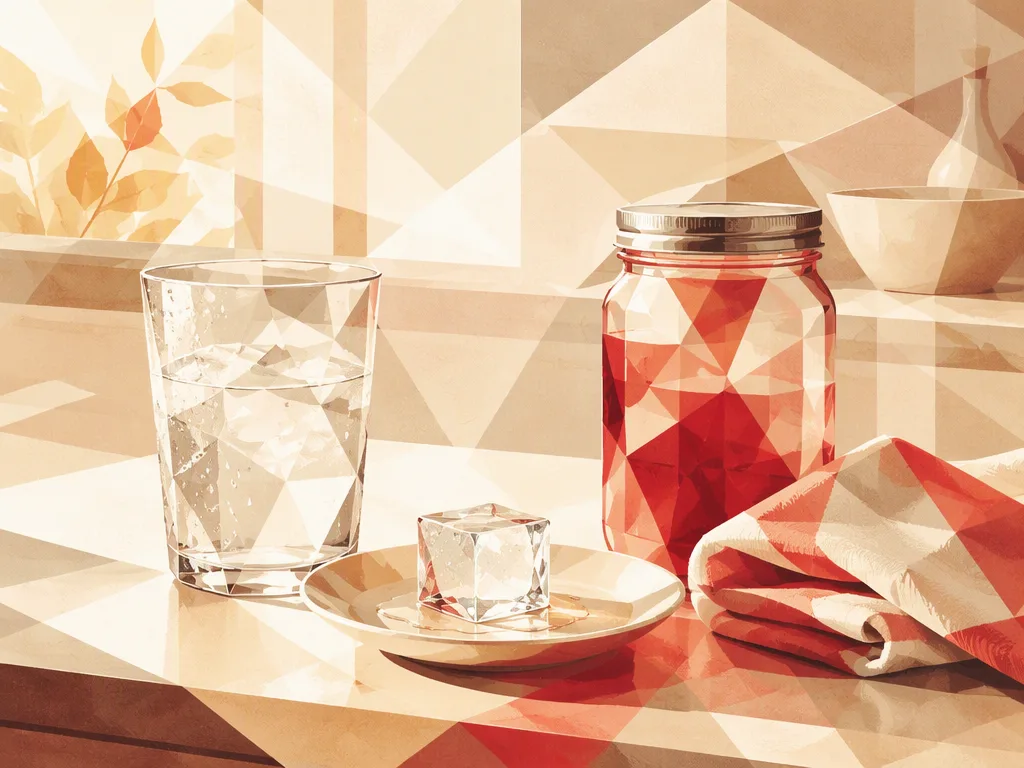
An ice cube is left on a plate in a warm kitchen. Slowly, it melts.
- It absorbs heat from the room.
- It releases heat into the room.
- The room air presses it into a liquid.
Piensa en cuál está más caliente: el hielo o la habitación.
Show solution
- It absorbs heat from the room.
El calor se transfiere de las cosas más calientes a las más frías. Incluso el aire fresco de una habitación puede estar lo suficientemente caliente como para derretir el hielo.
-
2. Completa el espacio en blanco.
A ball rolls across a level carpet. It slows down because ___ acts against its movement.
- gravity
- friction
- magnetism
Think about the contact between the ball and the carpet.
Show solution
A ball rolls across a level carpet. It slows down because friction acts against its movement.
Friction resists movement between touching surfaces. Some of the energy from the ball's movement becomes heat.
-
3. Elige la respuesta correcta.
¿Por qué puedes ver tu cara en el espejo?
You stand in front of a mirror in a bright room.
- It makes its own light in the shape of your face.
- It pulls light from your eyes toward your face.
- It sends light from your face back to your eyes.
Un espejo cambia la dirección de la luz.
Show solution
- It sends light from your face back to your eyes.
Un espejo refleja la luz. Su superficie lisa mantiene ordenada la luz reflejada, por eso ves una imagen clara.
-
4. Elige la respuesta correcta.
¿Qué produce el sonido?
You pull a guitar string to one side and let it go. You hear a musical note.
- The string heats the air as it moves.
- The string vibrates and makes the air vibrate.
- The string sends light waves through the air.
Observa cómo se mueve la cuerda después de soltarla.
Show solution
- The string vibrates and makes the air vibrate.
El sonido viaja por el aire en forma de vibraciones. El cuerpo de la guitarra también vibra, lo que hace que el sonido sea más fuerte.
-
5. Completa el espacio en blanco.
Cooking oil and water are at the same temperature. The oil floats on top because it is ___.
- more dense than water
- as dense as water
- less dense than water
Compara el peso de volúmenes iguales de aceite y agua.
Show solution
Cooking oil and water are at the same temperature. The oil floats on top because it is less dense than water.
La densidad compara la masa con el volumen. Una taza de aceite de cocina pesa menos que una taza de agua.
-
6. Elige la respuesta correcta.
Why is your shadow longer in the late afternoon?
On level ground, your shadow is usually longer in the late afternoon than around noon.
- The Sun is lower in the sky.
- The Sun is higher in the sky.
- The Sun is much closer to Earth.
Think about the angle at which sunlight reaches the ground.
Show solution
- The Sun is lower in the sky.
Light from a low Sun reaches the ground at a smaller angle, stretching shadows farther across it.
-
7. Elige la respuesta correcta.
¿De dónde viene el agua que está en la parte exterior?
A dry, unbroken glass is filled with ice water. Soon, drops form on the outside. No water has spilled.
- Water inside passes through the glass.
- Water in the air cools and becomes liquid.
- The ice pushes water over the top.
El aire contiene agua incluso cuando no puedes verla.
Show solution
- Water in the air cools and becomes liquid.
Este cambio se llama condensación. También produce gotas en el espejo del baño después de una ducha caliente.
-
8. Completa el espacio en blanco.
Two shirts are made of the same fabric and have the same thickness. In direct sunlight, the black shirt usually gets hotter because it ___.
- reflects more of the sunlight
- absorbs none of the sunlight
- absorbs more of the sunlight
Think about whether the light bounces away or enters the material.
Show solution
Two shirts are made of the same fabric and have the same thickness. In direct sunlight, the black shirt usually gets hotter because it absorbs more of the sunlight.
Absorbed sunlight adds heat to the fabric. White surfaces reflect more sunlight, which can help them stay cooler.
-
9. Elige la respuesta correcta.
¿Qué atrae el cabello hacia el globo?
You rub a balloon against a sweater. When you hold it near your hair, some hairs rise toward it.
- An electric force.
- A magnetic force.
- Extra air pressure.
La fricción puede transferir pequeñas partículas cargadas de un material a otro.
Show solution
- An electric force.
Al frotarlo, el globo adquiere una carga eléctrica. También puede atraer pequeños trozos de papel, aunque no sean de metal.
-
10. Elige la respuesta correcta.
Why does your skin feel cooler as your hands dry?
Your hands are wet. As they dry in the air, your skin feels cool.
- The water gives extra heat to your skin.
- The water becomes tiny pieces of ice.
- The water takes heat from your skin as it becomes a gas.
Changing liquid water into a gas requires energy.
Show solution
- The water takes heat from your skin as it becomes a gas.
This process is called evaporation. Sweat cools your body in the same way when it evaporates.
-
11. Elige la respuesta correcta.
¿Por qué calentar la tapa puede hacer que sea más fácil abrirla?
A metal lid is stuck on a glass jar. You run warm water over the lid.
- The metal lid becomes lighter.
- The metal lid expands a little.
- The metal lid shrinks a little.
Piensa en cómo cambia el tamaño del metal cuando se calienta.
Show solution
- The metal lid expands a little.
La mayoría de los metales se expanden al calentarse. Incluso un pequeño aumento en el ancho de la tapa puede hacer que quede menos ajustada al frasco.
-
12. Elige la respuesta correcta.
¿Cómo ayuda el aire atrapado a que una bebida caliente se mantenga caliente?
A cup has two walls with still air trapped between them.
- The air slows the movement of heat out of the cup.
- The air produces new heat inside the cup.
- The air carries heat quickly through the walls.
El aire en reposo no transmite el calor fácilmente.
Show solution
- The air slows the movement of heat out of the cup.
El aire atrapado proporciona aislamiento: hace más lenta la pérdida de calor. Muchas chaquetas abrigadas también atrapan aire entre sus fibras.
-
13. Completa el espacio en blanco.
Two backpacks weigh the same, but one has wider shoulder straps. The wider straps can feel more comfortable because they spread the weight over ___.
- a smaller area of your shoulders
- the same area of your shoulders
- a larger area of your shoulders
Compare how a thin string and a wide belt press against your hand.
Show solution
Two backpacks weigh the same, but one has wider shoulder straps. The wider straps can feel more comfortable because they spread the weight over a larger area of your shoulders.
The same force spread over a larger area creates less pressure. Wider straps reduce pressure without reducing the backpack's weight.
-
14. Elige la respuesta correcta.
Why can potatoes take longer to cook in boiling water there?
High in the mountains, water boils at a lower temperature than it does at sea level.
- Water stops transferring heat once it boils.
- The water is cooler, even while it is boiling.
- The bubbles in the boiling water prevent heat from reaching the potatoes.
Boiling water is not always at the same temperature.
Show solution
- The water is cooler, even while it is boiling.
Lower air pressure allows water to boil at a lower temperature. Food can therefore cook more slowly, even with plenty of bubbles.
-
15. Elige la respuesta correcta.
What makes the bottle's sides bend inward?
A thin plastic bottle full of warm air is tightly closed. As it cools in a cold room, its sides bend inward.
- The air inside pushes harder than the air outside.
- The air pressure is equal inside and outside.
- The air outside pushes harder than the air inside.
The bottle is closed, so no more air can enter as the trapped air cools.
Show solution
- The air outside pushes harder than the air inside.
Cooling lowers the pressure of the trapped air. Outside air then pushes the flexible sides inward.