


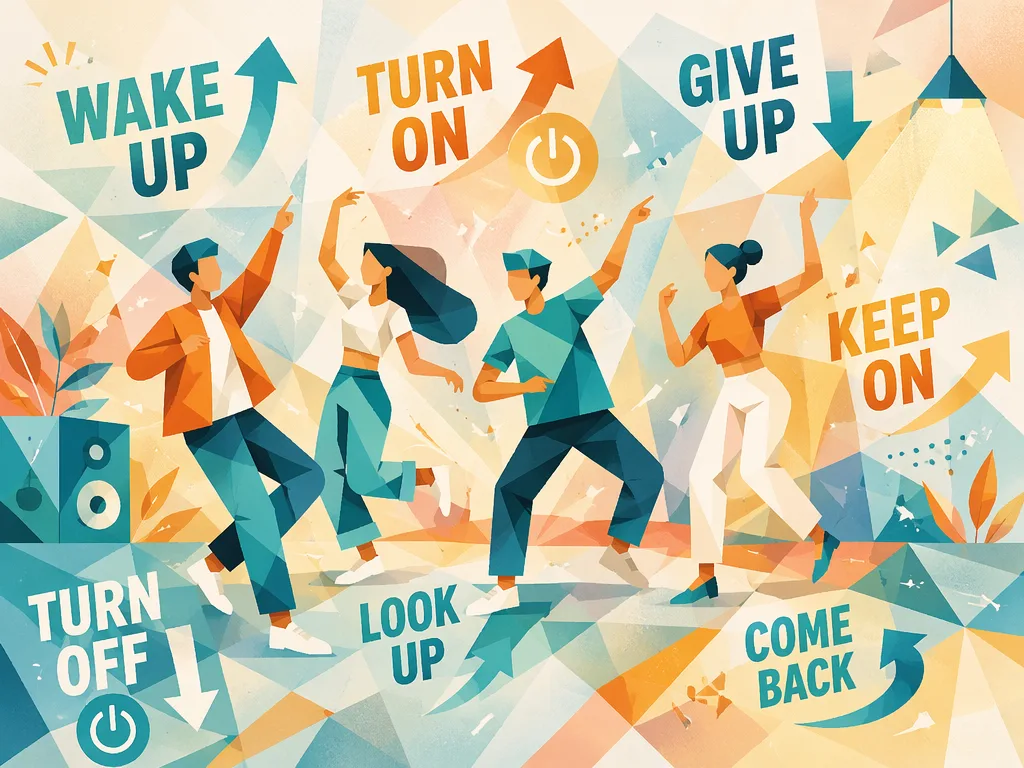
Theme & Story
“Get On Up (The Phrasal Verbs Jam)” is a fun, high-energy learning song about English phrasal verbs. Instead of telling a dramatic story, it creates a dance-party classroom where grammar becomes music. The singer gives commands like “wake up,” “stand up,” “put on,” “take off,” “turn on,” and “turn off,” helping learners hear and remember how these verb combinations work.
The main message is encouraging: keep practicing and don’t give up. The song turns grammar into movement, rhythm, and repetition, which makes it easier for learners to remember.
Metaphors & Meaning
The song uses music and dancing as a metaphor for learning English. Lines like “Let the phrasal verbs move your feet” suggest that grammar is not boring or static—it can be active, physical, and enjoyable.
“Get on the floor!” is a cultural dance-party phrase meaning “come dance!” Here, it also prepares learners for the repeated use of particles like on, up, off, and down.
“Two little words making something new” explains the central idea of phrasal verbs: a simple verb plus a small word can create a new meaning. For example, give means to hand something to someone, but give up means to stop trying.
Vocabulary & Slang
- Get on the floor: A common party or dance phrase meaning “start dancing.”
- Groove: To dance or enjoy music with rhythm. It has a relaxed, funky feeling.
- Sleepy head: A playful way to describe someone who is tired or still asleep.
- Funky beat: A lively rhythm associated with funk music; it suggests something danceable and fun.
- Don’t be soft: Here it means “don’t sing quietly” or “don’t be shy.” In casual English, “soft” can mean weak or timid.
- Catch them all: Means “learn or understand all of them.” It may also remind listeners of pop-culture slogans about collecting things.
- wake up: stop sleeping.
- get up: leave the bed or rise to your feet.
- put on: place clothing on your body.
- take off: remove clothing, or for planes, leave the ground.
- stand up: rise to a standing position.
- give up: stop trying.
- keep on: continue doing something.
- turn on: start a device, light, or music.
- turn off: stop a device, light, phone, or music.
- pick up: lift something from a surface.
- put down: place something onto a surface.
- look for: search for something.
- look at: direct your eyes toward something.
- turn = rotate or change direction
- turn on = activate
- turn off = deactivate
- “Wake up!”
- “Stand up tall!”
- “Put on your shoes.”
- “Don’t give up.”
- “Put on your shoes” = correct
- “Put your shoes on” = also correct
- “Put it on” = correct
- “Put on it” = incorrect when the object is a pronoun
Key phrasal verbs in the song:
Grammar Notes
The song teaches phrasal verbs, which are usually made of:
verb + particle
Examples: wake up, turn on, give up
The “extra word” may look small, but it can completely change the meaning. For example:
Many lines use the imperative form, which is used for commands, instructions, or encouragement:
Notice the negative imperative:
Don’t + base verb
Example: Don’t give up.
The song also shows that some phrasal verbs are separable when they have an object:
Overall, the song is a memorable grammar chant: it uses rhythm, repetition, and movement to help learners understand that phrasal verbs are small combinations with big meanings.