


How Animals Communicate
Discover how animals send messages through sounds, scents, movements, and light—and what those messages can mean.
Preview
Questions with solutions-
1. Choisissez la bonne réponse.
What is the dog most likely communicating?
A person reaches toward a dog's food bowl. The dog becomes stiff and growls.
- Stay away from my food.
- Let's play together.
- Follow me somewhere else.
Notice both the sound and the dog's body.
Show solution
- Stay away from my food.
A growl can be a warning. Reading body position together with sound helps people understand a dog's message.
-
2. Choisissez la bonne réponse.
What are the chicks asking for?
A parent bird arrives at the nest with a worm. The chicks open their mouths wide and call loudly.
- Help building a nest
- Food from the parent
- Protection from the parent bird
Show solution
- Food from the parent
Chicks use both calls and open mouths to beg for food. Their signals can help a parent decide which chick to feed.
-
3. Choisissez la bonne réponse.
How can howling help a wolf group?
Wolves may howl when members of their group are far apart. A howl can travel much farther than a quiet sound.
- It keeps their location secret.
- It leaves a scent trail for others.
- It helps members stay in contact.
Think about the distance between the wolves.
Show solution
- It helps members stay in contact.
Howling lets wolves communicate without being close together. It can also help separated group members find one another.
-
4. Complétez le blanc.
Ants can mark a path with chemicals from their bodies. Other ants follow this path using their ___.
- sense of hearing
- sense of smell
- sense of sight
The message is chemical, not a sound or a picture.
Show solution
Ants can mark a path with chemicals from their bodies. Other ants follow this path using their sense of smell.
Ants detect these chemical messages with their antennae. A trail can guide many ants to the same food source.
-
5. Choisissez la bonne réponse.
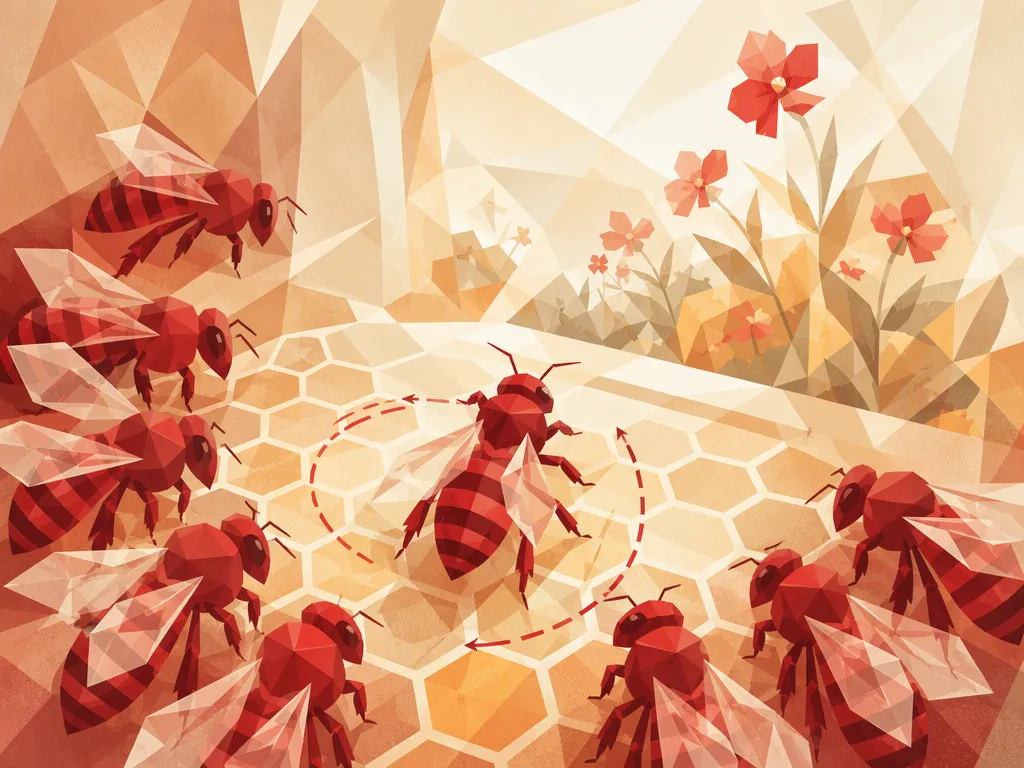
What information does the dance give other bees?
A honeybee finds flowers with nectar, a sweet liquid. Back at the hive, it performs a waggle dance.
- Where to find the flowers
- How to turn nectar into honey
- How to carry nectar while flying
The bee has found something useful outside the hive.
Show solution
- Where to find the flowers
The dance gives information about direction and distance. Other bees can use it to reach the food source.
-
6. Choisissez la bonne réponse.
Why does the flashing pattern matter?
Many kinds of fireflies use light flashes to find mates. Different kinds have different flashing patterns.
- It shows where another firefly found food.
- It reveals another firefly's exact age.
- It helps them recognize a mate of the same kind.
Not every firefly belongs to the same kind.
Show solution
- It helps them recognize a mate of the same kind.
The timing of the flashes matters, not just the light itself. A matching reply can help two fireflies find each other.
-
7. Complétez le blanc.
Cuttlefish use changing patterns on their bodies to signal to other cuttlefish. They create these patterns by changing their ___.
- swimming speed
- skin color
- body temperature
These messages are visible on the animal's surface.
Show solution
Cuttlefish use changing patterns on their bodies to signal to other cuttlefish. They create these patterns by changing their skin color.
Tiny colored parts of the skin can expand or shrink. This allows cuttlefish to change their appearance quickly.
-
8. Choisissez la bonne réponse.
What useful information do these different calls provide?
Eagles hunt from the air, while leopards approach on the ground. Vervet monkeys use different alarm calls for these two animals.
- The type of danger nearby
- The number of monkeys in the group
- The age of the monkey calling
Different dangers may need different responses.
Show solution
- The type of danger nearby
The calls help monkeys respond to a particular threat. A useful escape from a ground hunter may not be safe from an eagle.
-
9. Complétez le blanc.
Bottlenose dolphins have special whistles linked to their identity. Other dolphins can recognize them by these whistles, which work a little like ___.
- maps
- warnings
- names
Think about how we recognize a particular person.
Show solution
Bottlenose dolphins have special whistles linked to their identity. Other dolphins can recognize them by these whistles, which work a little like names.
Dolphins can copy another dolphin's special whistle when calling to that animal. Their whistles do more than announce that a dolphin is nearby.
-
10. Choisissez la bonne réponse.
How can these calls help the young crocodiles?
Young crocodiles call from inside their eggs shortly before hatching. Their mother may then dig open the nest.
- They teach the mother where to lay new eggs.
- They bring help when the young are ready to come out.
- They tell the mother that the young have reached the water.
The young are still inside their eggs.
Show solution
- They bring help when the young are ready to come out.
Communication can begin before an animal hatches. These calls can also help young crocodiles hatch around the same time.
-
11. Choisissez la bonne réponse.
What does the cleaner fish's dance offer?
A small cleaner fish performs a repeated dance near a larger fish. The larger fish stops and lets it remove tiny animals called parasites from its skin.
- A cleaning service
- A challenge to fight
- Directions to a food source
Show solution
- A cleaning service
The cleaner gets a meal, while the larger fish loses unwanted parasites. The signal helps two different kinds of fish cooperate.
-
12. Choisissez la bonne réponse.
A person nearby hears nothing. What can still be true?
Elephants make very low calls that can travel far. Some calls are below the range that human ears can detect.
- The elephant is definitely not making any sound.
- Any call the elephant makes must be too quiet to travel far.
- The elephant may be calling outside the person's hearing range.
A sound's pitch and its loudness are different things.
Show solution
- The elephant may be calling outside the person's hearing range.
A call can be strong but too low for human ears. Silence to us does not always mean silence to another animal.
-
13. Choisissez la bonne réponse.
What does this show about whale communication?
Male humpback whales can copy songs they hear from other whales. Over time, a new song can spread between groups.
- Every whale keeps the same song throughout its life.
- Some signals can be learned from other animals.
- Whales can learn songs only from their parents.
Think about how a new song reaches another group.
Show solution
- Some signals can be learned from other animals.
Learning from others can create shared traditions. Whale songs can change as new patterns spread.
-
14. Choisissez la bonne réponse.
How can the false alarm help the drongo?
A bird called a drongo sometimes copies another animal's alarm call when no danger is present. Nearby animals leave their food and hide.
- It can take the food they leave behind.
- It can follow them to a real hunter.
- It can learn where they originally found the food.
What becomes available when the other animals run away?
Show solution
- It can take the food they leave behind.
Animal signals are not always honest. Drongos can use false warnings to steal food, although they also give real warnings.
-
15. Choisissez la bonne réponse.
Who benefits from this exchange?
A bird called a honeyguide calls and moves from tree to tree. People follow it to a wild bees' nest. After they collect honey, the bird eats some of the wax left behind.
- Only the people
- Only the honeyguide
- Both the people and the honeyguide
Compare what each side gets to eat.
Show solution
- Both the people and the honeyguide
Communication can support cooperation between humans and wild animals. The honeyguide gains access to wax that is difficult to reach in a closed nest.