


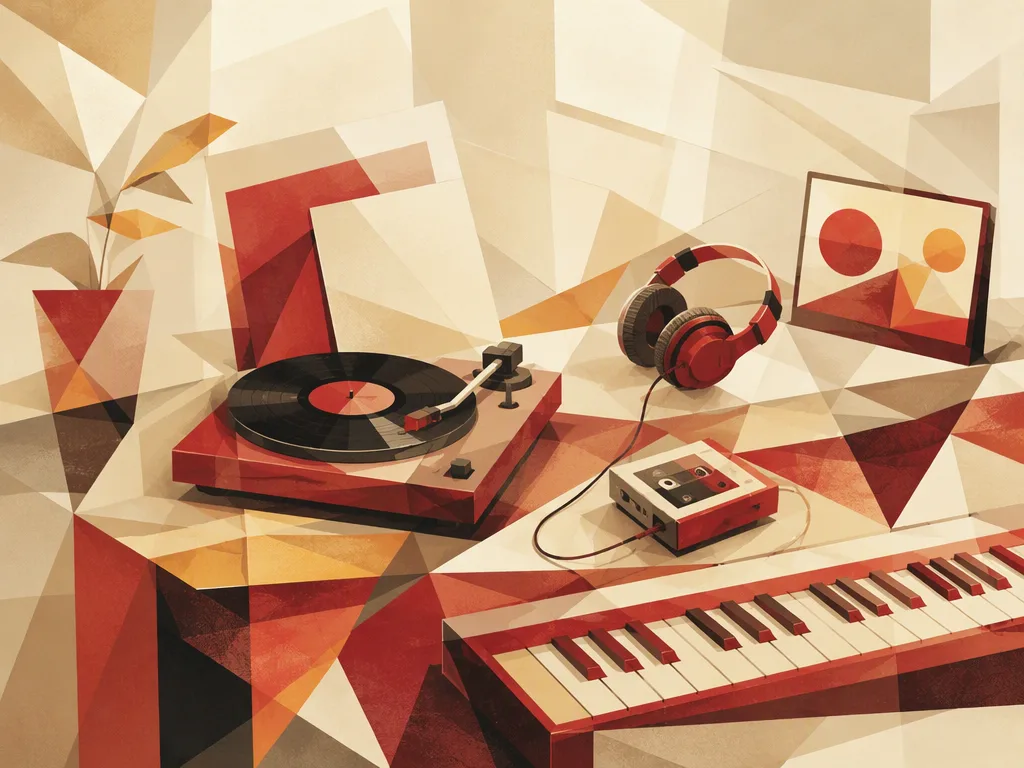
Music Through the Decades
Explore the sounds, ideas, and inventions that changed how people make and enjoy music.
Preview
Questions with solutions-
1. Choisissez la bonne réponse.
What music format is being played?
A listener places a large black disc on a turntable. A needle follows the thin lines on its surface.
- A vinyl record
- A cassette tape
- A compact disc
- A digital audio file
Think about which format needs a needle.
Show solution
- A vinyl record
The thin lines are called grooves. The needle follows them, and its tiny movements become sound.
-
2. Choisissez la bonne réponse.
What was this new style called?
In the 1950s, a new style mixed rhythm and blues with country music. Its strong beat and electric guitars excited many young listeners.
- Swing jazz
- Traditional country
- Rock and roll
- Acoustic blues
Show solution
- Rock and roll
Rock and roll brought different musical traditions together. Dancing was an important part of its early appeal.
-
3. Choisissez la bonne réponse.
What would this steady pulse help dancers do?
Disco became popular in the 1970s. Many disco songs had a clear, consistent dance beat.
- Know the lyrics before hearing the song
- Keep their steps in time with the music
- Hear every instrument playing alone
- Predict exactly when the singer would stop
Think about how dancers match their movements to music.
Show solution
- Keep their steps in time with the music
A regular beat helps people move together. Disco recordings often kept that beat going between vocal sections.
-
4. Choisissez la bonne réponse.
On which Caribbean island did reggae develop?
During the 1970s, Bob Marley helped reggae reach listeners around the world.
- Cuba
- Puerto Rico
- Barbados
- Jamaica
Show solution
- Jamaica
Reggae developed in Jamaica. Its guitar rhythm often puts stress between the main beats, creating a distinctive feel.
-
5. Choisissez la bonne réponse.
What is the jazz player doing?
During a solo, a jazz player creates a melody in the moment instead of following every note on a page.
- Improvising
- Tuning the instrument
- Reading written music exactly
- Playing back a recording
The melody is being created during the performance.
Show solution
- Improvising
Improvisation can make each performance different. Players still listen carefully to the rhythm and the other musicians.
-
6. Choisissez la bonne réponse.
What was the main purpose of these songs?
In the 1960s, many folk singers performed songs about peace and equal rights. They hoped their music would help build a fairer society.
- To celebrate personal wealth
- To focus only on private love stories
- To encourage social change
- To tell stories without a social message
Think about what the singers wanted to change beyond music.
Show solution
- To encourage social change
These were protest songs. Simple melodies often made them easy for groups to sing together.
-
7. Choisissez la bonne réponse.
Which instrument is described?
On many 1980s pop recordings, musicians played an electronic keyboard that could create entirely new sounds, not just copy a piano.
- An acoustic piano
- A synthesizer
- A saxophone
- An electric guitar
This instrument creates and shapes sounds electronically.
Show solution
- A synthesizer
Synthesizers gave musicians a much wider choice of sounds. They became a major part of the sound of 1980s pop.
-
8. Choisissez la bonne réponse.
Which part of hip-hop is described?
A performer delivers words in a strong rhythm over a beat. The voice follows speech patterns rather than mainly holding long musical notes.
- Humming a melody
- Singing in harmony
- Beatboxing
- Rapping
The focus is on rhythmic words, not vocal drum sounds.
Show solution
- Rapping
Rapping uses rhythm, rhyme, and the sound of words. Hip-hop grew from a wider culture that also included DJing and dance.
-
9. Choisissez la bonne réponse.
Which action fits this attitude?
Many early punk bands used a few simple chords and a loud, direct sound. They encouraged people to make music without needing years of training.
- Starting a band with friends and improving by playing
- Waiting until every member has completed advanced training
- Accepting only professionally trained musicians
- Waiting to perform until everyone can play complex solos
Think about whether beginners were welcome.
Show solution
- Starting a band with friends and improving by playing
Punk encouraged a do-it-yourself approach. People could form bands and organize shows instead of waiting for permission from the music industry.
-
10. Choisissez la bonne réponse.
How did this differ from polished, cheerful pop?
In the early 1990s, grunge brought rough guitar sounds and serious, personal lyrics to a wider audience.
- It focused more on bright electronic dance rhythms.
- It used softer sounds and happier love stories.
- It offered a rougher sound and a darker mood.
- It replaced guitars with smooth orchestral arrangements.
Compare both the sound and the feelings in the lyrics.
Show solution
- It offered a rougher sound and a darker mood.
Grunge showed that a less polished sound could reach a large audience. Its success helped bring alternative rock into the mainstream.
-
11. Choisissez la bonne réponse.
Which promotional plan would make the best use of this development?
In the 1980s, television programs regularly showed music videos. Viewers could see an artist's clothes, movements, and visual ideas while hearing a song.
- Sending only an audio recording to a radio station
- Creating a memorable video with a distinctive look for the artist
- Printing the lyrics inside the album cover
- Advertising concert dates on posters around town
Consider what television could show that radio could not.
Show solution
- Creating a memorable video with a distinctive look for the artist
Music videos helped artists build a visual identity. Dance moves and clothing could become as recognizable as the song.
-
12. Choisissez la bonne réponse.
What could the singer do without recording the whole band again?
In a studio, the drums, bass, and voice are recorded separately. The singer likes the performance but wants to correct one vocal line.
- Make the drums louder to change the lyrics.
- Change the bass notes to fix the vocal line.
- Speed up every part to create a new vocal performance.
- Record that vocal line again and keep the other parts.
The voice is stored separately from the instruments.
Show solution
- Record that vocal line again and keep the other parts.
Recording parts separately gives musicians more control. They can improve one part while keeping performances they already like.
-
13. Choisissez la bonne réponse.
How does the new track use the older recording?
A producer takes a short sound from an older recording and places it in a new track. This is called sampling and is common in hip-hop and electronic music.
- It gives part of an earlier performance a new setting.
- It is a new recording of the entire older song with different musicians.
- It uses only the older song's written lyrics.
- It presents the complete older recording without changes.
A sample uses recorded sound, not just the same musical idea.
Show solution
- It gives part of an earlier performance a new setting.
A sample can be as small as a drum hit or a short phrase. Producers may change its speed or combine it with new sounds.
-
14. Choisissez la bonne réponse.
What can this planned order help create?
An album opens with energetic songs, moves into quieter music, and ends with a hopeful song. The artist carefully planned this order.
- The same emotional mood from beginning to end
- A beat that gets faster with every song
- An emotional journey across the album
- A live concert recording of every song
Notice how the energy and feelings change from the first song to the last.
Show solution
- An emotional journey across the album
Song order can give an album a larger shape. Even separate songs can work together to suggest a story or a changing mood.
-
15. Choisissez la bonne réponse.
What does this show about music trends?
Streaming playlists can introduce older songs to people who have never heard them. A recording may find a new audience decades after its release.
- Only recent recordings can attract new listeners.
- A song's age does not determine whether it can gain new fans.
- Older songs must be recorded again before people can enjoy them.
- A recording always keeps the same audience throughout its life.
Separate the age of the recording from the age of its audience.
Show solution
- A song's age does not determine whether it can gain new fans.
Music history is not only a story of new styles replacing old ones. New ways of discovering music can connect different generations.