


Space Missions That Made History
Explore landmark journeys to the Moon, planets, and comets—and discover how clever engineering made them possible.
Preview
Questions with solutions-
1. Choisissez la bonne réponse.
What made Sputnik 1 historic?
Launched in 1957, Sputnik 1 broadcast radio signals while circling Earth.
- It was the first satellite to carry an animal into orbit.
- It was the first human-made satellite to orbit Earth.
- It was the first satellite to transmit television programs.
Its main achievement was reaching orbit, not carrying a passenger.
Show solution
- It was the first human-made satellite to orbit Earth.
People could detect Sputnik's radio signals from the ground, making this small satellite a powerful symbol of the space age.
-
2. Choisissez la bonne réponse.
What did Yuri Gagarin become the first person to do?
Gagarin traveled aboard Vostok 1 in 1961. His historic flight lasted less than two hours.
- Travel into space and orbit Earth.
- Walk outside a spacecraft.
- Live aboard a space station.
He remained inside his spacecraft during its journey around Earth.
Show solution
- Travel into space and orbit Earth.
Vostok 1 completed one orbit. Gagarin ejected from the capsule during the final descent and landed by parachute.
-
3. Choisissez la bonne réponse.
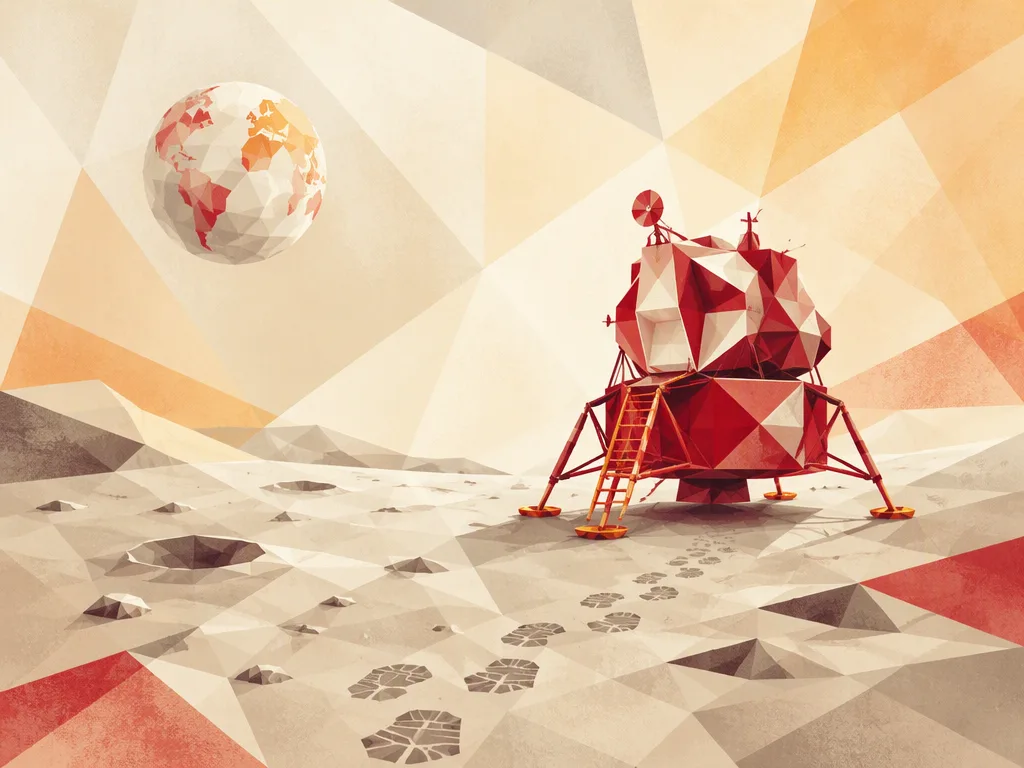
Which achievement made Apollo 11 historic?
In July 1969, Apollo 11 carried Neil Armstrong, Buzz Aldrin, and Michael Collins toward the Moon.
- A spacecraft landed on the Moon for the first time.
- A crew orbited the Moon for the first time.
- Humans landed on the Moon for the first time.
The mission's most famous moment happened on the lunar surface.
Show solution
- Humans landed on the Moon for the first time.
Armstrong and Aldrin explored the surface while Collins remained in lunar orbit, ready for their return.
-
4. Choisissez la bonne réponse.
What kind of mission was Mariner 4?
In 1965, Mariner 4 passed Mars and transmitted close-up images. It continued into space rather than entering orbit or reaching the surface.
- A surface landing.
- A flyby.
- An orbital mission.
The spacecraft gathered information during a passing encounter.
Show solution
- A flyby.
Mariner 4 returned the first successful close-up images of Mars, revealing a landscape marked by impact craters.
-
5. Choisissez la bonne réponse.
Why was a long stay on Venus especially difficult for Venera 13?
Venera 13 landed on Venus in 1982. Surface temperatures there are high enough to melt lead.
- Venus has no solid ground to support a lander.
- The surface is so cold that batteries quickly freeze.
- The heat puts severe stress on electronic equipment.
Consider how ordinary electronic devices react to very high temperatures.
Show solution
- The heat puts severe stress on electronic equipment.
Venus's dense atmosphere traps heat, making its surface hotter than Mercury's even though Venus is farther from the Sun.
-
6. Choisissez la bonne réponse.
What new role did Apollo 13's lunar module take on?
After an oxygen tank failed on Apollo 13, the Moon landing was canceled. The crew moved into the lunar module while the command module's systems were shut down to save power.
- A temporary life-support shelter for the crew.
- A replacement capsule for reentry through Earth's atmosphere.
- A vehicle for completing an uncrewed Moon landing.
The immediate priority was keeping the astronauts alive, not reaching the Moon.
Show solution
- A temporary life-support shelter for the crew.
The crew later returned to the command module, whose heat shield protected them during reentry.
-
7. Choisissez la bonne réponse.
How did astronauts on the 1993 servicing mission improve Hubble's images?
Hubble's main mirror had a flaw that blurred its images. Astronauts installed equipment that adjusted the path of light reaching its instruments.
- They removed and replaced the entire main mirror.
- They added corrective optics that made up for the mirror's flaw.
- They reshaped the original mirror's surface in orbit.
Think of a solution similar to giving the telescope glasses.
Show solution
- They added corrective optics that made up for the mirror's flaw.
Hubble was designed for servicing in space, so astronauts could replace instruments without bringing the telescope back to Earth.
-
8. Choisissez la bonne réponse.
Which task depended on Huygens reaching the ground?
Cassini studied Saturn from orbit. Its companion probe, Huygens, separated from it, descended through the atmosphere of Saturn's moon Titan, and landed in 2005.
- Tracking Titan's path around Saturn.
- Studying the upper atmosphere during descent.
- Directly testing how firm the ground was at the landing site.
One measurement requires physical contact with the surface.
Show solution
- Directly testing how firm the ground was at the landing site.
Huygens carried an instrument that tested the ground during touchdown. It also made the first landing on a moon other than Earth's.
-
9. Choisissez la bonne réponse.
Why was aerogel useful for collecting comet dust?
Stardust caught fast-moving comet particles in aerogel, an extremely light, porous material. The grains left tracks as the material gradually slowed them down.
- It captured fragile grains while limiting damage from sudden impacts.
- It turned the grains into gas for storage.
- It reflected the grains away to prevent collection.
A sudden stop could destroy the material scientists wanted to study.
Show solution
- It captured fragile grains while limiting damage from sudden impacts.
Stardust returned its collector to Earth, allowing laboratories to examine the captured comet material with many different instruments.
-
10. Choisissez la bonne réponse.
How did planetary encounters help Voyager 2 travel onward?
Voyager 2 reached several giant planets using carefully timed close passes. These gravity assists helped it travel farther without relying only on its engines.
- Friction in the planets' atmospheres increased its speed.
- The planets' gravity changed its speed and direction.
- The spacecraft collected fresh rocket fuel from the planets' clouds.
The spacecraft benefited from a force acting at a distance.
Show solution
- The planets' gravity changed its speed and direction.
The energy gain comes from the planet's motion, not from fuel collected nearby. The planet's own motion changes by an extremely small amount.
-
11. Choisissez la bonne réponse.
Why could a small bounce carry Philae far from its first landing spot?
Rosetta's Philae lander reached a small comet in 2014, but its anchoring harpoons failed to fire. It bounced away from its first landing spot before touching down elsewhere.
- Its harpoons fired so strongly that they launched it upward.
- The comet had no gravity, so the lander could never touch down again.
- The comet's weak gravity pulled the lander back down only gently.
A small comet has much less mass than Earth, but it still attracts objects.
Show solution
- The comet's weak gravity pulled the lander back down only gently.
Landing gently is not always enough on a low-gravity world. Anchoring equipment helps keep a spacecraft attached after contact.
-
12. Choisissez la bonne réponse.
What did the shorter orbital period demonstrate?
DART deliberately struck Dimorphos, a small moon of an asteroid. After the impact, Dimorphos completed each orbit around its larger companion in less time.
- A spacecraft impact can change an asteroid's motion.
- The collision completely destroyed Dimorphos.
- Every threatening asteroid can now be redirected with certainty.
The measurement shows a specific change, not a guarantee about every future situation.
Show solution
- A spacecraft impact can change an asteroid's motion.
DART was a controlled planetary-defense test. Dimorphos was not a threat to Earth, so scientists could test the technique safely.