


My father had a small estate in Nottinghamshire, and I was the third of his five sons. When I was fourteen, he sent me to Emmanuel College in Cambridge, where I studied hard for three years. However, my education was too expensive for our modest family, so I became an apprentice to Mr. James Bates, a well-known surgeon in London, and stayed with him for four years. Whenever my father sent me a little money, I spent it on learning navigation and mathematics, because I always believed that one day I would travel. After leaving Mr. Bates, I studied medicine for nearly three years at Leyden in Holland, knowing that it would be useful on long voyages.
When I returned, Mr. Bates recommended me as surgeon on the Swallow, and I sailed with her for three and a half years. Afterwards I decided to settle in London. I married Mrs. Mary Burton, the second daughter of a stocking merchant, and opened a small practice. But two years later my good master Bates died, and since I had few friends, my business began to fail; my conscience would not let me copy the dishonest tricks of many in my profession. After discussing the matter with my wife, I went to sea again. For six years I served as surgeon on two ships, sailing to the East and West Indies. In my free hours I read the best authors, and on shore I studied the manners of the people and learned their languages, which came easily to me thanks to my good memory.
The last of these voyages was not very successful, so I grew tired of the sea and tried to make a living at home. After three years of waiting for things to improve, I accepted a good offer from Captain William Prichard of the Antelope, who was preparing a voyage to the South Sea. We set sail from Bristol on the 4th of May, 1699, and at first the voyage went very well.
On our way to the East Indies, however, a violent storm drove us to the north-west of Van Diemen’s Land. Twelve of our crew had died from overwork and bad food, and the rest were very weak. On the 5th of November, in thick fog, the sailors saw a rock very close to the ship, but the wind was so strong that we were driven straight onto it, and the ship broke apart. Six of us, myself included, lowered the boat into the sea and managed to row away from the ship and the rock. We rowed for about three leagues until we had no strength left, and then we let the waves carry us. About half an hour later, a sudden gust of wind from the north turned the boat over. I do not know what happened to my companions in the boat, or to those who stayed on the rock or in the ship, but I believe they were all lost.
For my part, I swam wherever chance carried me, pushed forward by the wind and the tide. I often let my legs drop but could feel no bottom. When I was almost exhausted and could struggle no longer, my feet touched the ground, and by then the storm had calmed. The sea floor rose so gently that I walked nearly a mile before I reached the shore, at about eight o’clock in the evening. I walked inland for almost half a mile but saw no houses or people; perhaps I was too weak to notice them. I was so tired, and the evening was so warm, that I lay down on the short, soft grass and slept more deeply than ever before in my life, for about nine hours.
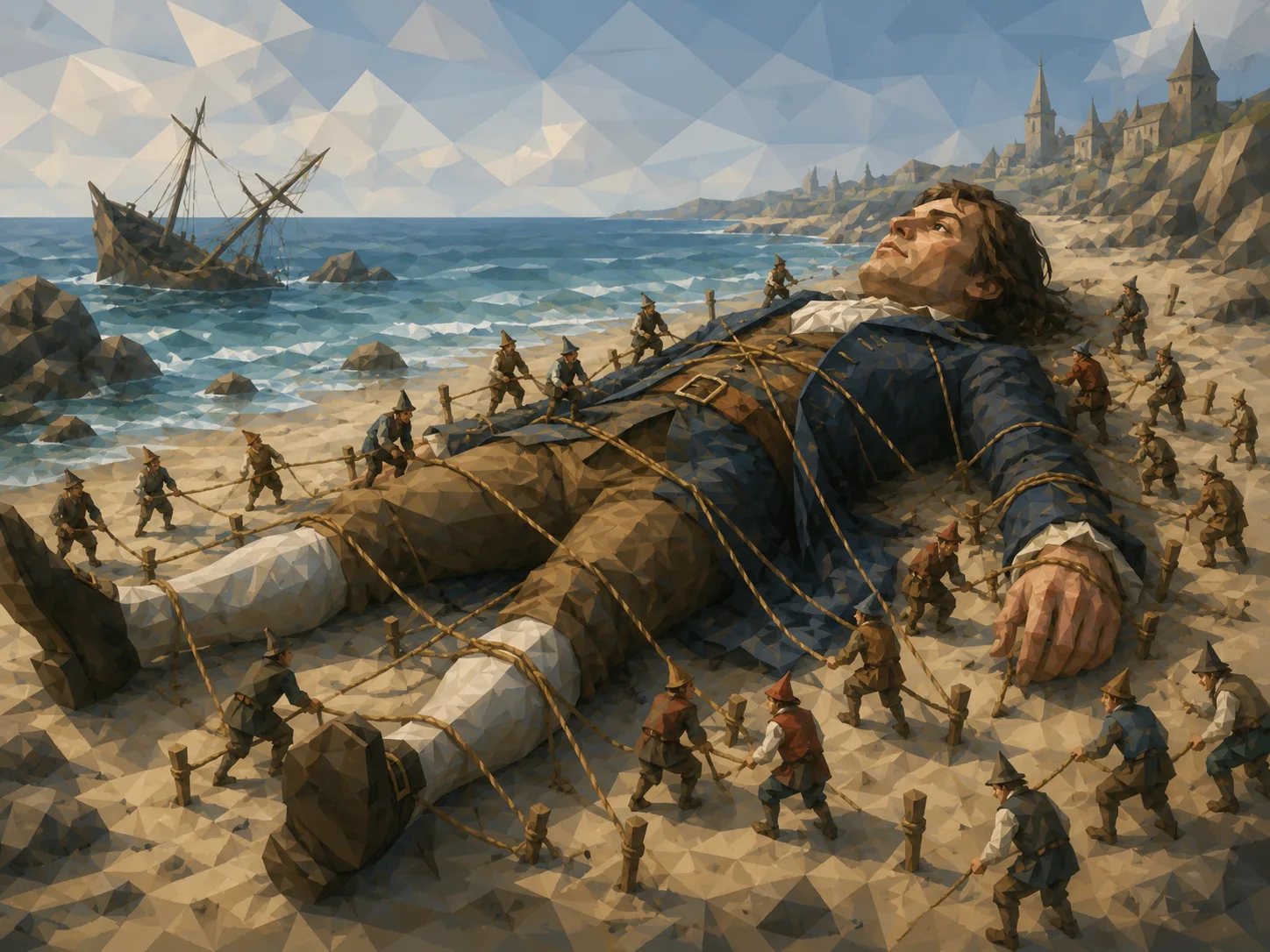
When I woke up, it was just daylight. I tried to get up but could not move at all. I was lying on my back, and my arms and legs were tied firmly to the ground on both sides. My long, thick hair was tied down in the same way, and I felt several thin cords across my body, from my armpits to my thighs. I could only look up at the sky. The sun began to grow hot, and the light hurt my eyes. I heard a confused noise around me, but I could see nothing.
Soon I felt something alive moving on my left leg. It came gently forward over my chest, almost up to my chin. Looking down as far as I could, I saw a human creature less than six inches tall, with a bow and arrow in his hands and a quiver on his back. At the same time, I felt at least forty more of these little people following him. I was so astonished that I roared loudly, and they all ran back in fright; some of them, as I was told later, were hurt when they jumped from my sides to the ground. However, they soon returned, and one of them, who came close enough to see my whole face, lifted up his hands and eyes in wonder and cried out in a high but clear voice, "Hekinah degul!" The others repeated these words several times, but I did not know what they meant.
After a long struggle, I managed to break the strings and pull out the pegs that held my left arm to the ground. With another painful pull, I loosened the strings that tied my hair on the left side, so that I could turn my head about two inches. But the little creatures ran away before I could catch them. Then I heard a great shout, and someone cried, "Tolgo phonac!" At once more than a hundred arrows struck my left hand and pricked me like needles. They shot another flight into the air, and many arrows fell on my body and face, which I quickly covered with my free hand. When I tried again to get loose, they shot an even larger shower of arrows, and some tried to stick spears into my sides, but luckily my leather jacket was too thick for them to pierce. I decided that the wisest thing was to lie still until night, when I could easily free myself with my left hand.
When they saw that I was quiet, they stopped shooting. For more than an hour I heard knocking near my right ear, like people at work. They were building a small platform, about a foot and a half high, with ladders to climb it. A man who seemed to be a person of importance stood on it and made a long speech to me, of which I did not understand a single word. I could see from his gestures that he was sometimes threatening me and sometimes promising kindness. I answered in a few words, in the humblest way I could, and since I had eaten nothing for many hours, I kept putting my finger to my mouth to show that I was hungry. The hurgo, as they call a great lord, understood me very well. At his command, more than a hundred people climbed ladders on my sides and walked towards my mouth with baskets full of meat. There were shoulders and legs shaped like those of sheep, but smaller than the wings of a lark, and loaves of bread about the size of musket balls. I ate two or three at a mouthful, and they watched my appetite with great wonder. When I made a sign that I wanted a drink, they rolled one of their largest barrels to my hand. I emptied it in one swallow, for it held less than half a pint. They brought me a second barrel, and when I had finished it, they shouted for joy and danced on my chest.
I confess that I was often tempted, while they walked back and forth over my body, to seize forty or fifty of them and throw them to the ground. But I remembered the pain of their arrows, and I also felt bound by the promise of good behaviour that I had made them. Besides, they had fed me so generously that I felt I was their guest. I could not help admiring the courage of these tiny people, who dared to climb onto the body of such a giant while one of my hands was free.
Soon a high official arrived from the Emperor. He walked up my right leg to my face with about a dozen attendants, showed me his royal papers, and spoke to me for about ten minutes, often pointing towards the capital city, about half a mile away. I understood that I was to be carried there as a prisoner. I made signs that I wanted my freedom, but he shook his head. However, he also made me understand that I would have plenty of food and drink and would be treated well. My face and hands were covered with painful blisters from their arrows, and their numbers kept growing, so I gave signs that they could do with me whatever they wished. They then loosened the cords on my left side, so that I could turn onto my right side and relieve myself, while the people quickly moved out of the way. They also rubbed a pleasant-smelling ointment on my face and hands, which soon took away the pain of the arrows.
After this, I fell into a deep sleep for about eight hours, which was no surprise, since the Emperor’s doctors had put a sleeping potion into the wine. The Emperor had learned of my arrival as soon as I was found asleep on the shore, and his council had ordered everything that followed. These people are excellent mathematicians and engineers. Five hundred carpenters quickly built a wooden frame on twenty-two wheels, about seven feet long and four feet wide. Nine hundred of their strongest men lifted me onto it with ropes and pulleys while I slept, and fifteen hundred of the Emperor’s largest horses, each about four and a half inches high, pulled me towards the capital.
About four hours into the journey, I woke up because of a ridiculous accident. While the carriage had stopped for a repair, a young officer of the guards climbed up to my face out of curiosity and pushed the end of his spear into my left nostril. It tickled my nose like a straw and made me sneeze violently, and he and his friends ran away before I saw them. That night we rested with five hundred guards on each side of me, ready to shoot if I tried to move. At about noon the next day, we arrived near the city gates.
The carriage stopped beside an ancient temple, the largest in the kingdom, which was no longer used for worship. It had been chosen as my lodging. Its great gate was about four feet high and almost two feet wide, so I could easily creep through it. The king’s blacksmith fastened ninety-one small chains to my left leg with thirty-six padlocks. More than a hundred thousand people came out of the city to see me, and when the workmen were sure that I could not break free, they cut all the cords that bound me. I rose to my feet feeling sadder than ever before in my life, and the noise and astonishment of the crowd were beyond description. My chains were about two yards long, which allowed me to walk back and forth in a half circle and to creep into the temple and lie down at full length.