


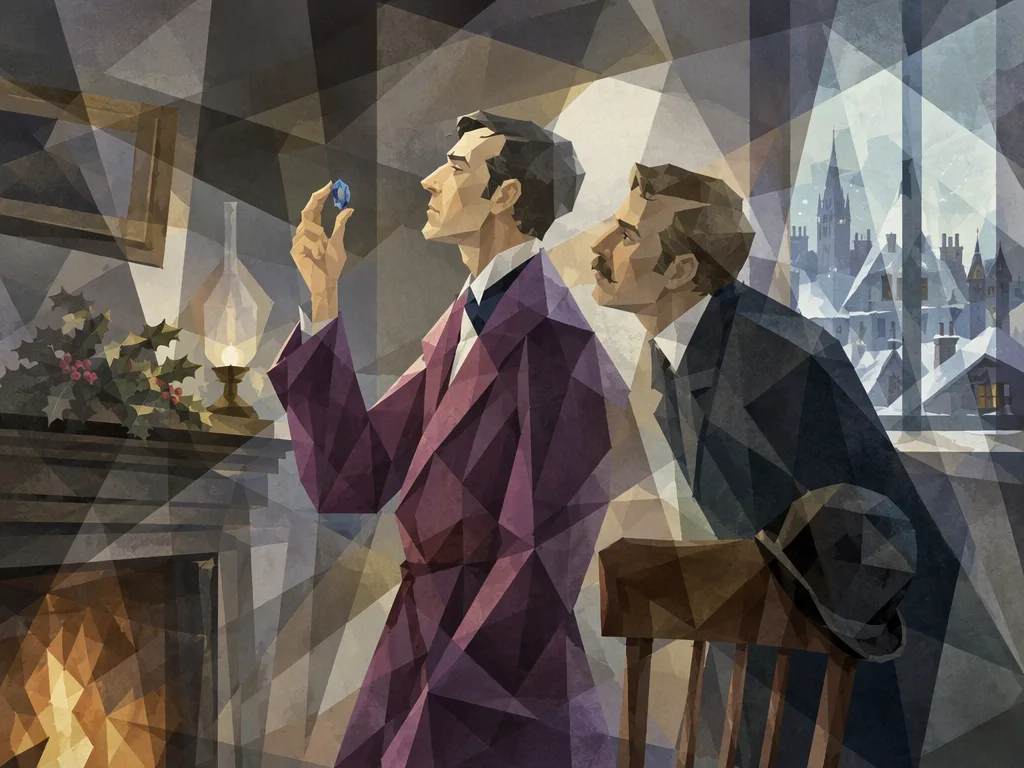
To Sherlock Holmes she is always *the* woman. I have rarely heard him call her by any other name. In his eyes, she stands above every other woman in the world. It was not that he felt anything like love for Irene Adler. All strong feelings—and love above all—had no place in his cold, sharp, balanced mind. He was, I believe, the finest thinking and observing machine the world has ever seen. As a lover, though, he would have been completely out of place. He never spoke of gentle feelings except with a mocking joke. Such feelings were useful to watch in other people, because they helped an observer see behind human actions. For a trained thinker, however, letting strong emotion into his own calm mind was a dangerous distraction. It was like a grain of sand in a delicate watch, or a crack in one of his own magnifying glasses. It could throw every result into doubt. Yet there was one woman for him, and that woman was Irene Adler.
I had seen very little of Holmes lately. My marriage had pulled us apart. My own happy home and the quiet cares of family life took up all my attention. Meanwhile, Holmes disliked every kind of social life with all his heart. He stayed in our old rooms at 221B Baker Street, buried among his books and driven by the fierce energy of his mind. He was still deeply fascinated by the study of crime. He used his brilliant powers of observation to follow clues and solve mysteries that the police had given up as hopeless. Now and then I saw brief reports of his work in the daily newspapers. Apart from that, I knew little of my old friend and companion.
One night—it was March 20, 1888—I was returning from visiting a patient, for I had gone back to medical practice. My walk took me along Baker Street. As I passed the familiar front door, I felt a sudden wish to see Holmes again and learn how he was using his extraordinary powers. His upstairs rooms were brightly lit. Even as I looked up, I saw his tall, thin shadow cross the window blind twice. He was pacing the floor swiftly and eagerly, with his head bent forward and his hands clasped behind his back. I knew every mood and habit of his, and that sight told its own story. He was at work again, hot on the trail of some new problem. I rang the bell and went up to the sitting room that had once been half mine.
Holmes was never warm and emotional in his greetings. Still, I think he was glad to see me. With hardly a word, but with a kindly look in his eyes, he waved me to an armchair, tossed his cigar case across, and pointed to the drinks in the corner. Then he stood in front of the fire and looked me over in his quiet, searching way.
"Married life suits you," he remarked. "I think, Watson, that you have gained seven and a half pounds since I saw you."
"Seven!" I answered.
"Really, I would have thought a little more. Just a trifle more, I fancy, Watson. And in practice again, I see. You did not tell me that you meant to return to medical work."
"Then how do you know?"
"I see it. I deduce it. How do I also know that you got very wet lately, and that you have a clumsy and careless servant girl?"
"My dear Holmes," I said, "this is too much. You would certainly have been burned as a witch if you had lived a few centuries ago. It is true that I took a walk in the country on Thursday and came home in a dreadful mess. But I have changed my clothes, so I cannot imagine how you deduce it. As for Mary Jane, she really is hopeless, and my wife has told her she must leave. Still, I fail to see how you work that out."
He chuckled softly and rubbed his long, thin hands together.
"It is simplicity itself," he said. "My eyes tell me that on the inside of your left shoe, just where the firelight strikes it, the leather is marked by six almost parallel cuts. Clearly, they were made by someone who scraped carelessly around the edge of the sole to remove dried mud. So you see how I reach both conclusions: you were out in terrible weather, and you have a servant girl who ruins good shoes. As for your practice, a gentleman walks into my rooms smelling of hospital disinfectant. He has a dark chemical stain on his right forefinger, and a bulge on the right side of his top hat where he keeps his stethoscope. I would be dull indeed if I did not see that he is an active member of the medical profession."
I could not help laughing at the ease with which he explained his reasoning. "When I hear you give your reasons," I remarked, "the thing always looks so ridiculously simple that I feel I could easily do it myself. Yet each time I am completely puzzled until you explain every step. And still, I believe my eyes are just as good as yours."
"Quite so," he answered, lighting a cigarette and dropping into an armchair. "You see, but you do not observe. The difference is clear. For example, you have often seen the stairs that lead up from the front hall to this room."
"Many times."
"How often?"
"Well, some hundreds of times."
"Then how many steps are there?"
"How many? I do not know."
"Exactly! You have not observed, even though you have seen. That is just my point. Now, I know that there are seventeen steps, because I have both seen and observed. By the way, since you enjoy these little problems—and since you are good enough to write down one or two of my small experiences—you may be interested in this."
He tossed over a sheet of thick, pink-tinted notepaper that had been lying open on the table. "It came in the last mail," he said. "Read it aloud."
The note had no date, no signature, and no address.
"There will call upon you tonight, at a quarter to eight o'clock," it said, "a gentleman who wishes to consult you upon a matter of the very deepest importance. Your recent services to one of the royal houses of Europe have shown that you are one who may safely be trusted with matters whose importance can hardly be exaggerated. This account of you we have from all quarters received. Be in your rooms then at that hour, and do not take it amiss if your visitor wears a mask."
"This really is a mystery," I remarked. "What do you think it means?"
"I have no data yet. It is a great mistake to theorize before one has data. Without noticing it, one begins to twist facts to suit theories, instead of theories to suit facts. Look at the note itself, though. What do you deduce from it?"
I examined the handwriting and the paper carefully. "The man who wrote it is probably rich," I said, trying to copy my friend's methods. "Paper like this must cost several shillings a packet. It is unusually thick and stiff."
"Unusual—that is the very word," said Holmes. "It is not English paper at all. Hold it up to the light."
I did so, and saw a large *E* with a small *g*, a *P*, and a large *G* with a small *t* woven into the paper itself.
"What do you make of that?" asked Holmes.
"The name of the maker, no doubt. Or his initials."
"Not at all. The *G* with the small *t* stands for *Gesellschaft*, which is the German word for 'Company.' It is a common short form, like our 'Co.' *P*, of course, stands for *Papier*. Now for the *Eg*. Let us check our European reference book." He took a heavy brown volume down from his shelves and turned the pages. "Eglow, Eglonitz—here we are, Egria. It is in a German-speaking area—in Bohemia, not far from Carlsbad, famous for its many glass factories and paper mills. Ha, ha, my boy, what do you make of that?" His eyes sparkled, and he blew a great triumphant cloud of blue smoke from his cigarette.
"The paper was made in Bohemia," I said.
"Precisely. And the man who wrote the note is a German. Do you notice the strange order of his words? 'This account of you we have from all quarters received.' A Frenchman or a Russian could never have written that. It is the German who is so rude to his verbs. It only remains, then, to discover what this German wants—a man who writes on Bohemian paper and prefers wearing a mask to showing his face. And here he comes, if I am not mistaken, to answer all our doubts."
As he spoke, we heard the sharp clatter of horses' hooves and wheels scraping against the curb, followed by a hard pull at the doorbell. Holmes gave a low whistle.
"A pair of horses, by the sound," he said. He glanced out the window. "Yes. A fine little carriage and a pair of beauties. Worth a hundred and fifty pounds each. There's money in this case, Watson, if there is nothing else."
"I think I had better leave, Holmes."
"Not a bit, Doctor. Stay where you are. I am lost without you. Besides, this promises to be interesting. It would be a pity to miss it."
"But your client—"
"Never mind him. I may need your help, and so may he. Here he comes. Sit down in that armchair, Doctor, and give us your closest attention."
Slow, heavy footsteps climbed the stairs and paused just outside the door. Then came a loud, commanding knock.
"Come in!" said Holmes.
A giant of a man entered. He could hardly have been less than six feet six inches tall, with broad shoulders and the chest and arms of a prize fighter. His clothes were rich—almost too rich and showy for English taste. Wide bands of dark fur ran across the sleeves and front of his double-breasted coat. Over his shoulders hung a deep blue cloak lined with flame-colored silk, fastened at the neck with a brooch holding a single bright jewel. High boots trimmed at the tops with brown fur completed the show of royal wealth. He carried a broad-brimmed hat in one hand, while across the upper half of his face, down past his cheekbones, he wore a black mask. His hand was still raised to it as he walked in. From the lower half of his face, he looked like a man of fierce character, with a thick lower lip and a long, straight chin that showed stubborn determination.
"You had my note?" he asked in a deep, rough voice with a strong German accent. "I told you that I would call." He looked from me to Holmes, uncertain which of us to speak to.
"Please take a seat," said Holmes. "This is my friend and colleague, Dr. Watson, who is sometimes kind enough to help me in my cases. Whom have I the honor of addressing?"
"You may address me as Count Von Kramm, a Bohemian nobleman. I understand that this gentleman, your friend, is a man of honor and good sense, whom I may trust with a matter of the greatest importance. If not, I would much prefer to speak with you alone."
I started to rise, but Holmes caught my wrist and pushed me back into my chair. "It is both, or none," he said. "You may say before this gentleman anything that you may say to me."
The Count shrugged his broad shoulders. "Then I must begin," he said, "by asking you both to promise absolute secrecy for two years. At the end of that time, the matter will be of no importance. At present, it is not too much to say that it is serious enough to affect European history."
"I promise," said Holmes.
"And I," I added.
"You will excuse this mask," our strange visitor continued. "The great person who employs me wishes his agent to remain unknown to you. I may admit at once that the title I just gave you is not really my own."
"I was aware of it," said Holmes dryly.
"The situation is extremely delicate, and every care must be taken to prevent what could become an immense scandal and seriously harm one of the royal families of Europe. To speak plainly, the matter touches the great House of Ormstein, hereditary kings of Bohemia."
"I was also aware of that," murmured Holmes, settling back in his armchair and closing his eyes.
Our visitor looked with some surprise at the relaxed, lounging figure before him. No doubt he had heard Holmes described as the sharpest thinker and most energetic detective in Europe. Slowly, Holmes opened his eyes and looked impatiently at his huge client.
"If Your Majesty would kindly state your case," he remarked, "I would be better able to advise you."
The giant sprang from his chair and paced up and down the room in wild agitation. Then, with a desperate gesture, he tore the mask from his face and threw it onto the floor. "You are right!" he cried. "I am the King! Why should I try to hide it?"
"Why, indeed?" murmured Holmes. "Your Majesty had not spoken before I knew that I was addressing Wilhelm Gottsreich Sigismond von Ormstein, Grand Duke of Cassel-Felstein, and hereditary King of Bohemia."
"But you can understand," said our visitor, sitting down once more and passing a hand across his high white forehead, "you can understand that I am not used to handling such business in person. Yet the matter is so delicate that I could not trust an agent without putting myself in his power. I have traveled in secret from Prague to consult you."
"Then please consult me," said Holmes, shutting his eyes once more.
"The facts are briefly these. Some five years ago, during a long stay in Warsaw, I met the famous Irene Adler. Her name is no doubt familiar to you."
"Kindly look her up in my index, Doctor," murmured Holmes without opening his eyes. For many years he had kept a careful index of newspaper reports about people and events, so it was hard to name any person or subject on which he could not give facts right away. I opened the heavy book and quickly found Irene Adler's page. I handed it to Holmes.
"Let me see!" said Holmes, glancing down the column. "Hmm! Born in New Jersey in the year 1858. Opera singer—hmm. Sang in Milan—yes! Leading lady at the Imperial Opera of Warsaw—yes! Retired from the stage—ha! Living in London—quite so! As I understand it, Your Majesty became involved with this young woman, wrote her some foolish, damaging letters, and now wishes to get those letters back."
"Exactly so. But how—"
"Was there a secret marriage?"
"None."
"Any legal papers or certificates?"
"None."
"Then I fail to follow Your Majesty. If this young person brings out her letters for blackmail or any other purpose, how can she prove they are genuine?"
"There is my handwriting."
"Pooh, pooh! Forgery."
"My private notepaper."
"Stolen."
"My own seal."
"Imitated."
"My photograph."
"Bought."
"We were both in the photograph."
"Oh, dear! That is very bad! Your Majesty has indeed been foolish."
"I was mad—insane."
"You have put yourself in serious danger."
"I was only Crown Prince then. I was young. I am only thirty now."
"It must be recovered."
"We have tried and failed."
"Your Majesty must pay. It must be bought."
"She will not sell."
"Stolen, then."
"Five attempts have been made. Twice burglars in my pay searched every corner of her house. Once we stole her luggage while she was traveling. Twice she was stopped and searched on the road. There has been no result."
"No sign of it?"
"None at all."
Holmes laughed. "It is quite a pretty little problem," he said.
"But a very serious one to me," returned the King reproachfully.
"Very serious indeed. And what does she plan to do with the photograph?"
"To ruin me."
"But how?"
"I am about to be married."
"So I have heard."
"To the second daughter of the King of Scandinavia. You may know the strict principles of her family. She herself has the highest moral standards. Even a shadow of doubt about my past behavior would bring the marriage to an end."
"And Irene Adler?"
"She threatens to send them the photograph. And she will do it. I know she will do it. You do not know her, Mr. Holmes, but she has a soul of steel. She has the face of the most beautiful of women, and the mind of the most determined of men. Rather than let me marry another woman, there are no lengths to which she would not go—none."
"You are sure she has not sent it yet?"
"I am sure."
"And why?"
"Because she has said she will send it on the day when the engagement is publicly announced. That will be next Monday."
"Oh, then we have three days yet," said Holmes with a yawn. "That is very fortunate, as I have one or two other important matters to look into right now. Your Majesty will, of course, stay in London for the present?"
"Certainly. You will find me at the Langham Hotel under the name of Count Von Kramm."
"Then I shall drop you a note to let you know how we progress."
"Please do so. I shall be wild with anxiety."
"And as for money?"
"You have a free hand."
"Completely?"
"I tell you, I would give one of the provinces of my kingdom to have that photograph."
"And for present expenses?"
The King drew a heavy soft-leather bag from beneath his cloak and laid it on the table.
"There are three hundred pounds in gold and seven hundred in notes," he said.
Holmes scribbled a receipt on a page of his notebook and handed it to him.
"And the lady's address?" he asked.
"Briony Lodge, Serpentine Avenue, St. John's Wood."
Holmes wrote it down. "One last question," he said. "Was the photograph a large one?"
"It was."
"Then good night, Your Majesty, and I trust that we shall soon have good news for you. And good night, Watson," he added, as the wheels of the royal carriage rolled down the street. "If you would be good enough to come tomorrow afternoon at three o'clock, I would like to talk this little matter over with you."