


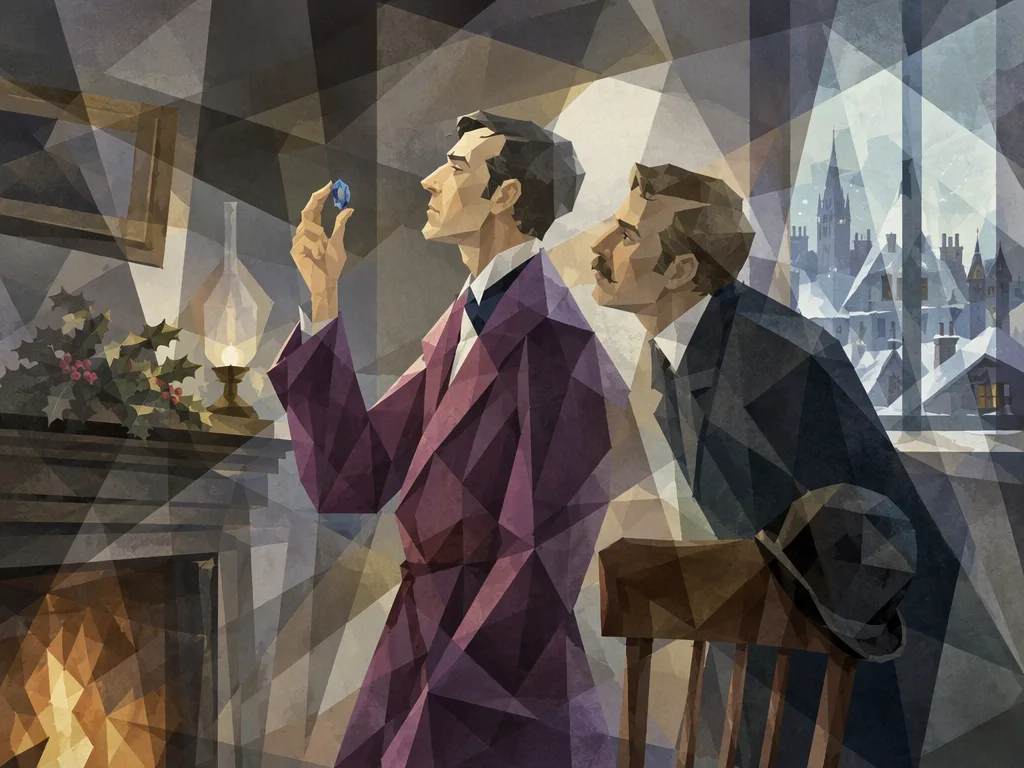
Holmes disappeared into his bedroom and came out a few minutes later as a kind, simple old clergyman. His broad black hat, baggy trousers, white tie, gentle smile, and curious, friendly gaze were perfect. It was not only that Holmes changed his clothes. His expression, his voice, and his very spirit seemed to shift with every new role he played. The stage lost a fine actor, just as science lost a brilliant thinker, when he became a specialist in crime.
It was a quarter past six when we left Baker Street, and ten minutes to seven when we reached Serpentine Avenue. Dusk was already falling, and the street lamps were just being lit as we paced up and down in front of Briony Lodge, waiting for its owner to return. The house looked just as Holmes had described it, yet the street seemed much less quiet than I had expected. In fact, for a small lane in a peaceful neighborhood, it was remarkably lively. A group of shabbily dressed men stood smoking and laughing on one corner. A knife-grinder stood nearby with his wheel, two soldiers in uniform were flirting with a young nanny, and several well-dressed young men strolled up and down with cigars in their mouths.
"You see," Holmes remarked as we walked back and forth outside the house, "this marriage actually makes things simpler. The photograph has become a double-edged weapon now. She will probably be just as eager to keep it away from Mr. Godfrey Norton as our client is to hide it from his princess. Now the question is: where are we to find the photograph?"
"Where indeed?"
"It is most unlikely that she carries it around with her. It is a large photograph—far too big to hide easily inside a woman's dress. She knows the King is quite capable of having her stopped and searched on the street. Two attempts of that kind have already been made. We can be sure, then, that she does not carry it with her."
"Where, then?"
"Her banker or her lawyer. There is that double chance. Yet I am inclined to think neither. Women are naturally secretive, and they prefer to hide things themselves. Why should she hand such a treasure over to anyone else? She could trust herself to keep it safe, but she could never tell what political pressure might be put upon a businessman. Besides, remember she has decided to use the photograph within a few days. It must be somewhere she can put her hands on it quickly. It must be in her own house."
"Yet the house has been broken into twice."
"Bah! They did not know how to look."
"Then how will you look?"
"I will not look."
"What then?"
"I will get her to show me."
"But she will refuse."
"She will not be able to help herself. Listen—I hear the rumble of wheels. That is her carriage. Now carry out my orders to the letter."
As he spoke, the gleam of carriage lamps swung around the curve of the avenue. A neat private carriage rolled up to the door of Briony Lodge. The moment it stopped, one of the rough men at the corner dashed forward to open the carriage door, hoping for a penny. But another man, who had run up for the same reason, shoved him aside. A fierce quarrel broke out at once. The two soldiers jumped in on one side of the fight, and the knife-grinder fought just as hotly on the other. A blow landed, and within seconds the lady who had just stepped from her carriage stood trapped in a small crowd of angry, shouting men swinging fists and sticks. Holmes rushed into the crowd to protect her. Just as he reached her side, he gave a sharp cry and dropped to the ground, with blood running freely down his face. At his fall, the soldiers ran off one way and the rough men the other. A number of better-dressed people, who had watched the fight without joining in, rushed forward to help the lady and care for the injured clergyman. Irene Adler—as I shall still call her—had hurried up the front steps, yet she paused at the top, her graceful figure lit from behind by the bright hall, looking down anxiously into the street.
"Is the poor gentleman badly hurt?" she asked.
"He is dead!" cried several voices.
"No, no, there's life in him!" shouted another. "But he will be gone before you can get him to a hospital!"
"He is a brave fellow," said a woman. "They would have stolen the lady's purse and watch if not for him. They were a rough gang, too. Ah, he is breathing now."
"He cannot lie here in the street. May we bring him inside, madam?"
"Of course. Bring him into the sitting room. There is a comfortable sofa. This way, please!"
Slowly and carefully, Holmes was carried into Briony Lodge and laid upon the sofa in the front room, while I watched everything from my post beside the window. The lamps inside were lit, and the blinds had not been drawn, so I could see him clearly. I do not know whether Holmes felt any guilt at that moment for the trick he was playing, yet I know I had never felt more deeply ashamed of myself in my life. Watching that beautiful woman, and seeing the gentle kindness with which she bent over the injured stranger, made our plot feel cruel. Still, it would have been the worst betrayal to fail Holmes now in the task he had trusted me with. I hardened my heart and pulled the smoke rocket from beneath my overcoat. After all, I told myself, we were not harming her. We were only keeping her from harming someone else.
Holmes had propped himself up on the sofa, and I saw him wave a hand like a man gasping for air. A maid hurried over and threw open the window. At that exact moment, Holmes raised his hand. At the signal, I tossed the rocket into the room and shouted, "Fire!"
The word had scarcely left my lips before the whole crowd outside—gentlemen, grooms, and servant maids alike—joined in a general shriek of "Fire!" Thick clouds of smoke curled across the sitting room and poured out through the open window. I caught a glimpse of figures rushing back and forth inside. Moments later, Holmes's voice rang out from within, assuring everyone it was only a false alarm. Slipping through the shouting crowd, I made my way to the corner of the street. Ten minutes later, I was relieved to feel my friend's arm slip through mine, and we hurried away from the noisy street. He walked briskly and silently for a few minutes until we turned into one of the quiet lanes leading toward the Edgware Road.
"You did it very nicely, Doctor," he remarked. "Nothing could have gone better. Everything is all right."
"You have the photograph?"
"I know where it is."
"And how did you find out?"
"She showed me, just as I told you she would."
"I am still in the dark."
"I have no wish to make a mystery of it," he said, laughing. "The whole thing was perfectly simple. Of course, you saw that everyone in the street was working with us. They were all hired for the evening."
"I guessed as much."
"Well, when the fight broke out, I had a little wet red paint hidden in the palm of my hand. I rushed forward, dropped to the pavement, clapped my hand to my face, and made a pitiful sight. It is an old trick."
"I guessed that much too."
"Then they carried me inside. She was bound to let me in—what else could she do?—and right into her sitting room, which was the very room I suspected. I knew the photograph had to be either there or in her bedroom, and I meant to learn which. They laid me on a sofa, I asked for air, they had to open the window, and you got your chance."
"How did that help you?"
"It was the key to everything. When a woman thinks her house is on fire, her first instinct is to run straight to the thing she values most. It is an overwhelming urge, and I have used it more than once. A married woman grabs her baby; an unmarried woman reaches for her jewel box. Clearly, our lady tonight had nothing inside that house more precious to her than the photograph we are hunting. She was sure to run to save it. The alarm of fire worked splendidly. The smoke and shouting were enough to shake nerves of steel, and she answered beautifully. The photograph is hidden in a small space behind a sliding panel just above the right-hand bell rope. She went straight to it in an instant, and I caught a glimpse of it as she half pulled it out. When I called out that it was a false alarm, she pushed it back, glanced at the rocket, and hurried from the room. I have not seen her since. I rose, made my excuses, and slipped out of the house. For a moment I wondered if I should grab the photograph right then, but her coachman had walked into the room and was watching me closely. It seemed safer to wait. A little impatience can ruin everything."
"And now?" I asked.
"Our search is practically over. I shall call there with the King tomorrow—and with you, if you care to come along. We will be shown into the sitting room to wait for the lady, though it is very likely that when she comes down, she will find neither us nor the photograph. It may please His Majesty to take it back with his own hands."
"And when will you go?"
"At eight in the morning. She will still be asleep, so we will have the room to ourselves. Besides, we must move quickly, for this marriage may bring a complete change in her life and habits. I must send a telegram to the King without delay."
By this time we had reached Baker Street and stopped outside the front door. Holmes was feeling in his pockets for the key when someone walked past on the dimly lit pavement and called out:
"Good night, Mister Sherlock Holmes."
There were several people walking by just then, yet the greeting seemed to come from a slim youth in a long overcoat who hurried past into the gloom.
"I've heard that voice before," said Holmes, staring down the dark street. "Now, I wonder who the deuce that could have been."
I slept at Baker Street that night, and we were having our toast and coffee in the morning when the King of Bohemia burst into the room.
"You really got it!" he cried, seizing Sherlock Holmes by both shoulders and staring eagerly into his face.
"Not yet."
"But you have hopes?"
"I have hopes."
"Then come! I am too impatient to wait another second."
"We must find a cab."
"No, my carriage is waiting outside."
"Then that makes things simpler." We hurried downstairs and drove off once more toward Briony Lodge.
"Irene Adler is married," Holmes remarked along the way.
"Married! When?"
"Yesterday."
"But to whom?"
"To an English lawyer named Norton."
"Still, she could not love him."
"I hope she does."
"Why do you hope that?"
"Because it would free Your Majesty from any fear of future trouble. If the lady loves her husband, she does not love Your Majesty. If she does not love Your Majesty, there is no reason why she should interfere with Your Majesty's plans."
"That is true. And yet—! Well, I wish she had been of my own rank! What a queen she would have made!" He fell into a dark, quiet mood and spoke no more until we pulled up in Serpentine Avenue.
The front door of Briony Lodge stood open, and an elderly woman was waiting on the steps. She watched us with a cold, mocking look as we stepped out of the carriage.
"Mr. Sherlock Holmes, I believe?" she said.
"I am Mr. Holmes," my friend answered, studying her with a sharp, startled look.
"Indeed! My mistress told me that you were likely to call. She left this morning with her husband on the 5:15 train from Charing Cross for Europe."
"What!" Sherlock Holmes staggered back, pale with shock and disappointment. "Do you mean she has left England?"
"Never to return."
"And the papers?" asked the King hoarsely. "All is lost!"
"We shall see." Holmes pushed past the servant and rushed into the sitting room, with the King and me at his heels. Furniture had been pushed about in every direction. Shelves stood empty and drawers hung open, as if the lady had searched through them in a hurry before fleeing. Holmes ran straight to the bell rope, tore back a small sliding wooden panel, reached inside, and pulled out a photograph and a letter. The photograph was of Irene Adler alone, dressed in an evening gown. The letter was addressed to Sherlock Holmes, with the words "To be kept until called for." My friend tore it open, and all three of us read it together. It had been written at midnight the night before:
My dear Mr. Sherlock Holmes,
You really did it very well. You took me in completely. Until after the alarm of fire, I did not have a single suspicion. Then, when I saw how I had given myself away, I began to think. Months ago, I had been warned against you. I was told that if the King hired an agent, it would certainly be you, and your address was even given to me. Yet with all that warning, you still made me show you what you wanted to know. Even after I became suspicious, I found it hard to believe anything bad of such a dear, kind old clergyman.
Still, you know, I have been trained as an actress myself. Men's clothes are nothing new to me, and I often make use of the freedom they give. I sent John, my coachman, to watch you. Then I ran upstairs, put on my walking clothes—as I call them—and came down just as you left. I followed you all the way to your door, and made sure I really was an object of interest to the famous Mr. Sherlock Holmes. Then, rather recklessly, I wished you good night and set off to see my husband.
We both agreed that flight was our safest choice when hunted by so dangerous an opponent, so you will find the nest empty when you call tomorrow. As for the photograph, your client may rest in peace. I love and am loved by a better man than he. The King may do what he pleases without interference from one whom he has cruelly wronged. I keep the photograph only to protect myself, as a weapon that will always keep me safe from any steps he might take in the future. I leave behind a photograph he might care to keep, and I remain, dear Mr. Sherlock Holmes,
Very truly yours,
Irene Norton, née Adler
"What a woman—oh, what a woman!" cried the King of Bohemia, when all three of us had read the letter. "Did I not tell you how quick and determined she was? Would she not have made an admirable queen? Is it not a pity that she was not on my level?"
"From what I have seen of the lady, she seems, indeed, to be on a very different level from Your Majesty," said Holmes coldly. "I am sorry that I have not been able to bring Your Majesty's business to a more successful conclusion."
"On the contrary, my dear sir!" cried the King. "Nothing could be more successful. I know that her word cannot be broken. The photograph is now as safe as if it were in the fire."
"I am glad to hear Your Majesty say so."
"I owe you an enormous debt. Please tell me how I can reward you. This ring—" He slipped an emerald ring shaped like a snake off his finger and held it out on his open palm.
"Your Majesty has something which I would value even more highly," said Holmes.
"You only have to name it."
"This photograph!"
The King stared at him in amazement. "Irene's photograph!" he cried. "Certainly, if you wish it."
"I thank Your Majesty. Then there is nothing more to be done in this matter. I have the honor to wish you a very good morning." Holmes bowed, turned away without seeming to notice the hand the King had stretched out to him, and set off with me toward Baker Street.
And that was how a great scandal threatened to affect the kingdom of Bohemia, and how the best plans of Mr. Sherlock Holmes were beaten by a woman's wit. He used to make jokes about the cleverness of women, but I have not heard him do it lately. And when he speaks of Irene Adler, or when he looks at her photograph, it is always under the honorable title of *the* woman.