


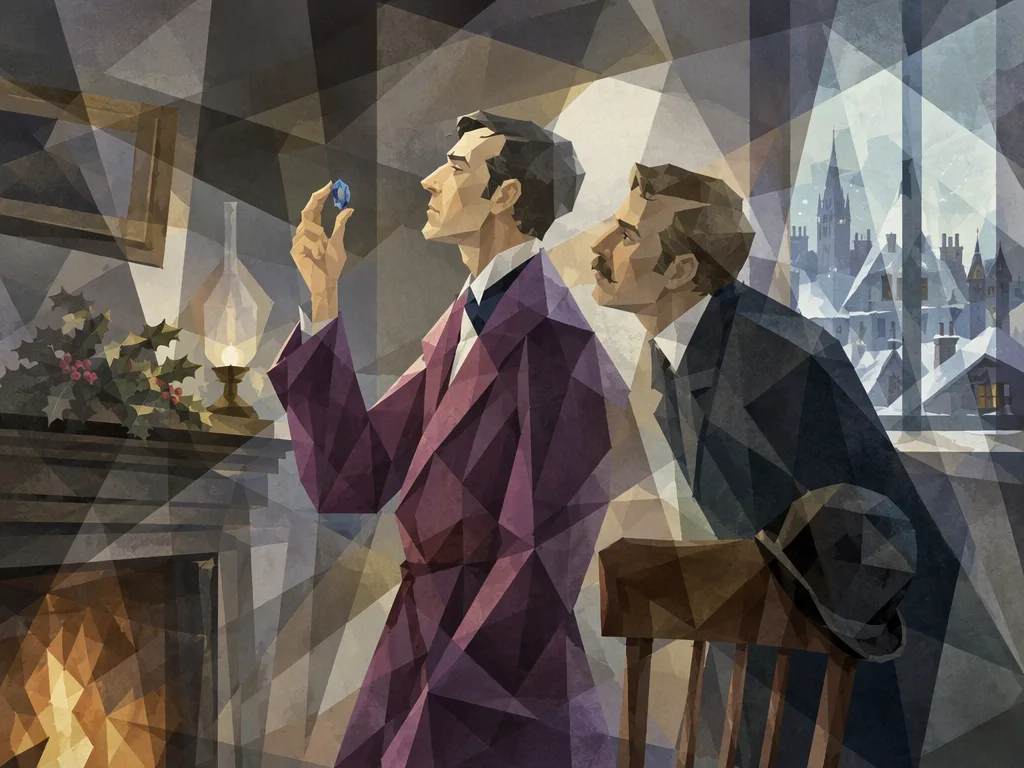
"Precisely so," said Holmes. "I ought to know its size and shape, since I have read the advertisement about it in *The Times* every day lately. It is completely unique. Its true value can only be guessed, though the reward of a thousand pounds is certainly less than a twentieth part of its market price."
"A thousand pounds! Good Lord!" Peterson dropped heavily into a chair and stared from one to the other of us.
"Yes, that is the reward," Holmes said. "And I have reason to know that the stone holds personal memories for the Countess—she would give up half her fortune if she could only recover it."
"If I remember right, it was stolen at the Hotel Cosmopolitan," I remarked.
"Yes, on December 22, just five days ago. John Horner, a plumber, was accused of stealing it from the lady's jewel box. The evidence against him looked so strong that the case has been sent to a higher court. I believe I have an account of the matter here."
He searched through his pile of newspapers, checking the dates, until he smoothed one out, folded it back, and read the report aloud.
"Hotel Cosmopolitan Jewel Robbery. John Horner, twenty-six, a plumber, was brought before the court, charged with stealing the valuable stone known as the blue carbuncle from the jewel box of the Countess of Morcar on December 22. James Ryder, head attendant at the hotel, told the court that he had taken Horner up to the Countess's dressing room on the day of the robbery to repair a loose bar in the fireplace. Ryder remained with Horner for a short time, then was called away. When he returned, Horner had vanished, the writing desk had been forced open, and the small jewel box where the Countess kept the stone lay empty on the dressing table. Ryder immediately raised the alarm, and Horner was arrested that evening, although the stone could not be found on him or in his rooms. Catherine Cusack, the Countess's maid, stated that she heard Ryder's cry of dismay when he discovered the theft, ran into the room, and found things as Ryder had described. Inspector Bradstreet of the police gave evidence about the arrest of Horner, who struggled wildly and insisted he was innocent. Because Horner had been in prison for robbery before, the judge refused to settle the case in the lower court and sent it to a higher court. Horner, who showed intense emotion throughout the hearing, fainted at the end and was carried out of the courtroom."
"Hmm! So much for the court," said Holmes thoughtfully, tossing the paper aside. "The question for us to solve now is the chain of events leading from a broken jewel box at one end to the inside of a goose in Tottenham Court Road at the other. You see, Watson, our little deductions have suddenly taken a much more serious turn. Here is the stone; the stone came from the goose, and the goose came from Mr. Henry Baker, the gentleman with the bad hat and the habits I bored you with earlier. So now we must work seriously to find this gentleman and learn what part he played in the mystery. First we should try the simplest way, which is an advertisement in all the evening papers. If that fails, I will turn to other methods."
"What will you say?"
"Give me a pencil and that slip of paper. Let us see: 'Found at the corner of Goodge Street, a goose and a black felt hat. Mr. Henry Baker can have the same by applying at 6:30 this evening at 221B Baker Street.' That is clear and brief."
"Very. Will he see it, though?"
"He is sure to keep an eye on the papers. For a poor man, the loss was a heavy one. Clearly he was so frightened when he broke the window and saw Peterson coming that he thought of nothing except running away. Since then, however, he must have bitterly regretted dropping his bird. Besides, printing his name will make sure he hears about it, because everyone who knows him will point it out. Here you are, Peterson—run down to the advertising office and have this placed in all the evening papers."
"Which ones, sir?"
"Every evening paper in London."
"Very good, sir. And the stone?"
"Ah, yes, I will keep the stone. Thank you. Oh, and Peterson—buy another goose on your way back and leave it here with me. We must have one to give this gentleman in place of the bird your family is now eating."
When the messenger had gone, Holmes picked up the stone and held it toward the light. "It is a lovely thing," he said. "Just see how it flashes and sparkles. Of course, fine stones are magnets for crime—they are the devil's favorite bait. In the older and larger jewels, every polished side may stand for a bloody deed. This stone is not yet twenty years old. It was found on the banks of the Amoy River in southern China, and it has every quality of a carbuncle, except that its color is deep blue instead of ruby red. In spite of its short life, it already has a dark history: two murders, an acid attack, a suicide, and several robberies have all been committed for the sake of this little blue stone. Who would think that so pretty a toy could send so many people to the gallows and to prison? I will lock it up in my strongbox now and send a note to the Countess to let her know we have it."
"Do you think this man Horner is innocent?"
"I cannot tell."
"Well, then, do you imagine that the other man, Henry Baker, had anything to do with the theft?"
"I think it is much more likely that Henry Baker is completely innocent, and had no idea the bird he carried was worth far more than if it were made of solid gold. Still, I can settle that with a very simple test if we get an answer to our advertisement."
"And you can do nothing until then?"
"Nothing."
"In that case, I will continue my morning rounds with my patients. I will come back this evening at the hour you mentioned, because I want to see the end of such a tangled mystery."
"I will be very glad to see you. I dine at seven. There is a roast bird—a woodcock, I believe. After today's events, perhaps I ought to ask Mrs. Hudson to check inside it first."
I was delayed by one of my patients, so it was a little after half past six when I reached Baker Street again. As I walked up to the house, I saw a tall man waiting outside in the bright semicircle of light from the window above the door. He wore a flat Scottish cap, and his coat was buttoned tightly up to his chin. Just as I arrived, the front door opened, and we were shown up together to Holmes's sitting room.
"Mr. Henry Baker, I believe," said Holmes, rising from his armchair and greeting the visitor with the easy warmth he could show so well when he wished. "Please take this chair by the fire, Mr. Baker. It is a cold night, and I notice your clothing seems better suited to summer than to winter. Ah, Watson, you have come at just the right moment. Is that your hat, Mr. Baker?"
"Yes, sir, that is undoubtedly my hat."
He was a large man with rounded shoulders, a big head, and a broad, intelligent face that narrowed to a pointed, graying brown beard. A touch of red on his nose and cheeks, along with a slight trembling of his outstretched hand, reminded me of Holmes's guess about his habits. His worn black coat was buttoned right up to the neck with the collar turned up, and his thin wrists stuck out from his sleeves without any sign of shirt cuffs. He spoke slowly and carefully, choosing each word, and gave the impression of an educated man who had fallen on hard times.
"We have kept these things for two days," said Holmes, "because we expected to see an advertisement from you with your address. I wonder why you did not put one in the papers."
Our visitor gave a slightly embarrassed laugh. "Shillings have not been so plentiful with me as they once were," he replied. "I had no doubt that the gang of roughs who attacked me had carried off both my hat and the bird. I did not wish to spend more money in a hopeless effort to get them back."
"Very natural. Now, about the goose—we were forced to eat it."
"To eat it!" Our visitor half rose from his chair in alarm.
"Yes. It would have been no good to anyone if we had kept it longer. However, I trust this other goose on the sideboard, which is roughly the same weight and completely fresh, will suit your needs just as well?"
"Oh, certainly, certainly," Mr. Baker answered with a sigh of relief.
"Of course, we still have the feathers, legs, and insides of your own bird, so if you wish—"
The man burst into a hearty laugh. "They might serve as souvenirs of my adventure," he said, "but beyond that, I can hardly see what use the remains of my late friend would be to me. No, sir, with your permission, I will turn my attention to the excellent bird I see on the sideboard."
Sherlock Holmes glanced sharply across at me and gave a slight shrug.
"There is your hat, then, and there is your bird," he said. "By the way, would you mind telling me where you got the goose you lost? I know a little about poultry, and I have rarely seen a finer bird."
"Certainly, sir," said Baker, who had stood up and tucked his new prize under his arm. "Several of us spend our evenings at the Alpha Inn, near the British Museum—we work inside the Museum itself during the day, you understand. This year our good landlord, Mr. Windigate, started a goose club. By paying a few pence every week, each of us was promised a bird at Christmas. I paid my money faithfully, and you know the rest. I am deeply grateful to you, sir, for a Scottish cap fits neither my age nor my dignity." With a comical air of importance, he bowed solemnly to both of us and strode out of the room.
"So much for Mr. Henry Baker," said Holmes as he closed the door behind him. "It is quite certain that he knows nothing whatever about the matter. Are you hungry, Watson?"
"Not particularly."
"Then I suggest we turn our dinner into a late supper and follow this trail while it is still hot."
"By all means."
It was a bitterly cold night, so we put on our heavy overcoats and wrapped scarves around our throats. Outside, the stars shone coldly in a cloudless sky, and the breath of passersby turned into white puffs like pistol smoke. Our footsteps rang sharply on the frozen pavement as we walked briskly toward Bloomsbury. In fifteen minutes we reached the Alpha Inn, a small pub on a street corner near Holborn. Holmes pushed open the door of the private bar and ordered two glasses of beer from the red-faced landlord in his white apron.
"Your beer ought to be excellent if it matches your geese," said Holmes.
"My geese!" The man looked surprised.
"Yes. Only half an hour ago I was talking with Mr. Henry Baker, a member of your goose club."
"Oh, yes, I see. Well, sir, those weren't *our* geese."
"Really? Whose, then?"
"I bought two dozen of them from a dealer in Covent Garden."
"Did you? I know some of the sellers there. Which one was it?"
"Breckinridge is his name."
"Ah, I don't know him. Well, here is to your good health, landlord, and good business to your house. Good night."
"Now for Mr. Breckinridge," Holmes said, buttoning his coat as we stepped back into the freezing air. "Remember, Watson, although we have something as ordinary as a goose at one end of this chain, at the other end we have a man who will certainly get seven years in prison unless we can prove him innocent. It is possible our search will only prove him guilty. Either way, we have a line of inquiry that the police missed, and a rare stroke of luck has put it in our hands. Let us follow it out to the very end. Southward, then, and quick march!"
We crossed Holborn and wound through a maze of narrow back streets until we came out into Covent Garden Market. One of the largest stalls carried the name of Breckinridge above it. The owner—a sharp-faced man with neat side-whiskers, looking very much like someone used to horses and racetracks—was helping a boy put up the wooden shutters.
"Good evening. It's a cold night," said Holmes.
The seller nodded and shot a suspicious look at my friend.
"Sold out of geese, I see," Holmes went on, pointing at the empty marble counters.
"I can let you have five hundred tomorrow morning."
"That won't help me."
"Well, there are still some on the stall with the gas lamp over there."
"Ah, but someone sent me to you."
"Who did?"
"The landlord of the Alpha."
"Oh, yes. I sent him two dozen."
"Fine birds they were, too. Now, where did you get them from?"
To my surprise, the question set off a burst of anger from the seller.
"Now then, mister," he said, cocking his head and putting his hands on his hips, "what are you getting at? Speak straight now."
"It is straight enough. I would like to know who sold you the geese you supplied to the Alpha."
"Well then, I won't tell you. So there!"
"Oh, it doesn't really matter. Still, I don't see why you should get so heated over such a small thing."
"Heated! You'd be heated too, maybe, if you were pestered the way I am! When I pay good money for good birds, that should be the end of the business. Instead it's 'Where are the geese?' and 'Who did you sell the geese to?' and 'What will you take for the geese?' You'd think they were the only geese in the world, to hear all the fuss made over them."
"Well, I have nothing to do with any other people asking questions," said Holmes carelessly. "If you won't tell us, my bet with a friend is off, that's all. Still, I am always ready to back my opinion about poultry, and I have five pounds on it that the bird I ate was raised in the country."
"Then you've lost your five pounds, because it was raised in town," snapped the seller.
"Nothing of the kind."
"I say it was."
"I don't believe it."
"Do you think you know more about birds than I do? I've handled them ever since I was a boy! I tell you, every bird that went to the Alpha was raised in town."
"You will never persuade me of that."
"Will you bet, then?"
"It feels like taking your money, because I know I am right. Still, I'll bet you one pound, just to teach you not to be stubborn."
The seller chuckled darkly. "Bring me the books, Bill," he said.
The boy brought over a thin little volume and a thick, grease-stained account book, laying them out together under the hanging lamp.
"Now then, Mr. Know-It-All," said the seller, "I thought I was out of geese, yet before I finish you'll see there is still one left in my shop. See this little book?"
"Well?"
"That's the list of people I buy from. Look here on this page—these are the country sellers, and the numbers beside their names show where their accounts are in the big book. Now look at this other page written in red ink. That is my list of town suppliers. Look at the third name. Read it out to me."
"Mrs. Oakshott, 117 Brixton Road—249," Holmes read.
"Right. Now look that up in the big book."
Holmes turned to page 249. "Here it is: 'Mrs. Oakshott, 117 Brixton Road, egg and poultry supplier.'"
"Now then, what is the last entry?"
"'December 22. Twenty-four geese at seven shillings and sixpence each.'"
"Right. There you are. And underneath?"
"'Sold to Mr. Windigate of the Alpha, at twelve shillings.'"
"What do you have to say now?"
Sherlock Holmes looked deeply annoyed. He took a gold coin from his pocket and threw it down onto the marble counter, then turned away with the look of a man too disgusted for words. A few yards off, he stopped under a streetlamp and laughed in his hearty, silent fashion.
"Whenever you see a man with side-whiskers like that and a racing paper sticking out of his pocket, you can always hook him with a bet," he said. "I dare say that if I had laid a hundred pounds down in front of him, he would never have given me information as complete as he handed over just to win a bet. Well, Watson, I think we are nearing the end of our search. The only question left is whether we should go on to Mrs. Oakshott's tonight, or wait until tomorrow. It is clear from what that rude fellow said that others besides us are anxious about these geese, and I—"
His words were suddenly cut short by a loud burst of shouting from the stall we had just left.