


For a moment or two I sat breathless, unable to believe my ears. Then my senses came rushing back, and a crushing weight seemed to lift straight off my shoulders. That cool, sharp, teasing voice belonged to only one man in the world.
"Holmes!" I cried. "Holmes!"
"Come out," he said, "and please be careful with the revolver."
I ducked under the low stone doorway, and there he sat on a rock outside, his gray eyes dancing with amusement as he looked at my astonished face. He looked thin and worn, his sharp face tanned brown by the sun and wind. In a tweed suit and cloth cap, he might have passed for any ordinary traveler walking the moor, yet he had somehow kept his chin shaved smooth and his shirt collar as clean and neat as if we were in Baker Street.
"I have never been gladder to see anyone in my life," I said, shaking his hand warmly.
"Or more surprised, eh?"
"I have to admit it."
"The surprise wasn't all on one side, I assure you. I had no idea you had found my quiet shelter, still less that you were sitting inside it, until I was within twenty yards of the door."
"My footprints, I suppose?"
"No, Watson, I wouldn't claim to recognize your footprint among all the footprints in the world. If you really want to fool me, you must change your tobacconist. When I see a cigarette end marked Bradley, Oxford Street, I know that my friend Watson is nearby. You can see it lying there beside the path, where you threw it down at the dramatic moment when you rushed into the empty hut."
"Exactly."
"Knowing how stubborn you are, I guessed at once that you were sitting inside in ambush, weapon in hand, waiting for the owner to come home. So you actually thought I was the criminal?"
"I didn't know who you were, but I was determined to find out."
"Well done, Watson! And how did you track me down? Did you spot me on the night of the convict hunt, when I was careless enough to let the moon rise behind me?"
"Yes, I saw you then."
"And have you been searching every hut on the moor until you reached this one?"
"No, your boy was spotted, and that showed me where to look."
"The old gentleman with the telescope, no doubt. That explains the flashes of light I kept seeing on his roof." Holmes stepped to the doorway and glanced inside. "Ha, I see Cartwright brought up fresh supplies. And what is this paper? So you have been to Coombe Tracey, have you?"
"Yes."
"To see Mrs. Laura Lyons?"
"Exactly."
"Excellent! Our investigations have clearly been moving along parallel lines, and when we put what we know together, we should have nearly the whole picture."
"I'm thankful from the bottom of my heart that you are here, Holmes, because the responsibility and the mystery were becoming too much for my nerves. Still, how on earth did you get here, and what have you been doing? I thought you were in Baker Street working on a blackmail case."
"That was what I wanted you to think."
"So you use me, and yet you don't trust me!" I cried, feeling a sting of hurt pride. "I think I deserved better from you, Holmes."
"My dear Watson, you have been priceless to me in this case, as in so many others, and I beg you to forgive me if I seemed to play a trick on you. In truth, I did it partly for your own safety. I saw how great a danger you were facing, and that is why I came down to see things for myself. If I had stayed openly at the Hall with you and Sir Henry, our clever enemies would have been on their guard, and I could never have moved about freely. By keeping out of sight, I remain an unknown piece on the board, ready to strike at the right moment."
"But why keep me in the dark?"
"Knowing couldn't have helped us, and it might have exposed me. You would have wanted to share news with me, or out of kindness you would have tried to bring me food or warm things, and any mistake could have given us away. Instead, I brought Cartwright down with me—you remember the bright boy from the messenger office in London—and he takes care of my simple needs: a loaf of bread and a clean collar. What more does a man need? He has given me an extra pair of eyes and a very quick pair of legs, and both have been worth their weight in gold."
"Then all my reports were wasted!" My voice shook slightly as I thought of the care and pride I had put into writing them.
Holmes reached into his pocket and pulled out a thick bundle of papers.
"Here are your reports, my dear fellow, and very well read, I assure you. I arranged for them to be sent straight on to me, only one day late. Let me tell you how deeply I admire the energy and good sense you have shown in an extraordinarily difficult case."
I was still a little sore over being deceived, yet the warmth of Holmes's praise melted my anger away. Deep down, I knew he was right: the investigation truly had worked better because I hadn't known he was on the moor.
"That's better," Holmes said, watching my face clear. "Now tell me everything that happened with Mrs. Laura Lyons. It wasn't hard for me to guess you had gone to see her, because she is the one person in Coombe Tracey who can help us. In fact, if you hadn't gone today, I would probably have gone myself tomorrow."
The sun had dropped below the hills, and dusk was creeping over the moor. As the air turned chilly, we stepped inside the hut for shelter. Sitting together in the fading light, I told Holmes every word of my conversation with Mrs. Lyons. He listened with keen attention, asking me to repeat parts of it twice until he had every detail clear.
"This is vital," he said when I finished. "It fills a gap I hadn't been able to bridge in this complex case. You know, I suppose, that Mrs. Lyons and Stapleton are very close?"
"I didn't know they were close."
"There is no doubt about it. They meet, they write, and they understand each other completely. That puts a powerful weapon in our hands. If only I can use it to turn his wife against him—"
"His wife?"
"I will give you some news in return for yours, Watson. The woman who passes here as Miss Stapleton is actually his wife."
"Good heavens, Holmes! Are you sure? How could he let Sir Henry fall in love with her?"
"Sir Henry falling in love did no harm to anyone except Sir Henry. Stapleton made very sure Sir Henry went no further, as you saw yourself. I repeat, she is his wife, not his sister."
"But why pretend?"
"Because he saw she would be far more useful to him if people thought she was an unmarried woman."
In a flash, all my unspoken doubts and uneasy feelings centered on the naturalist. Under that calm, colorless manner, with his straw hat and butterfly net, I saw something chilling—a man of endless patience and cold cunning, with a smiling face and a killer's heart.
"Then he is our enemy!" I cried. "It was he who followed us in London!"
"That is how I read the puzzle."
"And the warning letter—it must have come from his wife!"
"Exactly."
A dark, monstrous scheme seemed to take shape in the shadows around me. "But how can you be sure she is his wife?"
"Because Stapleton was careless enough to tell you one true fact about his past when you first met him, and I expect he has regretted it many times since. He told you he once owned a school in the north of England. No man is easier to trace than a schoolmaster—school agencies keep records of everyone in the profession. A short inquiry showed me that a school there failed in disgrace, and that the owner vanished with his wife under a different name. The descriptions matched. When I learned the missing man collected insects, the proof was complete."
Night was deepening inside the hut.
"If she really is his wife," I asked, "where does Mrs. Laura Lyons come in?"
"Your visit today answered that. I didn't know Mrs. Lyons was hoping to get a divorce. Believing Stapleton was a free man, she clearly expected to marry him."
"And when she learns the truth?"
"Then she may become very useful to us indeed. Our first task tomorrow morning is for both of us to go see her. Meanwhile, Watson, haven't you been away from Sir Henry rather long? Your place is at Baskerville Hall."
The last red glow had faded in the west, and a few faint stars glimmered in the dark violet sky.
"One last question, Holmes," I said, standing up. "Surely there is no need for secrets between us now. What is the meaning of all this? What is Stapleton trying to do?"
Holmes's voice dropped low.
"It is murder, Watson—refined, cold-blooded, deliberate murder. Don't ask me for details yet. My nets are closing around him, just as his are closing around Sir Henry, and with your help I almost have him. There is only one danger left—that he might strike before we are ready. Another day, two at the most, and my case will be complete. Until then, guard Sir Henry as closely as a mother guards a sick child. Your work today was well worth the risk, yet I almost wish you hadn't left his side. Wait—listen!"
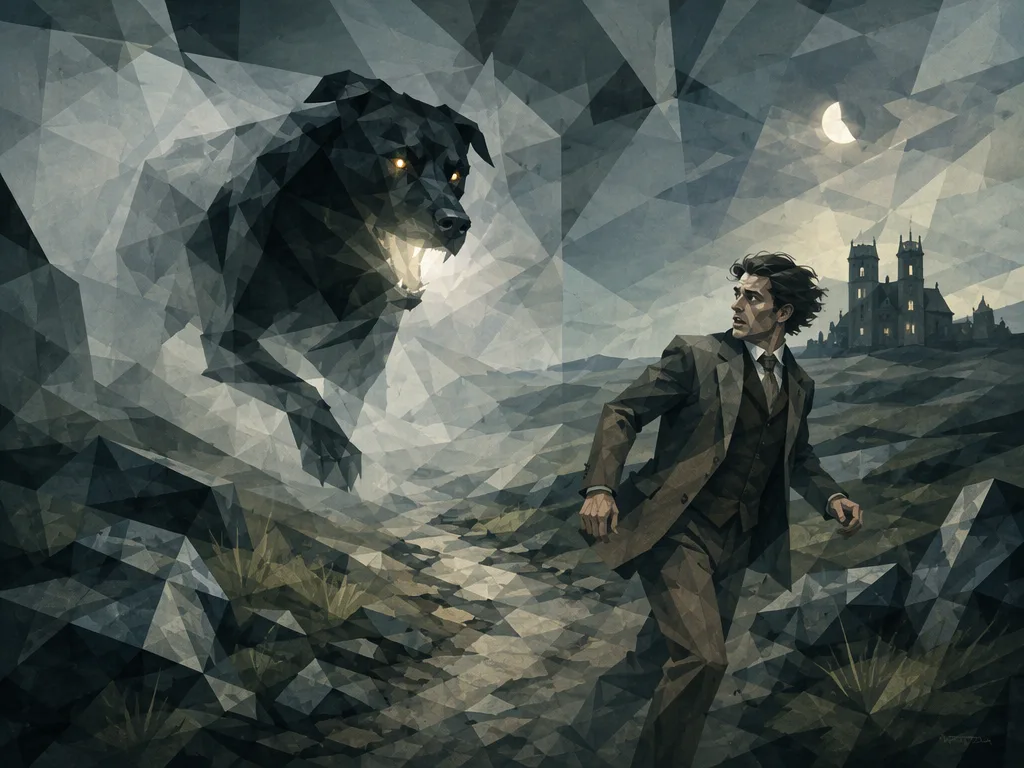
A terrible scream—a long yell of horror and pain—tore through the quiet night across the moor. My blood ran cold.
"Oh, my God!" I gasped. "What was that? What does it mean?"
Holmes sprang to the doorway, his tall, strong figure bent forward as he peered into the blackness.
"Hush!" he whispered. "Hush!"
The scream had come from somewhere far out on the dark moor. Now it rang out again—nearer, louder, more desperate than before.
"Where is it?" Holmes whispered, and the tremble in his voice told me that even this man of iron was deeply shaken. "Where is it coming from, Watson?"
"Over there, I think," I said, pointing into the night.
"No, over there!"
A third agonizing scream echoed through the silence, louder and closer than ever. And now a second sound joined it—a deep, rolling growl, strange and threatening, rising and falling like the distant sea.
"The hound!" cried Holmes. "Come, Watson, come! Good heavens, what if we are too late!"
He broke into a sprint across the dark moor, and I ran close behind him. Seconds later, from rough ground straight ahead of us, came one last despairing shriek, followed by a heavy, dull thud. We stopped dead and listened. Not another sound broke the silence of the windless night.
I saw Holmes raise a hand to his forehead in despair. He stamped his foot on the rocky ground.
"He has beaten us, Watson. We are too late."
"No, no, surely not!"
"What a fool I was to wait! And you, Watson, see what comes of leaving your post! Still, if the worst has happened, we will make him pay for it!"
Blindly we raced forward through the gloom, stumbling over boulders, pushing through low bushes, panting up hills and charging down slopes toward the spot where those awful sounds had died away. At every hilltop Holmes stared eagerly around, but the dark shadows lay thick across the moor and nothing moved.
"Can you see anything?" I gasped.
"Nothing."
"Wait—listen! What was that?"
A faint groan reached our ears. Then it came again from our left. Along that side, a ridge of rocks ended in a steep drop over a slope covered in fallen stones. Halfway down that rocky slope lay a dark, twisted shape.
As we scrambled toward it, the shape grew clearer. A man lay face down on the stones, his head bent under him at a terrible angle, his shoulders hunched and his legs twisted as if he had tumbled headlong down the cliff. That faint groan must have been his dying breath, for no sound came from him now. Holmes laid a hand on him and pulled it back with a sharp cry of horror. He struck a match, and in its brief yellow flare I saw his fingers dark with blood, and a widening pool spreading beneath the man's broken skull. And I saw something else that turned my heart cold and sick—the reddish tweed suit of Sir Henry Baskerville.
Neither of us could forget that suit, the very one Sir Henry had worn the first morning we met him in Baker Street. We caught one clear glimpse of it before the match flickered out, leaving us in darkness as empty as our hopes. Holmes groaned aloud, his face pale in the gloom.
"The monster!" I cried, clenching my fists. "Oh, Holmes, I will never forgive myself for leaving him to die!"
"I am more to blame than you, Watson. To make my case neat and complete, I threw away my client's life. It is the worst blow I have suffered in my whole career. Yet how could I know—how could anyone know—that he would go out on the moor alone against every warning?"
"To hear his screams—my God, those screams!—and not be able to reach him in time! Where is the hound that drove him to his death? It might be hiding among these rocks right now. And Stapleton—where is he? He will pay for this crime!"
"He shall. I swear it. Uncle and nephew have both been murdered—one frightened to death by the sight of a beast he thought came from hell, the other chased over a cliff while running for his life. Now we must prove the link between the man and the beast. Beyond what we heard, we can't even prove the hound exists, since Sir Henry clearly died from the fall. Yet clever as he is, I will have that man in my hands before another day passes!"
We stood silently on either side of the broken body, crushed by this sudden disaster that seemed to ruin all our work. Then the moon rose above the hills, and we climbed to the top of the rocks above the cliff to look out across the moonlit moor, half silver and half shadow. Miles away, toward Grimpen, a single steady yellow light shone across the darkness. It could only come from the Stapletons' lonely house. With an angry curse, I shook my fist at it.
"Why don't we arrest him right now?" I demanded.
"We don't have the proof yet. That man is as careful and sly as a fox. What matters isn't what we know, Watson, but what we can prove. One false move, and he slips through our fingers."
"Then what can we do?"
"We will have plenty to do tomorrow. Tonight we can only take care of our poor friend."
Together we climbed back down the steep slope to the body, dark and clear against the silver stones. The sight of those twisted limbs sent a sharp pain through me and blurred my eyes with tears.
"We must go for help, Holmes! We can't carry him all the way back to the Hall—good heavens, are you losing your mind?"
Holmes had given a sudden cry and dropped to his knees beside the body. Now he was jumping up, laughing, and shaking my hand wildly. Could this be my calm, self-controlled friend?
"A beard! A beard! The man has a beard!"
"A beard?"
"It is not Sir Henry—it is—why, it is my neighbor, the convict!"
With shaking hands we rolled the body over, and there in the cold, clear moonlight lay the face of Selden, the escaped prisoner—the heavy brow, the deep-set animal eyes, the rough beard I had seen by candlelight on the rocks only nights before.
Suddenly everything became clear to me. I remembered Sir Henry telling me he had given his old clothes to Barrymore, and Barrymore had passed them to Selden to help him escape. Suit, boots, shirt, cap—everything he wore had belonged to Sir Henry. It was still a grim sight, yet this man had already been condemned to death by the laws of his country. Relief and thankfulness flooded through me as I explained it all to Holmes.
"Then those clothes cost the poor devil his life," Holmes said. "Clearly the hound was set on Sir Henry's scent—using the old black boot stolen at the London hotel, most likely—and tracked this man down instead. Yet there is one very strange puzzle here. How did Selden know, in the dark, that a hound was hunting him?"
"He heard it."
"Hearing a dog baying out on the moor wouldn't drive a tough criminal like Selden into such wild terror that he would risk capture by screaming at the top of his lungs. From his cries, he must have run a long way after he realized what was chasing him. How did he know?"
"What puzzles me even more," I said, "supposing our guesses are right—"
"I guess nothing."
"Well, why was the hound running loose tonight at all? Stapleton wouldn't let it out unless he expected Sir Henry to be on the moor."
"My question is the harder one, Watson, because I think we will learn the answer to yours very soon, while mine may remain a mystery. Now, what shall we do with this poor wretch's body? We can't leave him out here for the foxes and crows."
"Let's carry him into one of the stone huts until we can send for the police."
"Good idea. Together we can easily carry him that far. Wait—who is this? It is the man himself, bold as brass! Not a word to show we suspect him, Watson, or all my plans crumble to dust!"
A figure was walking toward us across the moor, and I caught the dull red glow of a cigar. As he stepped into the moonlight, I recognized Stapleton's small, neat figure and brisk, confident stride. He stopped when he saw us, then came forward again.
"Why, Dr. Watson, is that you?" he called out. "You are the last person I expected to meet out on the moor at this hour. Good heavens, what is this? Has someone been hurt? Don't—don't tell me it is our friend Sir Henry!"
He hurried past me and bent over the dead man. I heard a sharp intake of breath, and his cigar slipped from his fingers.
"Who—who's this?" he stammered.
"It is Selden, the convict who escaped from Princetown," I replied.
Stapleton turned a white, shocked face toward us, though within seconds he forced himself to hide his surprise and bitter disappointment. His eyes darted quickly from Holmes to me.
"Dear me! How dreadful! How did it happen?"
"He seems to have fallen over these rocks and broken his neck," I said. "My friend and I were out walking on the moor when we heard a scream."
"I heard a scream too! That is what brought me out. I was terribly worried about Sir Henry."
"Why Sir Henry in particular?" I couldn't help asking.
"Because I had invited him to come over tonight. When he didn't appear, I was surprised—and naturally I grew frightened for him when I heard cries out here." His eyes flashed again between my face and Holmes's. "By the way, did you hear anything else besides a scream?"
"No," said Holmes. "Did you?"
"No."
"What do you mean, then?"
"Oh, you know the wild stories the local people tell about a phantom hound and things of that sort. They say it can be heard on the moor at night. I wondered if anyone had heard such a sound tonight."
"We heard nothing of the kind," I said.
"And how do you explain this poor man's death?"
"I have no doubt that fear and living out in the cold drove him out of his mind," I answered. "He must have run blindly through the dark and fallen over these rocks."
"That sounds like the most likely explanation," Stapleton said, letting out a quiet sigh of relief. He turned politely to my companion. "What is your opinion, Mr. Holmes?"
Holmes gave a slight bow. "You recognized me quickly," he said.
"We have been expecting you ever since Dr. Watson came down. Unfortunately, you arrived just in time for a tragedy."
"Yes, indeed. Still, I have no doubt my friend's explanation fits the facts. I will carry a grim memory back to London with me tomorrow."
"Oh, you are returning tomorrow?"
"That is my plan."
"I hope your visit cleared up some of the mysteries that have puzzled us here?"
Holmes shrugged calmly. "One cannot always succeed as one hopes. A detective needs solid facts, not old legends and local rumors. It has not been a satisfying case."
Holmes spoke in his frankest, most casual tone. Stapleton studied his face closely for a moment, then turned back to me.
"I would offer to carry this poor fellow to my house," he said, "but it would frighten my sister so terribly that I cannot do it. If we cover his face with something, he should be safe here until morning."
So we covered the body and turned to leave. Politely refusing Stapleton's invitation to stop at his house, Holmes and I set off toward Baskerville Hall, leaving the naturalist to walk home alone. Looking back once, I saw his small figure moving steadily away across the wide moor, and behind him, on the silver slope, the dark shape of the man who had met such a terrible end.
"We are at close grips with him at last," Holmes said as we walked side by side. "What nerves that man has! Think how quickly he pulled himself together after the crushing shock of discovering the wrong man had fallen into his trap. I told you in London, Watson, and I say it again: we have never faced a more dangerous enemy."
"I am sorry he saw you."
"So was I at first, though there was no avoiding it."
"How will it change his plans now that he knows you are here?"
"It may make him more careful, or it may push him into doing something reckless right away. Like many clever criminals, he may trust too much in his own cleverness and believe he completely fooled us."
"Then why not arrest him tonight?"
"My dear Watson, you were always a man of action. Your first thought is always to strike at once. Suppose we did arrest him tonight—what good would it do? We couldn't prove a single thing against him. That is his devilish cleverness! If he worked through a human partner, we could find witnesses or evidence. Even if we dragged that huge hound out into the daylight, it wouldn't put a rope around its master's neck."
"Surely we have enough for a case!"
"Not a shadow of one—nothing but guesses and suspicions. Any court would laugh us out of the room if we walked in with that story and no hard proof."
"There is Sir Charles's death."
"He was found dead without a single mark on him. You and I know he died of sheer terror, and we know what frightened him, yet how do we prove that to twelve ordinary men on a jury? Where are the marks of a hound? Where are the teeth marks? We know a hound doesn't bite a dead body, and that Sir Charles died before the beast even reached him—but we have to prove it, and right now we can't."
"What about tonight, then?"
"Tonight leaves us no better off. Once again, there is no direct link between the hound and the man's death. We never even saw the hound! We heard it, yes, yet we can't prove it was chasing this man—and Stapleton had no reason on earth to want Selden dead. No, Watson, we must face the fact that we have no case yet, and we must be ready to take any risk tomorrow to build one."
"How do you plan to do that?"
"I have high hopes that Mrs. Laura Lyons will help us once she learns the truth. And I have a plan of my own as well. Tomorrow will bring trouble enough, yet before the day ends I hope to hold the winning hand at last."
I could get nothing more out of him, and he walked lost in deep thought all the way to the gates of Baskerville Hall.
"Are you coming up to the house?" I asked.
"Yes, there is no longer any reason to hide. Only one last word of warning, Watson: say nothing about the hound to Sir Henry. Let him believe Selden died by falling over the rocks, just as Stapleton wants us to think. Sir Henry will need steady nerves for what he has to face tomorrow evening, when—if I remember your report correctly—he is invited to dine with the Stapletons."
"Yes, and I am invited too."
"Then you must make an excuse and stay behind. He must go alone—we can arrange that easily enough. And now, since we missed dinner, I think both of us are ready for a good supper."