


"I have an old family paper in my pocket," said Dr. Mortimer.
"I noticed it as soon as you came into the room," said Holmes.
"It is very old."
"Early eighteenth century, unless it is a fake."
"How on earth can you say that, sir?"
"You have had an inch or two of it sticking out of your pocket the whole time you were talking. I would be a poor expert if I couldn't tell the age of a document within ten years or so. You may have read my short study on the subject. I would date that paper around 1730."
"The exact date is 1742." Dr. Mortimer pulled it from his breast pocket. "This paper was given into my care by Sir Charles Baskerville, whose sudden and tragic death in May caused so much talk in Devon. I was his close friend as well as his doctor. He was a strong-minded man, sir—practical, sharp, and no more imaginative than I am. Yet he took this paper very seriously, and his mind was prepared for just the kind of end that finally caught up with him."
Holmes held out his hand for the manuscript and smoothed it flat across his knee. "Look, Watson, at the old style of writing the letter *s* in two different ways. That is one of several clues that helped me fix the date."
I looked over his shoulder at the yellow paper and faded brown ink. At the top was written "Baskerville Hall," and below it, in large uneven figures, "1742."
"It looks like a statement of some kind," I said.
"Yes, it is a written account of a legend that runs in the Baskerville family."
"But I thought you wanted to consult me about something modern and practical?" Holmes said.
"It is most modern," Mortimer replied. "A pressing, practical matter that must be decided within twenty-four hours. Still, this paper is short and closely tied to the whole affair. With your permission, I will read it to you."
Holmes leaned back in his chair, pressed his fingertips together, and closed his eyes with a patient sigh. Dr. Mortimer held the old paper toward the light and began to read in a high, cracking voice:
"Many stories have been told about the origin of the Hound of the Baskervilles. Since I am a direct descendant of Hugo Baskerville, and I heard the story from my father, who heard it from his, I have written it down here just as I believe it happened. I want you to believe, my sons, that the same God who punishes sin can also forgive it, and no curse is so heavy that prayer and sorrow cannot lift it. Learn from this story not to fear the past, but to live carefully in the future, so that the dark passions that brought such ruin on our family may never break free again.
"Know then that in the days of the Great Civil War, Baskerville Hall belonged to Hugo Baskerville, a wild, godless, and wicked man. His neighbors might have forgiven his rough ways, for few saints live in these parts, but there was a cruel streak in him that made his name hated across the whole West Country. Now, this Hugo developed a dark desire for the daughter of a farmer who owned land near the Baskerville estate. She was a good, sensible young woman and always avoided him, because she feared his evil reputation. So one autumn day, when Hugo knew her father and brothers were away from home, he rode to the farm with five or six of his wild companions and carried the girl off. They locked her in an upper room at the Hall, while Hugo and his friends sat down below for a night of heavy drinking.
"Soon the poor girl upstairs was nearly out of her mind with fear at the shouting, singing, and terrible curses rising from the hall below. At last, driven by terror, she did something that would have frightened even the bravest man. Climbing out of a window under the roof, she used the thick ivy growing up the south wall—which still grows there today—to climb down to the ground, and ran homeward across the moor, nine miles back to her father's farm.
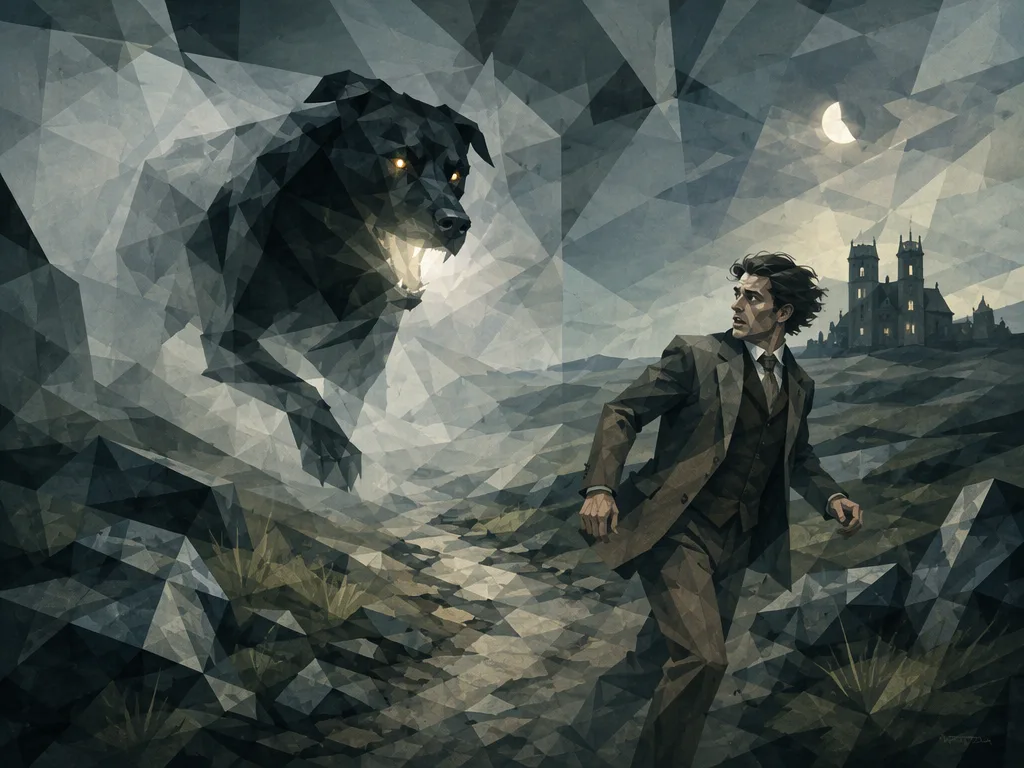
"A little later, Hugo left his guests to carry food and drink up to his prisoner, and found the room empty. At once he seemed possessed by a devil. Rushing down the stairs into the dining hall, he leaped onto the long table, knocking cups and plates flying, and shouted before them all that he would give his body and soul to the powers of evil that very night if only he could catch the girl. While his guests stared in shock at his fury, one of them—more wicked or more drunk than the rest—yelled that they should set the hunting dogs after her. Hugo ran outside shouting to his servants to saddle his black horse and let the pack out. Letting the dogs smell a scarf the girl had dropped, he sent them onto her trail and galloped off into the moonlight across the moor.
"For a few moments the drunken men stood silent, too stunned to grasp what was happening. Then they realized the terrible crime about to take place out on the moor. Everything was suddenly in an uproar—some shouting for pistols, some for horses, and some for more wine. At last they pulled themselves together, and all thirteen of them mounted and rode off in pursuit. The moon shone bright above them as they galloped side by side along the path the girl had to take to reach her farm.
"After riding a mile or two, they passed one of the night shepherds on the moor and shouted to ask if he had seen the hunt. The poor man was so terrified he could barely speak, but at last he said he had indeed seen the girl, with the dogs close behind her. 'But I have seen worse than that,' he gasped, 'for Hugo Baskerville rode past me on his black horse, and running silently at his heels was a hound from hell—may God never put such a creature behind me!' The drunken gentlemen cursed the shepherd and rode on. Yet soon their blood ran cold, for they heard rapid hoofbeats ahead, and Hugo's black horse galloped past them covered in white foam, with trailing reins and an empty saddle.
"Now the riders stayed close together, gripped by a great fear, though none of them dared turn back alone. Riding slowly forward, they came upon their own hunting dogs. Usually brave and fierce, the dogs were whimpering in a tight frightened group at the top of a narrow valley, some shrinking back, others staring down into the dip with bristling fur and terrified eyes.
"Most of the company halted, far more sober now than when they had set out. Only three of them—the boldest, or the drunkest—rode down into the narrow valley. It opened out into a wide hollow where two huge ancient stones stood in the bright moonlight. There in the center lay the poor girl where she had fallen, dead of fear and exhaustion. Near her lay the body of Hugo Baskerville. Yet it was not the sight of her body, nor Hugo's, that made the hair stand up on the heads of those three wild riders. Standing over Hugo was a monstrous black beast, shaped like a hound, yet larger than any hound mortal eyes had ever seen. And even as they looked, the creature tore Hugo's throat out. When it turned its blazing eyes and dripping jaws toward them, the three men shrieked in terror and rode wildly back across the moor. One, they say, died that very night from what he had seen, and the other two were broken men for the rest of their lives.
"Such is the story, my sons, of the coming of the hound that has haunted our family ever since. I have written it clearly because something openly known brings less terror than dark whispers and guesses. It cannot be denied that many of our family have met sudden, bloody, and mysterious deaths. Yet we may trust in the goodness of God, who will not punish innocent children forever. To His care I leave you, and I warn you to be careful and never cross the moor in those dark hours when the powers of evil are strongest.
"This from Hugo Baskerville to his sons Rodger and John, with strict orders to say nothing of it to their sister Elizabeth."
When Dr. Mortimer finished reading, he pushed his glasses up onto his forehead and looked across at Sherlock Holmes. Holmes gave a yawn and tossed the end of his cigarette into the fire.
"Well?" said Holmes.
"Don't you find it interesting?" asked Mortimer.
"For someone who collects fairy tales, perhaps," said Holmes.
Dr. Mortimer reached into another pocket and pulled out a folded newspaper.
"Now, Mr. Holmes, let me give you something much more recent. This is the *Devon County Chronicle* from May 14 of this year. It gives a short report of the facts found at the inquest into Sir Charles Baskerville's death, which happened a few days before."
Holmes leaned forward slightly, and his face became sharp and focused. Our visitor put his glasses back on and began to read:
"The sudden death of Sir Charles Baskerville, who was widely expected to run for Parliament in Mid-Devon at the next election, has filled the county with sadness. Although Sir Charles lived at Baskerville Hall for only a short time, his kindness and extraordinary generosity won the affection and respect of everyone who knew him. Sir Charles made a large fortune in South Africa and was wise enough to take his money and return home to restore the pride of his old family. Only two years ago he moved into Baskerville Hall, and everyone knows of the great plans he had to rebuild and improve the estate and help the area. Having no children, he wished the entire countryside to share in his wealth during his lifetime, and his generous gifts to local charities have often been reported in these pages.
"While every detail of his death could not be completely explained at the inquest, enough was proven to end the superstitious rumors circulating in the area. There is no reason whatever to suspect a crime, or to doubt that death came from natural causes. Sir Charles was a widower of simple personal habits. Despite his great wealth, his indoor staff at the Hall consisted only of a married couple named Barrymore—the husband serving as butler and the wife as housekeeper. Their testimony, supported by several friends, showed that Sir Charles's health had been failing for some time. In particular, he suffered from a weak heart, causing sudden paleness, shortness of breath, and dark moods of anxiety. Dr. James Mortimer, his friend and doctor, confirmed this.
"The facts of that night are simple. Every evening before going to bed, Sir Charles liked to walk down the famous yew alley at Baskerville Hall, smoking a cigar. On May 4, he announced his plan to leave for London the next day and told Barrymore to pack his luggage. That night he went out as usual for his evening walk and never returned. At midnight, finding the front door still open, Barrymore grew alarmed, lit a lantern, and went looking for his master. It had rained earlier in the day, so Sir Charles's footprints were easy to follow on the gravel path. Halfway down the alley is a gate that opens onto the moor, and there were signs that Sir Charles had stood there for a short time. He then continued down the path, and his body was found at the far end. One puzzling detail is Barrymore's statement that his master's footprints changed after passing the moor gate, making it look as if he had been walking on his toes. A horse dealer named Murphy was out on the moor not far away—though he admitted he had been drinking—and says he heard cries, though he could not tell which direction they came from. There were no marks of violence on Sir Charles's body. Although Dr. Mortimer noted that Sir Charles's face was twisted so horribly that at first he hardly knew his own friend, doctors confirmed that such twisting can happen when someone dies of sudden heart failure while struggling for breath. A medical examination after death showed long-standing heart disease, and the jury returned a verdict of death from natural causes.
"This conclusion is fortunate, because it is vital for Sir Charles's heir to move into the Hall and carry on the good work so sadly cut short. If the inquest had not put an end to the dark stories whispered about the place, it might have been hard to get anyone to live at Baskerville Hall. The next heir is believed to be Mr. Henry Baskerville, if he is still alive—the son of Sir Charles's younger brother. When last heard of, he was in America, and efforts are now being made to find him and tell him of his good fortune."
Dr. Mortimer folded the newspaper and put it back in his pocket. "Those are the public facts, Mr. Holmes, about the death of Sir Charles Baskerville."
"Thank you for bringing this to me," said Sherlock Holmes. "It certainly has some very interesting points. I remember seeing a brief mention of it in the papers at the time, though I was busy with another case at the time and did not follow the English news closely. This article contains all the public facts?"
"It does."
"Then please tell me the private ones." Holmes leaned back, placed his fingertips together again, and put on his calmest, most thoughtful expression.
"What I am about to tell you," said Dr. Mortimer, his voice showing real feeling for the first time, "I have told to no one else. I kept it from the inquest because a man of science does not want to stand in public and appear to support a local superstition. I also knew that Baskerville Hall would stand empty if I made its dark reputation worse. Since keeping silent did no harm, I felt I was right to hold back part of what I knew. With you, however, there is no reason not to be completely honest.
"Few people live out on the moor, so those of us who are there see a good deal of one another. Apart from Mr. Frankland at Lafter Hall and Mr. Stapleton the naturalist, there are no other educated men within many miles. Sir Charles was a quiet man, yet his illness brought us together, and our shared interest in science made us close friends.
"During the last few months of his life, I could see clearly that Sir Charles's nerves were stretched to the breaking point. He had taken this family legend deeply to heart—so much so that, although he walked in his own garden, nothing could make him step out onto the moor at night. Strange as it may sound, Mr. Holmes, he truly believed a terrible fate hung over his family, and the stories he could tell of his ancestors were certainly grim. The thought of some awful presence haunted him constantly. More than once, he asked me if I had ever seen a strange creature or heard a hound baying during my night rides to visit patients. He asked that question several times, always with a tremor of fear in his voice.
"I clearly remember driving up to the Hall in my cart one evening about three weeks before he died. Sir Charles happened to be standing at his front door. I had stepped down and was standing in front of him when I saw his eyes lock onto something over my shoulder, staring past me in sheer horror. I spun around just in time to catch a glimpse of something that looked like a large black calf moving past the top of the driveway. He was so frightened that I had to walk down to the spot and look around. Nothing was there, of course, yet the sight shook him terribly. I stayed with him all evening, and it was then, to explain his fear, that he gave me the 1742 paper I just read to you. At the time, I thought the whole thing was unimportant and believed his fear had no real cause.
"It was on my advice that Sir Charles decided to go to London. I knew his heart was weak, and the constant dread he lived in—no matter how foolish the reason—was harming his health. I thought a few months among the lively distractions of the city would make him a new man. Mr. Stapleton, a mutual friend who also worried about him, agreed completely. Then, at the last moment, came this terrible disaster.
"On the night Sir Charles died, Barrymore the butler sent Perkins the groom on horseback to fetch me. I was still up late, so I reached Baskerville Hall within an hour. I checked every single detail mentioned later at the inquest. I followed the footprints down the yew alley, saw where he seemed to have waited by the moor gate, noticed how his prints changed after that spot, made sure there were no other footprints on the gravel except Barrymore's, and examined the body, which no one had touched before I arrived. Sir Charles lay face down, his arms stretched out, his fingers dug into the dirt, and his face twisted in such agony that I could scarcely have sworn it was him. There was no physical wound of any kind.
"Yet Barrymore made one false statement at the inquest. He swore there were no marks on the ground around the body. He did not see any. But I did—a little way off, fresh and clear."
"Footprints?" asked Holmes.
"Footprints."
"A man's or a woman's?"
Dr. Mortimer looked at us strangely for a moment, and his voice sank almost to a whisper as he answered:
"Mr. Holmes, they were the footprints of a gigantic hound!"