


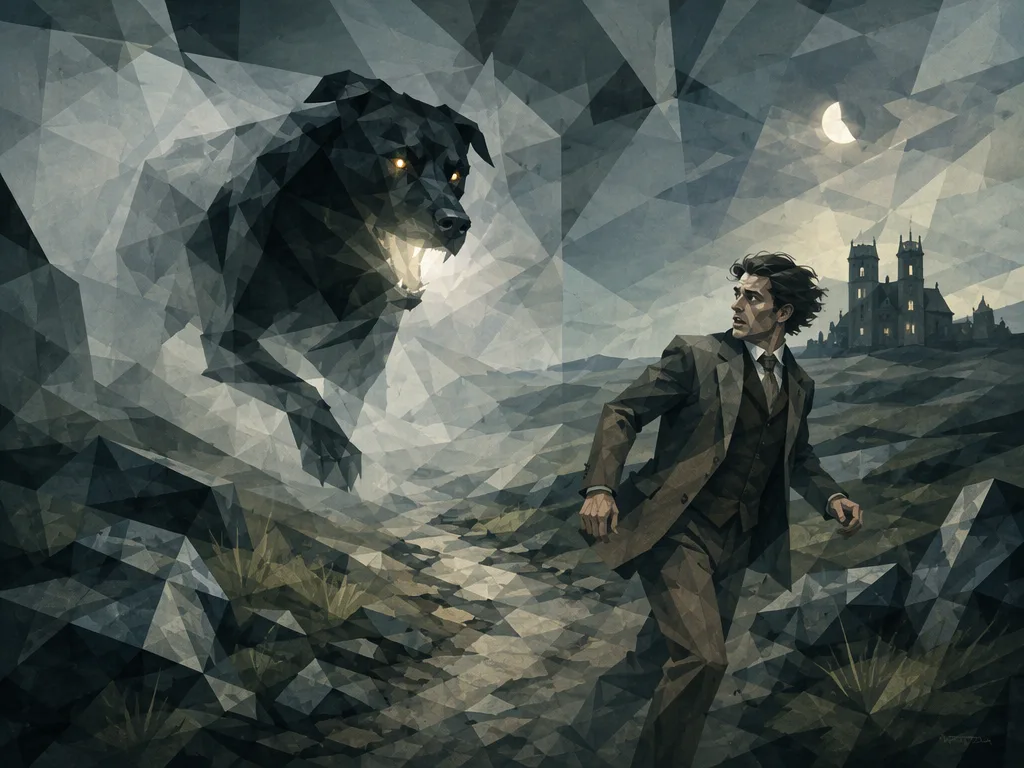
Sir Henry Baskerville and Dr. Mortimer were ready on Saturday morning, and we set out for Devon as planned. Holmes rode with me to Paddington Station to give me his final advice.
"I won't cloud your judgment with guesses or suspicions, Watson," he said. "Simply send me every fact as fully as you can, and leave the theories to me."
"What kind of facts?" I asked.
"Anything connected to the case, even indirectly—especially how Sir Henry gets along with his neighbors, and any new details about Sir Charles's death. I checked on a few things myself these last few days, though nothing came of it. One point at least is clear: Mr. James Desmond, the next heir, is a harmless, gentle old clergyman. None of this trouble comes from him, so we can cross him off our list completely. That leaves the people living around Sir Henry out on the moor."
"Shouldn't we get rid of this Barrymore couple right away?"
"Not at all! You couldn't make a worse mistake. If they are innocent, firing them would be unfair; if they are guilty, we would lose our best chance of proving it. No, keep them on your list of suspects. Then there is a groom at the Hall, if I remember right. There are two moorland farmers. There is our friend Dr. Mortimer—honest enough, I think—and his wife, whom we know nothing about. There is Stapleton the naturalist, and his sister, who is said to be a very attractive young lady. There is Mr. Frankland of Lafter Hall, another unknown quantity, plus one or two other neighbors. Those are the people you must study closely."
"I'll do my best."
"You brought a weapon, I hope?"
"Yes, I thought it wise."
"Good. Keep your revolver near you night and day, and never drop your guard."
Our companions had already reserved a first-class compartment and were waiting on the platform.
"No news at all," said Dr. Mortimer in answer to Holmes's questions. "I can swear to one thing, though—nobody followed us these last two days. We kept a sharp lookout wherever we went, and no watcher could have slipped past us."
"You stayed together the whole time, I assume?"
"Except yesterday afternoon," said Dr. Mortimer. "I like to spend one afternoon at the medical museum when I visit London."
"And I went to watch the crowd in the park," said Sir Henry. "Still, we had no trouble of any kind."
"That was very unwise all the same," said Holmes, shaking his head with a serious frown. "Please, Sir Henry, do not go about alone. Some great harm may come to you if you do. Did you ever find your other boot?"
"No, sir, it's gone for good."
"Indeed? That is very interesting. Well, goodbye," Holmes added as the train began to roll smoothly along the platform. "Keep in mind, Sir Henry, one line from that strange old legend Dr. Mortimer read us, and avoid the moor in those dark hours when the powers of evil are strongest."
I looked back when the station was already slipping behind us and saw Holmes's tall, still figure standing alone on the platform, watching us go.
The train journey was fast and pleasant. I passed the hours getting to know my companions better and playing with Dr. Mortimer's friendly spaniel. Before long, the brown earth outside turned rich red, brick houses gave way to gray stone, and red cattle grazed in bright green fields. Sir Henry leaned eagerly toward the window and cried out with pleasure at the familiar look of Devon.
"I've seen a good deal of the world since leaving here, Dr. Watson," he said, "but I've never found another place to match it."
"I've never met a man from Devon who didn't love his home county," I answered.
"Yet you were quite young when you last saw Baskerville Hall, weren't you?" asked Dr. Mortimer.
"I was only a boy in my teens when my father died, and I'd never seen the Hall at all. He lived in a little cottage down on the south coast, and from there I went straight to a friend in America. Everything down here is as new to me as it is to Dr. Watson, and I can't wait to see the moor."
"Then you won't have to wait long. Look right there," said Dr. Mortimer, pointing out the train window. "There is your first sight of the moor."
Beyond the green fields and a low line of trees rose a bleak gray hill, its jagged top dim and strange against the distant sky. Sir Henry sat silent for a long time with his eyes fixed on it. Even with his tweed suit and his American accent, he looked every inch the proud heir of the long line of fierce, strong men who had ruled there for centuries. Watching his determined jaw and steady eyes, I felt glad that if a hard, dangerous test awaited us on that wild plain, I had at least one brave friend who would face it beside me.
The train pulled up at a small country station. Outside a low white fence waited a carriage with a pair of sturdy horses. Our arrival was clearly a big event, for the stationmaster and porters rushed forward to carry our bags. Still, I was surprised to see two armed men in dark uniforms leaning on short rifles beside the gate, watching our faces carefully as we walked past. The driver—a small, weathered, hard-faced man—touched his hat to Sir Henry, and soon we were rolling briskly down a wide white road between sunny green hills and old stone farmhouses. Always behind the peaceful fields rose the dark, jagged ridge of the moor.
Soon the carriage turned up a narrow side road, climbing steadily between high banks into a wooded valley. We crossed a small stone bridge over a fast, foaming stream and wound upward under oak and fir trees. Every turn delighted Sir Henry, who leaned out asking questions endlessly. To my eyes, though, the country felt sad as autumn took hold. Yellow leaves covered the road and drifted down onto our coats, dulling the sound of our wheels as we climbed.
"Wait—what is that?" cried Dr. Mortimer suddenly.
A steep ridge of open heath rose ahead of us. Clear against the sky sat a guard on horseback, dark and stern, holding a rifle ready across his arm as he watched the road below.
"What's going on, Perkins?" asked Dr. Mortimer.
Our driver—Perkins, the groom from the Hall—half turned in his seat. "A convict escaped from Princetown Prison, sir. He's been loose three days now. Guards are watching every road and every station, though they haven't spotted him yet. The local farmers don't like it one bit, I can tell you."
"I thought they got five pounds for reporting him," said Dr. Mortimer.
"Yes, sir, but the chance of five pounds looks pretty poor next to the chance of having your throat cut. He isn't any ordinary prisoner. This man would stop at nothing."
"Who is he, then?"
"Selden, the Notting Hill murderer."
I remembered the case well. Holmes had taken an interest in it because the killing had been unusually cruel and senseless; Selden had only escaped hanging because doctors doubted he was sane.
Our carriage reached the top of the hill, and suddenly the vast, bleak moor spread wide before us, dotted with rough boulders and rocky hilltops—tors, as they call them here. A bitter cold wind swept down over us and set us shivering. Somewhere out across that empty plain hid a savage killer, lurking among the rocks like a wild animal, full of hatred for the world that had locked him away. Even Sir Henry stopped smiling and pulled his overcoat tighter around his shoulders.
We had left the green farmland far below us now. The road grew bleaker and wilder across huge brown slopes scattered with giant stones, passing an occasional bare stone cottage with no flowers or ivy on its walls. Suddenly we looked down into a deep hollow patched with low oaks and firs twisted sideways by years of fierce storms. Above the treetops rose two tall, narrow stone towers. Perkins pointed with his whip.
"Baskerville Hall," he said.
Its new master stood up in the carriage, cheeks flushed and eyes shining. Minutes later we reached the tall iron gates, crowned with stone boars' heads—the crest of the Baskervilles. One stone gatehouse stood in ruins; across from it rose a half-finished new one, begun with Sir Charles's fortune.
We turned into a long dark avenue where old trees arched overhead like a tunnel, blocking out the evening light. Far at the end, the house glimmered pale as a ghost. Sir Henry shivered as he looked down the shadowed drive.
"Was it here?" he asked quietly.
"No, no," said Dr. Mortimer. "The yew alley is on the other side of the house."
Sir Henry frowned at the dark trees. "I don't wonder my uncle felt uneasy in a place like this. It's enough to scare anyone. Inside six months I'll have a row of electric lights running right up this drive, and a bright lamp shining over the front door."
The trees opened onto a wide lawn before the old stone house. Ivy draped the heavy central block, where two ancient towers stood guard on either side of newer black-stone wings. Dim light glowed behind narrow windows, and a thin column of black smoke rose from a tall chimney into the fading sky.
"Welcome, Sir Henry! Welcome to Baskerville Hall!"
A tall man stepped out of the shadow of the porch to open the carriage door. Behind him, a woman stood framed in the yellow hallway light and came out to help carry our bags.
"You don't mind if I drive straight home, Sir Henry?" said Dr. Mortimer. "My wife is expecting me."
"Won't you stay and have dinner with us?"
"No, I really must go—there may be patients waiting for me. I'd offer to show you around the house, but Barrymore knows it far better than I do. Goodbye, and never hesitate to send for me day or night if you need help."
The sound of the carriage wheels faded down the drive as Sir Henry and I stepped inside, and the heavy front door clanged shut behind us.
We stood in a huge, lofty hall under heavy black oak beams. A log fire crackled warmly in the wide fireplace, and Sir Henry and I stretched out our numb hands toward the flames before looking around at the stained-glass window, the dark wood walls, and the stags' heads and family shields hanging in the dim glow of the central lamp.
"It's just how I pictured it," said Sir Henry. "Isn't this the very picture of an old family home? To think my people have lived in this same hall for five hundred years—it makes a man feel quiet inside."
His dark face shone with boyish pride in the firelight, while long shadows stretched up the dark walls behind him. Barrymore came back from taking up our bags and stood waiting respectfully. He was a striking man—tall, handsome, and unusually pale, with a neat square black beard and calm, careful manners.
"Would you like dinner served right away, sir?"
"Is it ready?"
"In just a few minutes, sir. You'll find hot water waiting in your rooms. My wife and I will gladly stay on, Sir Henry, until you make your new arrangements, though of course this house will need a much larger staff now."
"Why do you say that?"
"Only that Sir Charles lived very quietly, sir, so the two of us could manage everything. Naturally you will want to entertain guests and keep a busier household."
"Wait—do you mean you and your wife want to leave?"
"Only when it is convenient for you, sir."
"But your family has been with the Baskervilles for generations, hasn't it? I'd hate to start my life here by breaking an old family tie."
I thought I saw a flicker of real feeling cross the butler's pale face.
"I feel that too, sir, and so does my wife. To tell the truth, sir, we were both deeply attached to Sir Charles. His death was a terrible shock to us and made living here very painful. I'm afraid we could never feel comfortable at Baskerville Hall again."
"What do you plan to do, then?"
"With Sir Charles's generous gift, sir, I have no doubt we can set up a small business of our own. Now, sir, may I show you to your rooms?"
A wide double staircase led to an upstairs gallery and two long corridors running the length of the house. My bedroom was in the same wing as Sir Henry's, almost right next door. Those upstairs rooms were much brighter and more modern than the grand hall below, with cheerful wallpaper and plenty of candles that helped lift the gloomy mood of our arrival.
The dining room downstairs, however, was a chamber of heavy shadow. Black ceiling beams loomed over our heads, and our two dark-suited figures sat inside a tiny circle of light from one shaded lamp. Around the walls, rows of dim ancestral portraits in the dress of past centuries stared silently down at us. Neither of us felt like talking much, and I was relieved when dinner ended and we could move to the bright, modern billiard room for a cigarette.
"My word, that isn't a cheerful dining room," said Sir Henry. "I suppose a man gets used to it, though I feel a bit out of place here tonight. No wonder my uncle got nervous living all alone in a house like this. Let's turn in early tonight—maybe things will look brighter in the morning."
Before getting into bed, I pulled back my curtains and looked out over the dark front lawn. Beyond it, two small woods swayed and groaned in a rising wind. A half-moon slipped in and out of fast-moving clouds, shedding cold light over a broken rim of rocks and the long, bleak curve of the moor. I closed the curtains, feeling that the lonely view outside matched everything else about this house.
Yet my night did not end there. Tired as I was, I tossed restlessly from side to side, unable to fall asleep. Far away in the building, a clock chimed each quarter-hour against a silence as heavy as death. Then, suddenly, in the middle of the night, a clear sound cut through the stillness. It was the sob of a woman—a muffled, choking gasp from someone torn by grief they could no longer hold back.
I sat straight up in bed and listened with every sense awake. The sound had not come from far off; it was certainly somewhere inside the house. For half an hour I waited in the dark, listening intently, but no other sound broke the night except the distant chiming clock and the dry rustle of ivy against the wall outside my window.