


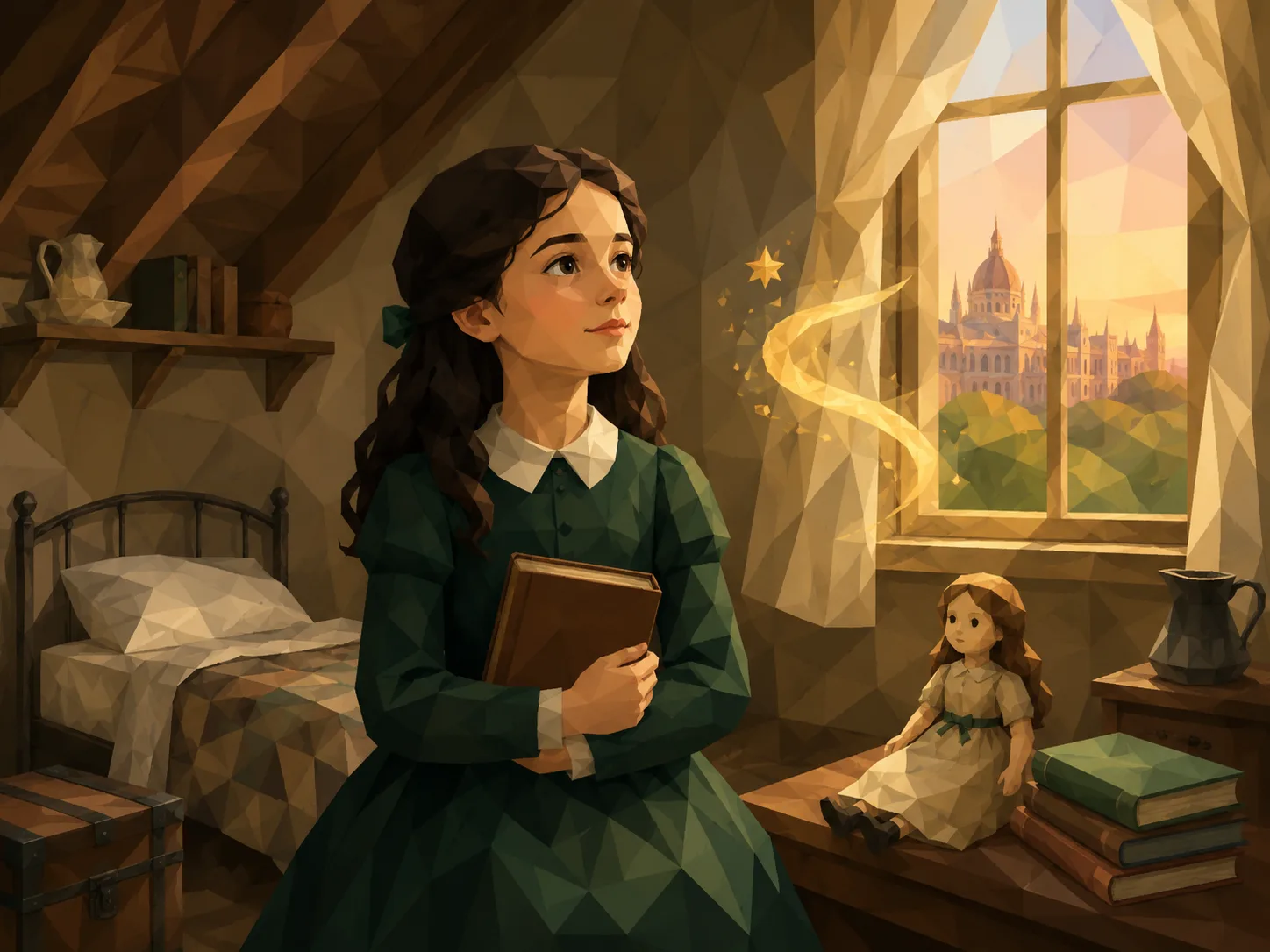
It was dangerous for Ermengarde and Lottie to visit the attic. They did not know when Sara Crewe was there. They were also afraid of Miss Amelia. Miss Amelia sometimes looked at the bedrooms at night. So, the girls did not visit Sara Crewe very often. Sara Crewe lived a very lonely life. She was even lonelier when she was downstairs. She had no one to talk to.
Miss Minchin often sent Sara Crewe on errands (short trips to buy things or do jobs). Sara Crewe walked through the streets with a basket. The wind was often cold. The rain made her shoes wet. The crowds of people made her feel more alone.
In the past, Sara Crewe was like a princess. She rode in a brougham (a private carriage pulled by horses). People looked at her pretty clothes and her happy face. Now, Sara Crewe was poor and thin. Her clothes were old and small for her. No one looked at her now. Sometimes Sara Crewe saw herself in a shop window. She looked very strange. Sometimes she wanted to laugh, and sometimes she felt sad.
In the evening, Sara Crewe looked into the windows of other houses. She saw warm rooms and happy families. She liked one family very much. She called them the Large Family. There were eight children, a mother, a father, and a grandmother. They were always happy. The children ran to meet their father at the door. They laughed and played together.
Sara Crewe gave the children names from her books. She called the baby Ethelberta. she called the other children names like Guy Clarence and Rosalind Gladys. One evening, something strange happened.
Sara Crewe was walking past the Large Family’s house. Some of the children were going to a party. They were walking to their carriage. Guy Clarence was five years old. He had blue eyes and curly hair. Sara Crewe stopped to look at him. She thought he was very cute.
It was nearly Christmas. The Large Family heard stories about poor children. They wanted to help someone. Guy Clarence had a sixpence (a small silver coin). He wanted to give it to a poor child. He saw Sara Crewe. He saw her old dress and her thin legs. He thought she was hungry.
Guy Clarence walked to Sara Crewe. "Here, poor little girl," he said. "Here is a sixpence for you."
Sara Crewe was shocked. She remembered when she gave money to poor children. Now, a child was giving money to her! Her face went red. She did not want to take the money.
"Oh, no," Sara Crewe said. "Thank you, but I cannot take it."
Her voice was very polite. The older sisters, Janet and Nora, listened to her. They knew she did not sound like a beggar. But Guy Clarence wanted to help. He put the coin in her hand.
"Yes, take it!" he said. "You can buy food with it."
Guy Clarence looked very kind. Sara Crewe did not want to make him sad. She took the coin. "Thank you," she said. "You are a very kind boy."
The carriage drove away. The children inside talked about Sara Crewe. "Why did you give her money?" Janet asked. "I do not think she is a beggar."
"She was not angry," Guy Clarence said. "She said I was a kind boy."
Janet thought for a moment. "A beggar would say 'Thank you, sir,'" Janet said. "She did not talk like that."
After that day, the Large Family was interested in Sara Crewe. They called her "The-little-girl-who-is-not-a-beggar." Sara Crewe put a hole in the sixpence. She wore it on a ribbon around her neck. She loved the Large Family, even though she did not know them.
Sara Crewe was also friends with Becky. She liked her French lessons with the little children. She was friends with the sparrows too. She stood on her table and chirped. The birds came to eat her crumbs. Melchisedec the rat also brought his wife and children to see her.
Sara Crewe talked to her doll, Emily, too. Sometimes she pretended Emily was a good witch. But one night, Sara Crewe was very tired and hungry. It was raining, and she was wet. The cook was mean to her. Miss Minchin was angry. Sara Crewe came to the attic and looked at Emily. Emily just sat there and stared with her glass eyes.
"I am going to die," Sara Crewe said.
Emily did not move.
"I am cold and hungry," Sara Crewe cried. "I walked many miles today. Everyone shouted at me. Some men laughed at me because I fell in the mud."
Sara Crewe looked at Emily’s face. Suddenly, Sara Crewe was very angry. She hit the doll off the chair. "You are only a doll!" she screamed. "You have no heart! You are made of sawdust (tiny pieces of wood)!"
Sara Crewe sat on the floor and cried. She never cried, but today was too hard. After some time, she felt sorry. She picked up Emily.
"You cannot help it," Sara Crewe whispered. "You are just a doll. You do your best." She kissed the doll and put her back on the chair.
Sara Crewe wanted someone to live in the empty house next door. One morning, she saw a big van. Men were carrying furniture into the house.
"The house is taken!" Sara Crewe said. "I hope a nice person lives there."
Sara Crewe looked at the furniture. She saw a table made of teakwood (a very strong, dark wood from Asia). She saw a screen (a light, moving wall) with beautiful pictures. These things looked like they came from India. Sara Crewe felt a little happy. Her father sent her things like that in the past.
"I think a rich family is moving in," Sara Crewe thought. "Maybe they lived in India."
Later, she saw the father of the Large Family. He went into the house next door. He looked like he was helping the new people.
Becky came to the attic that night. "An Indian gentleman is moving in next door," Becky said. "He is very rich, but he is very ill. The father of the Large Family is his lawyer. He has a statue of a Buddha (a holy man from the East). I think he is a heathen!"
Sara Crewe laughed. "I do not think he worships the statue," she said. "He just likes to look at it. My father had one too."
A few weeks later, the Indian gentleman arrived. A carriage stopped at the house. Two servants helped a man get out. He looked very sick and very thin. He wore warm furs. A doctor went into the house with him.
"There is a yellow gentleman next door," Lottie told Sara Crewe later. "Is he Chinese?"
"No," Sara Crewe said. "He is just very ill."
This was the start of the story of the Indian gentleman.