


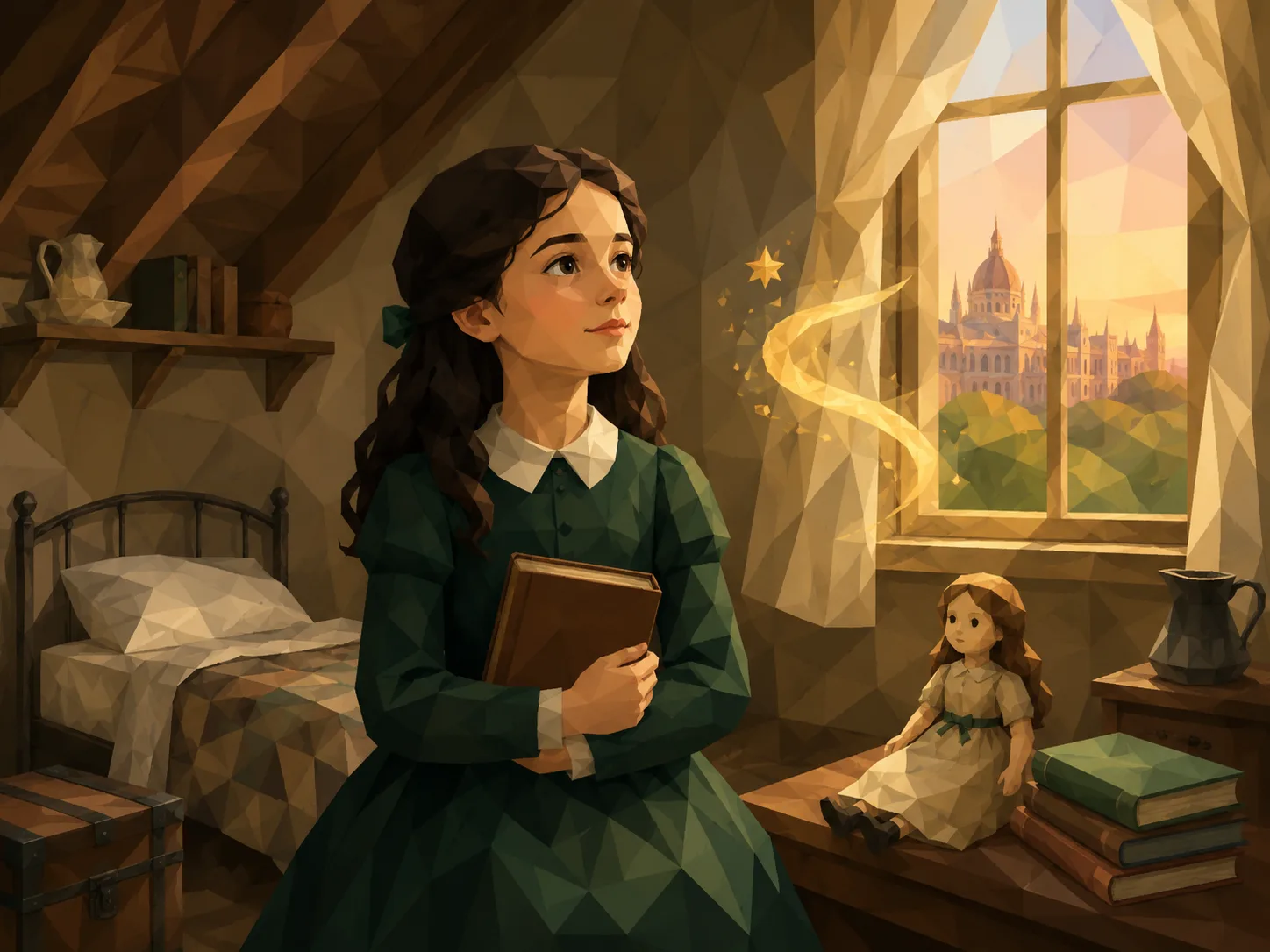
Sara Crewe liked to think about the house next door. It was interesting to imagine the rooms on the other side of the wall. She knew the schoolroom was next to the Indian gentleman’s study. She hoped the wall was thick. She did not want the noisy children to disturb the sick man.
"I like him very much," Sara Crewe told Ermengarde. "He is my friend. You can have a friend even if you never speak to them. I watch him and I feel sorry for him. He is like a relative to me. I worry when the doctor visits him."
"I do not like my relatives," Ermengarde said. "My aunts always say I am fat. They tell me I must not eat sweets. My uncle always asks me hard questions about history. He asks me about old kings and dates."
Sara Crewe laughed. "The Indian gentleman is not like that," she said. "He would not ask you hard questions. I am very fond of him."
Sara Crewe liked the Large Family because they were happy. She liked the Indian gentleman because he was unhappy. He was still very ill. The servants in the kitchen talked about him. He was an Englishman, but he lived in India for a long time.
The man lost all his money in some mines (large holes in the ground where people find gold or diamonds). He thought he was ruined. He became very sick with a bad fever. Later, he got his money back. Now he was rich again, but he was still very sad.
"He felt like my father," Sara Crewe thought. "He was sick like my father, but he did not die."
Sara Crewe felt very close to him. Sometimes Miss Minchin sent Sara Crewe out at night. Sara Crewe looked at the house next door. Sometimes the curtains were open. She saw her friend near the fire. She stood by the iron fence and whispered to him.
"Good night," Sara Crewe said softly. "I hope you feel better. I wish I could be your 'Little Missus.' I used to take care of my father when he was sick. Good night. God bless you."
Sara Crewe felt better after she spoke to him. She hoped her kind thoughts reached him. The man sat in a large chair. He looked into the fire and looked very sad. He looked like he had a big secret. Sara Crewe wondered what was wrong.
The father of the Large Family visited the man often. His name was Mr. Carmichael. He was a lawyer (a person who helps people with money and the law). His daughters, Janet and Nora, visited too. They liked the Indian gentleman very much. The man’s real name was Mr. Carrisford.
Janet told Mr. Carrisford about the "girl who was not a beggar." Mr. Carrisford was very interested. Ram Dass told him about the girl too. Ram Dass described the attic. He told Mr. Carrisford about the bare floor and the hard bed.
"I feel bad, Carmichael," Mr. Carrisford said to the lawyer. "I have so much money. But a poor girl lives in a cold room next door. It is not right."
"You cannot help everyone," Mr. Carmichael said. "Do not be sad. You must get well first."
Mr. Carrisford looked at the fire. "I am thinking about another child," he said. "I am looking for Ralph Crewe’s daughter. Is she poor like the girl next door? I must find her."
Mr. Carmichael looked worried. He knew this thought made Mr. Carrisford sick. "We looked in Paris," Mr. Carmichael said. "A woman named Madame Pascal had a school there. She said a girl went to Moscow with some Russians. But that girl’s name was Carew."
"Maybe it was Crewe," Mr. Carrisford said. "Ralph Crewe was my best friend. We worked together in the mines. I ran away when the mines failed. Ralph died because he thought I stole his money. He thought I was a bad man. I was sick and crazy with fever then."
"You were very ill," Mr. Carmichael said. "It was not your fault."
"I must find his child," Mr. Carrisford said. "I have her money now. The mines are full of diamonds. She is very rich, but I cannot find her! I do not even know her real name. Ralph only called her his 'Little Missus.'"
"We will find her," Mr. Carmichael said. "I will go to Moscow to look for her."
"Help me find her," Mr. Carrisford whispered. "Every night I dream of Ralph. He asks me, 'Where is the Little Missus?' I must find her."
On the other side of the wall, Sara Crewe sat in her cold attic. She talked to Melchisedec the rat.
"It was hard to be a princess today, Melchisedec," she said. "The weather is very cold. The streets are wet. Lavinia laughed at my old dress. I wanted to say something mean, but I stopped. A princess must be polite."
Sara Crewe put her head in her arms. She felt very lonely.
"Oh, father," she whispered. "I miss you. I miss being your 'Little Missus'."