


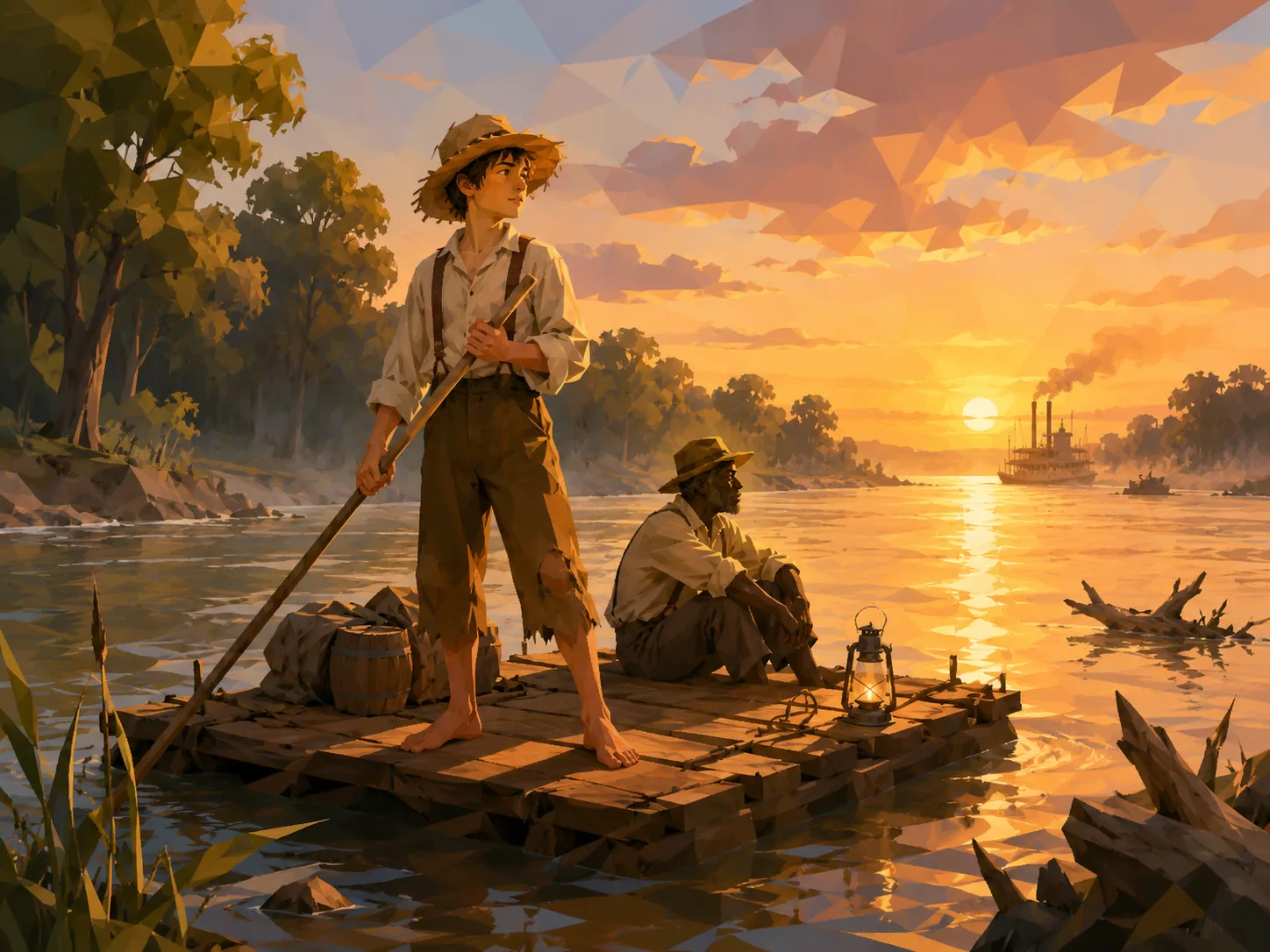
We were afraid we might pass Cairo in the dark without knowing it, because it was a small town. So we decided that when we saw a light, I would paddle to shore and ask. Jim watched all night. He said he would be a free man the minute he saw Cairo, but if he missed it, he would be in slave country again. Every few minutes he jumped up and said, “There it is!” But it was only fireflies. He said it made him shake all over to be so close to freedom.
Well, it made me shake all over too, because I began to understand that he was almost free—and whose fault was that? Mine. I had never really thought before about what I was doing, but now I did. I told myself it wasn’t my fault, because I didn’t make Jim run away. But my conscience said, “You knew he was running for his freedom, and you could have paddled to shore and told somebody. What did poor Miss Watson ever do to you, that you could watch her slave go off right in front of you and never say one word? She tried to teach you to read, she tried to teach you manners, she tried to be good to you in every way she knew.”
I felt so bad that I almost wished I was dead. And Jim talked out loud all the time. In a free state, he said, he would save every cent, and when he had enough, he would buy his wife, who belonged to a farm near Miss Watson’s place. Then they would both work to buy their two children, and if their master wouldn’t sell them, they would get someone who was against slavery to go and steal them.
I felt cold all over when I heard him talk like that. He would never have dared to talk like that before. Here was this man, whom I had as good as helped to run away, saying right out that he would steal his children—children that belonged to a man I didn’t even know, a man who had never done me any harm.
At last I said to my conscience, “Leave me alone—it isn’t too late yet. I’ll paddle to shore at the first light and tell.” At once I felt as light as a feather. Soon a light appeared, and Jim called out:
“We’re safe, Huck, we’re safe! That’s good old Cairo at last, I just know it!”
“I’ll take the canoe and go and see, Jim. It might not be, you know.”
He got the canoe ready and put his old coat in the bottom for me to sit on. As I pushed off, he said:
“Soon I’ll be shouting for joy, and I’ll say it’s all because of Huck. I could never have been free without Huck. You’re the best friend Jim ever had, and you’re the only friend old Jim has now.”
I was paddling off in a hurry to tell on him, but when he said this, all the hurry went out of me. When I was fifty yards off, Jim said:
“There goes good old Huck. You’re the only white gentleman who ever kept his promise to old Jim.”
I just felt sick. But I had to do it. Right then a boat came along with two men in it with guns.
“Five slaves ran away tonight, up above the bend,” one of them said. “Is there a man on that raft? Is he white or Black?”
I didn’t answer at once. I tried, but the words wouldn’t come. I didn’t have the courage of a rabbit. So I said, “He’s white.”
“I think we’ll go and see for ourselves.”
“I wish you would,” I said, “because it’s Pap who’s there, and maybe you could help me pull the raft to shore. He’s sick, and so are Mom and Mary Ann. Everybody goes away when I ask them to help.”
“That’s strange. Say, boy, what’s the matter with your father?”
“It’s the—well, it isn’t anything much.”
They stopped rowing. “Boy, that’s a lie. What is the matter with your father?”
“Please don’t leave us, sir. If you just let me throw you the rope, you won’t have to come near the raft.”
“Back, John, back!” said one, and they rowed backwards fast. “Your father has smallpox, and you know it very well! Do you want to spread it everywhere?”
“Well,” I said, crying, “I told everybody before, and they just went away and left us.”
“Poor boy. We’re sorry for you, but we don’t want smallpox. Float down about twenty miles, and you’ll come to a town. Here, I’ll put a twenty-dollar gold piece on this board, and you get it when it floats by.”
“Here’s twenty from me too,” said the other man. “Goodbye, boy. And if you see any runaway slaves, get help and catch them. You can make some money that way.”
“Goodbye, sir,” I said. “I won’t let any runaway slaves get by me if I can help it.”
They went off, and I got back on the raft feeling low, because I knew I had done wrong. I saw it was no use for me to try to learn to do right. Then I thought: if I had done right and given Jim up, would I feel better than I do now? No, I would feel just as bad. Well, then, what is the use of learning to do right, when it’s hard to do right and easy to do wrong, and the pay is just the same? I couldn’t answer that. So I decided not to worry about it any more, and to always do whatever was easiest at the time.
Jim was in the river under the back oar, with only his nose out of the water, ready to swim to shore if the men came on board. “How you fooled them, Huck! I think it saved old Jim, and old Jim isn’t going to forget you for that, honey.”
With forty dollars we could take a steamboat as far as we wanted to go in the free states. But the next town wasn’t Cairo, and the one after that was on high ground, and there was no high ground at Cairo.
“Maybe we went past Cairo in the fog that night,” I said.
“Let’s not talk about it, Huck. Poor slaves can’t have any luck. I always thought that rattlesnake skin wasn’t finished with its work.”
“I wish I had never seen that snake skin, Jim.”
“It isn’t your fault, Huck. You didn’t know.”
When it was light, there was the clear water of the Ohio near the shore, and out in the middle was the old muddy Mississippi. Cairo was behind us. We couldn’t take the raft back up against the current, so we tied it to the bank and hid in the woods to wait for dark and go back in the canoe. But when we went back to the raft at dark, the canoe was gone! We didn’t say a word. We both knew it was more work of the snake skin. So we went on down with the raft, to buy a canoe somewhere.
That night there was a thick gray mist on the river, and very late a steamboat came up the river, straight at us. Suddenly she was right over us, big and frightening, with a long row of open furnace doors shining like red-hot teeth. There was a shout and a ringing of bells, and as Jim jumped off one side and I jumped off the other, she came smashing straight through the raft.
I dived deep, because a thirty-foot wheel had to go over me. When I came up, the steamboat was already going on up the river in the dark. Steamboat crews never cared much about people on rafts.
I called for Jim about a dozen times, but no answer came. So I grabbed a board and swam for the shore. I climbed up the bank and walked in the dark, and suddenly there was a big old log house in front of me. I wanted to run past, but a lot of dogs jumped out, barking and howling at me, and I knew better than to move another step.