


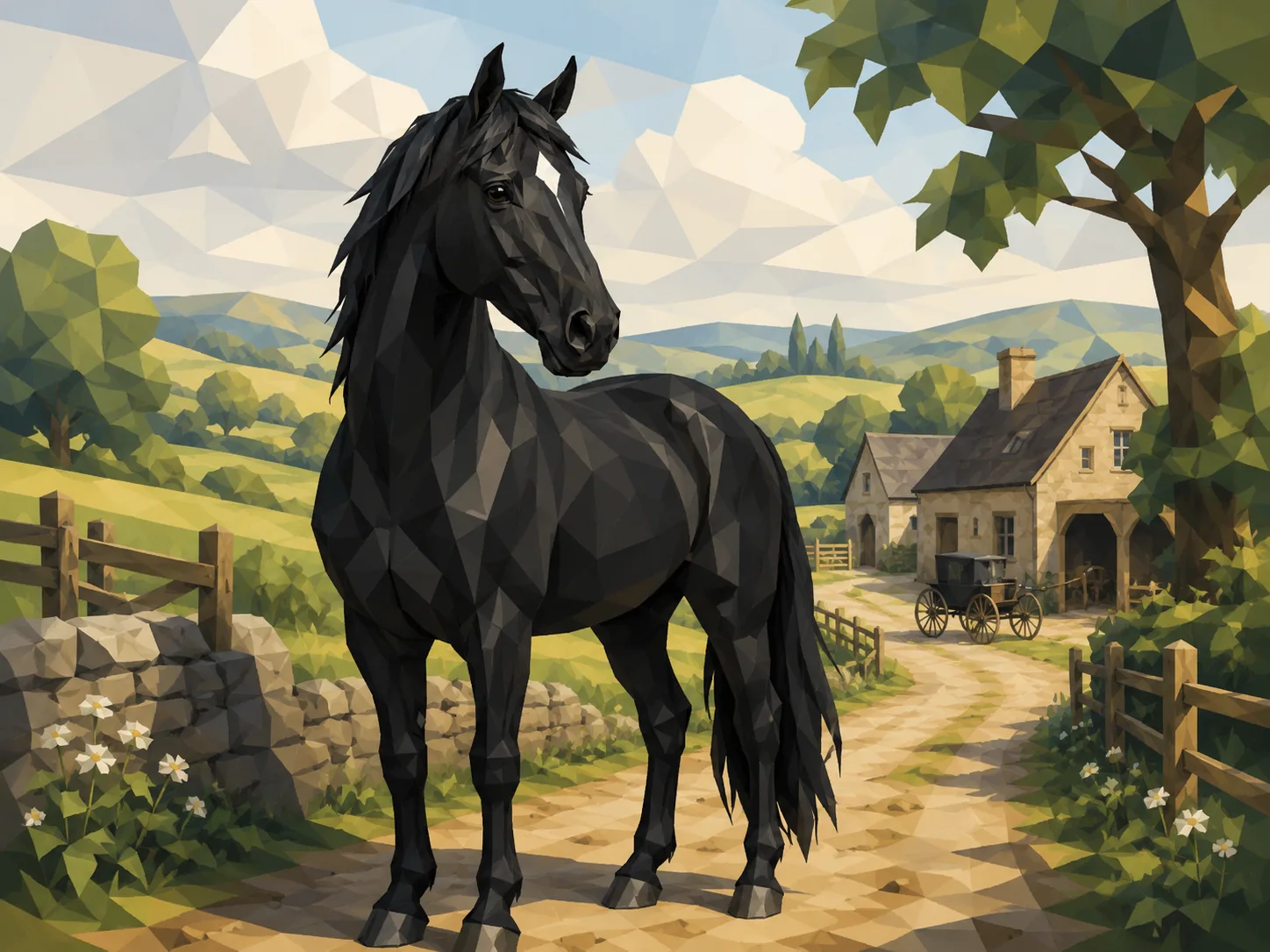
My new master’s name was Jeremiah Barker, but everyone called him Jerry, and so shall I. His wife Polly was a small, neat woman with dark eyes and a merry little mouth. Harry was twelve, a tall, good-tempered boy, and little Dolly, who was eight, was just like her mother. I never knew such a happy family, before or since.
Jerry had his own cab and two horses, which he drove and looked after himself. The other horse was Captain, a tall old white horse who still held his head proudly. As a young horse he had gone to the Crimean War with an officer of the cavalry, but I will tell his story later.
The next morning Polly brought me a slice of apple and Dolly a piece of bread. It was a great treat to hear a gentle voice again. Polly thought I was much too handsome for a cab, if it were not for my knees.
“There’s no one to tell us whose fault that was,” said Jerry, “so I’ll give him the benefit of the doubt. I never rode a firmer, neater stepper. We’ll call him Jack, after the old one. Shall we, Polly?”
“Do,” she said. “I like to keep a good name going.”
In the afternoon I was harnessed to the cab. Jerry made sure that my collar and bridle fitted comfortably, as carefully as John Manly himself. There was no bearing rein and no cruel bit, only a plain one. What a blessing that was!
At the cab stand a line of cabs stood waiting for passengers, and two or three drivers came round to look at me.
“Very good for a funeral,” said one.
“Too smart,” said another, shaking his head wisely. “You’ll find something wrong with him one of these mornings, or my name isn’t Jones.”
“Well,” said Jerry pleasantly, “Then I won’t worry about it until it happens.”
Then a broad-faced man in a big grey coat came up, and the others made way for him. He looked me all over, as if he were going to buy me himself.
“He’s the right sort for you, Jerry,” he said. “I don’t care what you paid for him, he’ll be worth it.”
So from that day the drivers on the stand thought well of me. This man was Grant, but everyone called him the Governor. He had been on that stand longer than anyone, and he settled the men’s quarrels. He was a good-humoured, sensible man, though when he had drunk too much, nobody liked to come too near his fist.
The first week was very hard. The noise and hurry of London and the crowds of carts and carriages made me nervous, but I soon found that I could trust my driver completely, and then I got used to it.
Jerry thought of his horses as much as of himself. He hardly ever used the whip; I knew from the way he took up the reins when to go on. At night he took off our halters and put up bars behind our stalls, so that we could turn round and stand whichever way we liked, and he always kept fresh water by us.
But the best thing of all was our Sunday of rest. We worked so hard in the week that I don’t think we could have kept going without it. On those quiet days Captain told me his story.