


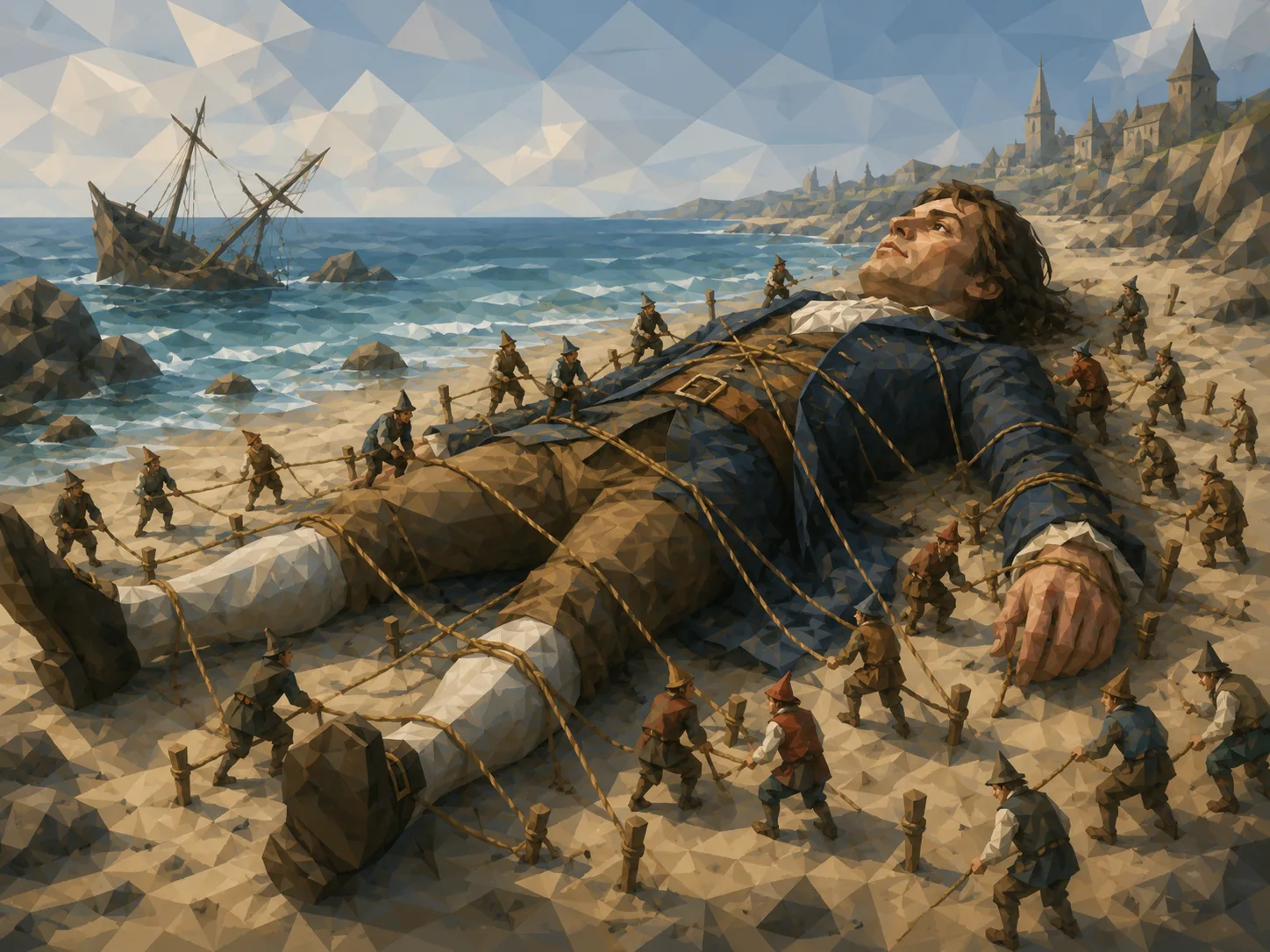
Of the inhabitants of Lilliput; their learning, laws, and customs; the manner of educating their children. The author’s way of living in that country. His vindication of a great lady.
While I plan to provide a more comprehensive account of this empire in a future work, I wish to satisfy the reader’s curiosity with a few general observations. Since the natives are usually just under six inches tall, everything else in their world—plants, animals, and trees—is in exact proportion. For instance, their tallest horses are about four or five inches high, and their geese are roughly the size of a common sparrow. Nature has adapted the Lilliputians' eyes perfectly to their environment; while they cannot see well at a distance, their close-range vision is incredibly sharp. I was often delighted to watch a cook plucking a bird no larger than a fly, or a young girl threading a needle with silk so fine it was practically invisible to me.
Their culture is equally unique. Their writing, for example, is neither horizontal like the Europeans' nor vertical like the Chinese; instead, it runs diagonally across the page from one corner to the other. Their burial customs are also quite peculiar. They bury their dead with their heads pointing directly downward because they believe that in eleven thousand months, the earth—which they conceive to be flat—will turn upside down. Consequently, they expect to be found standing on their feet at the moment of their resurrection.
Lilliputian laws are founded on principles that might seem strange to us, yet they are quite logical. For example, they view fraud as a far more serious crime than theft. They argue that while a person can protect their belongings from a thief through care and vigilance, honesty has no real defense against superior cunning. I was once heartily ashamed when I tried to defend a criminal by calling his crime a "breach of trust"; the Emperor was shocked that I would use what he considered the most aggravating part of the crime as an excuse.
Furthermore, while European governments rely almost entirely on punishment, the Lilliputians believe in the power of reward. Any citizen who can prove they have strictly followed the laws for seventy-three months is entitled to certain privileges and a financial reward. Because of this, the image of Justice in their courts has six eyes—to signify circumspection—and holds a bag of gold in her right hand, showing she is more inclined to reward than to punish. In choosing people for public office, they prioritize good morals over great abilities. They believe that while few people are born geniuses, virtues like truth and justice are within everyone’s reach.
Their approach to education is perhaps the most radical departure from our own. The Lilliputians believe that parents are the least suitable people to be trusted with the education of their children. Consequently, every town has public nurseries where children are sent at the age of twenty months. These schools are divided by rank and gender. In the nurseries for the nobility, children are raised with a strict focus on honor, courage, and religion. They are rarely allowed to see their parents, and when they do, the visits are brief and supervised to prevent any "silly" displays of affection or the giving of toys and sweets.
As for my own life in Lilliput, I lived there for over nine months. Being somewhat skilled with my hands, I managed to build myself a table and chair from the largest trees in the royal park. Two hundred seamstresses were employed to make my shirts and bed linens. They took my measurements as I lay on the ground, using a clever mathematical formula: they measured my thumb, and knowing that twice round the thumb is once round the wrist, and so on, they were able to fit me perfectly. Three hundred tailors worked on my clothes, using ladders to measure the length of my coat with a plumb-line.
My daily meals required an army of three hundred cooks. I would sit at my table and place twenty waiters on the surface, while a hundred more worked on the ground, pulling up barrels of wine and dishes of meat using a system of cords and pulleys. The food was excellent, though a single sirloin of their beef was usually just a large mouthful for me.
One afternoon, the Emperor and his family honored me by dining at my table. However, this visit gave my secret enemy, Flimnap the Treasurer, an opportunity to damage my reputation. He pointed out to the Emperor that I had already cost the treasury over a million sprugs, their largest gold coin, and suggested I was a financial burden. Flimnap was also maliciously jealous of his wife, as rumors had spread that she had taken a particular liking to me. I solemnly declare this to be a lie. While she did visit me often, she always came publicly in her coach with several companions. I would often pick up her coach and horses and place them on my table to converse with her comfortably, but there was never anything improper between us. Nevertheless, Flimnap’s hostility grew, and I soon sensed that my influence with the Emperor was beginning to decline.