


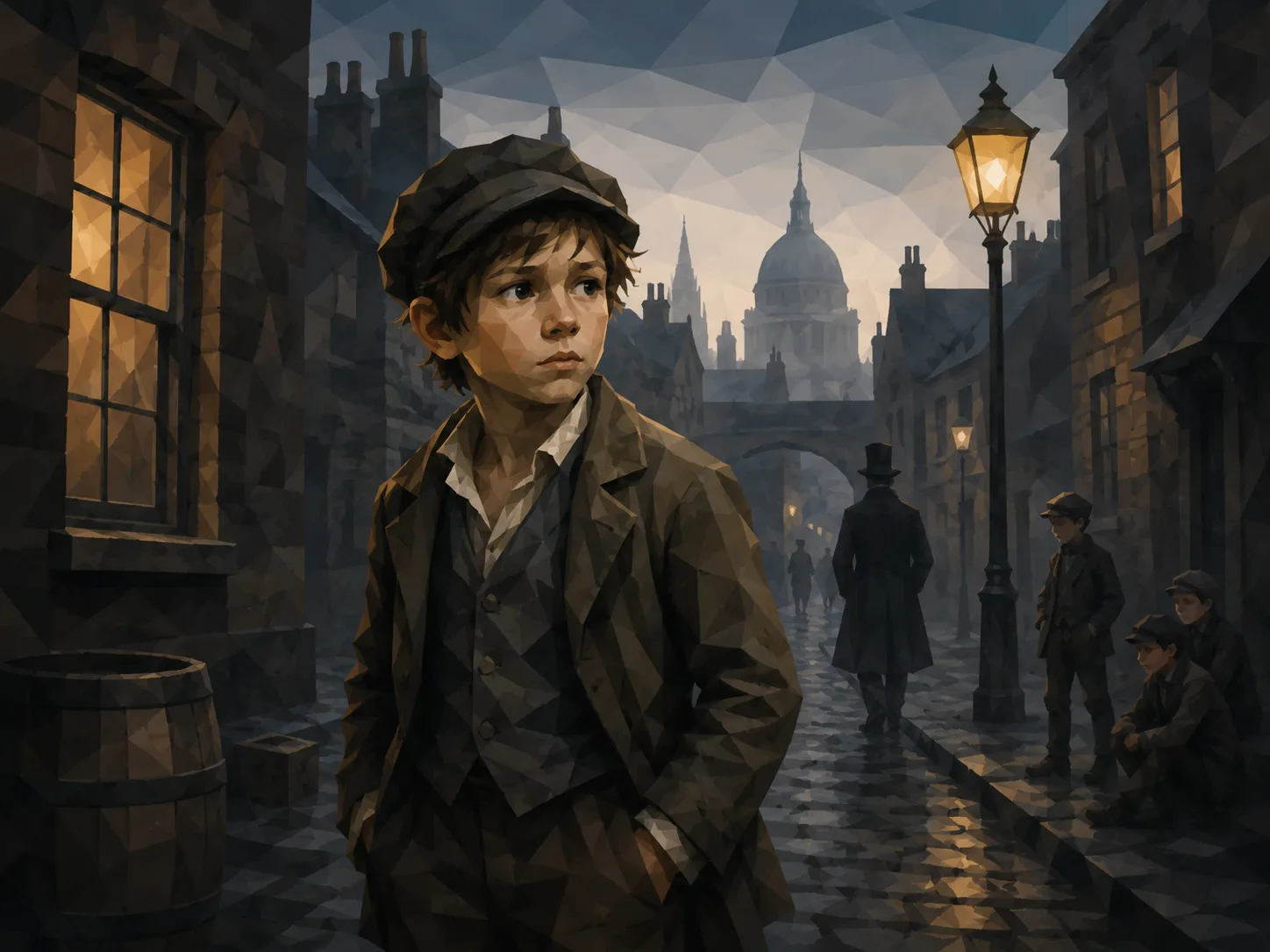
Oliver, having been left to himself in the undertaker’s shop, set the lamp down on a workman’s bench and gazed timidly about him. He was filled with a feeling of awe and dread, an emotion that many people much older than he would have no trouble understanding. An unfinished coffin rested on black tressels in the middle of the shop. It looked so gloomy and death-like that a cold shudder ran through him every time his eyes wandered toward it. He almost expected to see some terrifying figure slowly raise its head from the wooden box to drive him mad with fear.
Against the wall, a long row of elm boards had been arranged in a regular array, all cut in the same shape. In the dim light, they looked like high-shouldered ghosts with their hands in their pockets. Coffin-plates, wood chips, bright-headed nails, and shreds of black cloth lay scattered across the floor. The wall behind the counter was decorated with a lively painting of two mutes—professional mourners—standing on duty at a large door, wearing very stiff neckcloths. In the distance of the painting, a hearse drawn by four black horses approached. The shop felt narrow and hot, and the atmosphere seemed tainted with the lingering smell of coffins. Even the small space beneath the counter, where his mattress had been pushed, looked uncomfortably like a grave.
These were not the only dismal feelings that depressed Oliver. He was alone in a strange place, and we all know how desolate even the strongest person can feel in such a situation. The boy had no friends to care for, nor anyone to care for him. He felt no specific regret from a recent separation, for there was no loved or well-remembered face whose absence could weigh upon his heart.
Nevertheless, his heart was heavy. As he crept into his narrow bed, he wished that it were his coffin instead. He imagined how peaceful it would be to lie in a calm, lasting sleep in the churchyard, with the tall grass waving gently above his head and the sound of the old deep bell to soothe him.
Oliver was awakened the next morning by a loud kicking at the shop door. Before he could hurriedly put on his clothes, the kicking was repeated about twenty-five times in an angry and impatient manner. When he finally began to undo the chain, the kicking stopped and a voice began to shout.
“Open the door, will you?” cried the voice belonging to the legs that had been kicking.
“I will, right away, sir,” replied Oliver, turning the key and pulling back the bolt.
“I suppose you’re the new boy, aren’t you?” the voice asked through the keyhole.
“Yes, sir,” replied Oliver.
“How old are you?”
“Ten, sir,” Oliver answered.
“Then I’ll give you a beating when I get in,” said the voice. “You just wait and see if I don’t, you workhouse brat!” After making this unpleasant promise, the voice began to whistle.
Oliver had been subjected to such threats too often to doubt that the owner of the voice would carry out his promise. With a trembling hand, he opened the door and looked up and down the street. He expected to see a man warming himself nearby, but he saw no one except a large boy in a charity-school uniform sitting on a post. The boy was eating a slice of bread and butter, cutting it into large wedges with a knife and consuming them with great skill.
“I beg your pardon, sir,” said Oliver at length, seeing no other visitor. “Did you knock?”
“I kicked,” replied the charity-boy.
“Did you want a coffin, sir?” Oliver inquired innocently.
At this, the charity-boy looked extremely fierce. He told Oliver that he would be the one needing a coffin if he continued to make jokes at his superiors.
“You don’t know who I am, I suppose, Workhouse?” the boy continued, descending from the post with great dignity.
“No, sir,” Oliver replied.
“I’m Mr. Noah Claypole,” said the boy, “and you are under my authority. Now, take down the shutters, you lazy young ruffian!” With this, Mr. Claypole kicked Oliver and entered the shop with an air of superiority. It is difficult for a large-headed, small-eyed youth with a heavy expression to look dignified, especially when that youth also possesses a red nose and yellow breeches, but Noah certainly tried his best.
Oliver began the difficult task of taking down the shutters. He even broke a pane of glass while staggering under the weight of the first one. Noah, after kindly assuring Oliver that he would “get in trouble,” finally condescended to help him. Soon after, Mr. Sowerberry came downstairs, followed by his wife. Once Oliver had been punished for the broken window, as Noah had predicted, he followed the older boy downstairs for breakfast.
“Come near the fire, Noah,” said Charlotte, the servant. “I saved a nice piece of bacon for you from the master’s breakfast. Oliver, shut that door behind Mr. Noah and take those scraps I’ve put on the bread-pan lid. There’s your tea; take it over to that box and drink it quickly, because they’ll need you to watch the shop. Do you hear?”
“Do you hear, Workhouse?” Noah added.
“Goodness, Noah!” Charlotte laughed. “What a strange creature you are! Why don’t you leave the boy alone?”
“Leave him alone!” Noah remarked. “Everyone leaves him alone. His father and mother will never interfere with him, and his relatives let him have his own way. Don’t they, Charlotte? He! he! he!”
Charlotte burst into a hearty laugh, and Noah joined her. They both looked scornfully at poor Oliver Twist as he sat shivering on a box in the coldest corner of the room, eating the stale pieces of food that had been set aside for him.
Noah was a charity-boy, but he was not a workhouse orphan. He knew exactly who his parents were; his mother was a washerwoman and his father was a retired soldier with a wooden leg. For a long time, the other shop-boys in the neighbourhood had insulted Noah in the streets, calling him names because of his poor background. Noah had suffered these insults in silence. However, now that fortune had brought him a nameless orphan—someone even lower than himself—he took the opportunity to treat Oliver with the same cruelty he had experienced. This shows us a common, though unpleasant, side of human nature: the desire to look down on others to feel more important ourselves.
Oliver had been living at the undertaker’s for about a month. One evening, after the shop had been closed, Mr. and Mrs. Sowerberry were having supper in the back room. Mr. Sowerberry looked at his wife several times before speaking.
“My dear—” he began.
Mrs. Sowerberry looked up with such a sharp expression that he immediately stopped.
“Well?” she said.
“Nothing, my dear, nothing,” he stammered.
“Oh, you coward!” she remarked.
“Not at all, my dear,” he said humbly. “I just thought you didn’t want to hear. I was only going to say—”
“Don’t bother telling me,” she interrupted. “I’m nobody; don’t consult me. I wouldn’t want to intrude on your secrets.” She gave a nervous, hysterical laugh.
“But, my dear, I want your advice,” Sowerberry pleaded.
“No, no, ask someone else,” she replied. This was a common tactic she used to make her husband beg for her attention. Eventually, she allowed him to speak.
“It’s about young Twist, my dear,” said Mr. Sowerberry. “He’s a very good-looking boy.”
“He needs to be, considering how much he eats,” his wife remarked.
“There is a look of melancholy in his face which is very interesting,” Sowerberry continued. “He would make a wonderful 'mute' for children's funerals.”
Mrs. Sowerberry looked surprised, so her husband quickly explained his idea. He didn't mean a regular mourner for adults, but a child-sized mourner for children's ceremonies. He argued that it would be a new and professional touch that would impress their customers.
Mrs. Sowerberry, who had a good eye for the business, was impressed by the novelty of the idea. However, she didn't want to lose her dignity by agreeing too easily. She simply asked why he hadn't thought of it sooner. Taking this as agreement, it was decided that Oliver would be taught the mysteries of the trade and accompany his master to the next funeral.
An opportunity soon arrived. The next morning, Mr. Bumble, the parish official, entered the shop. He pulled a small piece of paper from his large leather pocket-book and handed it to Sowerberry.
“An order for a coffin, I see?” the undertaker remarked.
“A coffin first, and a parish funeral afterwards,” replied Mr. Bumble.
“The name is Bayton,” said Sowerberry, looking at the paper. “I’ve never heard of them.”
Bumble shook his head. “Obstinate people, Mr. Sowerberry. Very proud, I’m afraid.”
“Proud?” Sowerberry sneered. “That’s too much.”
“It’s sickening,” the beadle agreed. “We only heard of them two days ago. A woman in the same house asked for a doctor to see a sick woman. The doctor was out, but his apprentice sent some medicine in an old bottle.”
“That was prompt,” said the undertaker.
“Prompt indeed!” Bumble replied. “But the husband sent it back, saying it wouldn't suit his wife's illness. Good, strong medicine that worked for others, and he refused it! And now she’s dead, so we have to bury her. The sooner it’s done, the better.”
Mr. Bumble left the shop in a state of high indignation. Sowerberry turned to Oliver and told him to get his cap. They were going on a professional mission.
They walked through the most crowded and miserable part of town, eventually turning into a narrow, filthy street. The houses were tall and decaying, inhabited by the poorest class of people. Huge wooden beams were used to prop up the crumbling walls. The street was stagnant and foul-smelling, and even the rats in the gutters seemed hideous with hunger.
There was no bell or knocker at the house they were looking for. Sowerberry led Oliver through a dark passage and up a flight of stairs. He knocked at a door on the landing. It was opened by a girl of thirteen or fourteen.
The room was freezing, with no fire in the stove. A man was crouching over the empty hearth, and an old woman sat on a stool beside him. Some ragged children were in a corner, and in a small space opposite the door, something lay on the ground covered by an old blanket. Oliver shuddered; he knew it was a corpse.
The man’s face was thin and pale, his eyes bloodshot. The old woman had a wrinkled face and piercing eyes.
“Keep back!” the man screamed as the undertaker approached. “Don’t go near her!”
“Nonsense, my good man,” said Sowerberry, who was accustomed to such misery.
“I won’t have her put in the ground,” the man cried, clenching his fists. “She couldn't rest there. The worms would worry her—she is so thin, they wouldn't even eat her.”
The undertaker said nothing but began to take measurements with a tape. The man suddenly fell to his knees, crying.
“I tell you, she was starved to death!” he sobbed. “There was no fire, no candle. She died in the dark! I begged in the streets and they sent me to prison. When I came back, she was dying. They starved her!” He screamed and fell to the floor, shaking.
The children cried, but the old woman silenced them. She walked toward the undertaker.
“She was my daughter,” the old woman said with a strange, haunting smile. “It’s strange that I, who gave birth to her, should be alive and merry while she is cold and stiff. It’s as good as a play!”
As the old woman muttered to herself, Sowerberry turned to leave. She grabbed his coat, asking for a warm cloak for the funeral and a piece of bread. Sowerberry promised her anything just to escape her grasp, and he hurried out, pulling Oliver with him.
The next day, the funeral took place. Mr. Bumble and four men from the workhouse arrived to carry the coffin. The man and the old woman were given black cloaks to cover their rags.
“Move quickly,” Sowerberry whispered to the old woman. “We don't want to keep the clergyman waiting.”
They hurried to a neglected corner of the churchyard where the poor were buried. The clergyman had not yet arrived, so they waited in the cold rain. Some local boys played games around the coffin while the officials sat by a fire in the vestry, reading the newspaper.
Finally, the clergyman appeared, putting on his white robe as he walked. He read the shortest possible version of the burial service—it lasted only four minutes—and then left immediately.
“Fill it up!” Sowerberry told the grave-digger.
The grave was so full that the coffin was only a few feet from the surface. Once the earth was shoveled in, the group prepared to leave. The husband, who had been standing still as a statue, suddenly stared at Mr. Bumble and fainted. The old woman was too busy complaining about the undertaker taking back the warm cloak to notice him. They threw some water on the man, and once he regained consciousness, they locked the gate and went their separate ways.
“Well, Oliver,” said Sowerberry as they walked home, “how do you like it?”
“Pretty well, thank you, sir,” Oliver replied with hesitation. “Not very much, sir.”
“You’ll get used to it in time,” said Sowerberry. “It’s nothing once you are used to it.”
Oliver wondered how long it had taken Mr. Sowerberry to get used to such things, but he decided it was better not to ask. He walked back to the shop in silence, thinking over everything he had seen.